Start here · 5 min read
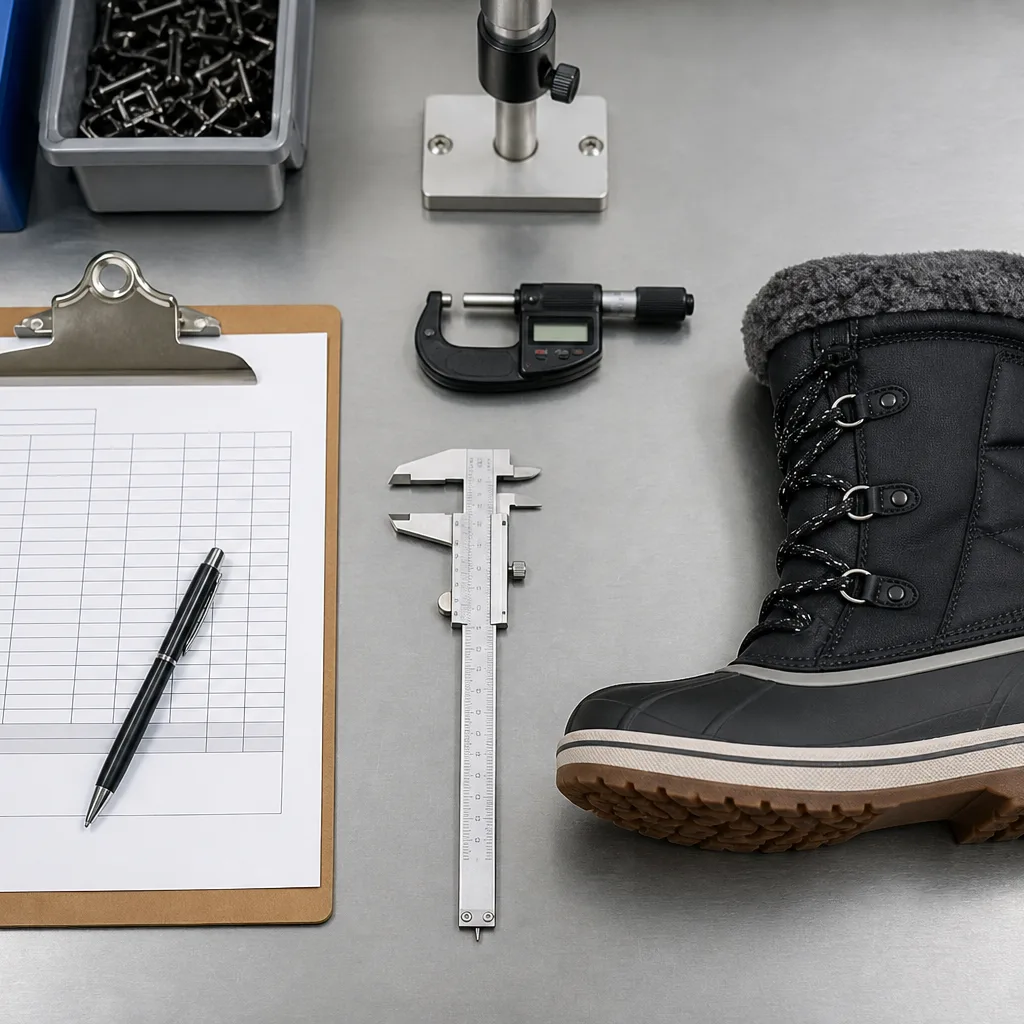
How to Choose a Snow Boot Supplier
Use a structured scorecard to compare supplier fit, sample quality, production controls, and export readiness before placing a seasonal order.
Read the buyer guideSnow boot manufacturer blog
100 buyer-focused articles organized around real sourcing decisions: supplier fit, product development, materials, waterproof construction, quality, cost, and delivery.
Start here · 5 min read
Use a structured scorecard to compare supplier fit, sample quality, production controls, and export readiness before placing a seasonal order.
Read the buyer guideCluster 01
Evaluate factories, manufacturers, suppliers, and sourcing models before an RFQ.
10 articlesCommercial · 5 min read
Use a structured scorecard to compare supplier fit, sample quality, production controls, and export readiness before placing a seasonal order.
Commercial · 5 min read
A practical factory-audit framework for buyers who need to verify that a snow boot supplier can turn an approved sample into repeatable bulk production.
Commercial · 5 min read
Direct factories and trading companies solve different sourcing problems. Compare ownership, breadth, control, and order complexity before choosing a model.
Commercial · 5 min read
Wholesale buying needs more than a low pair price. Evaluate assortment logic, SKU control, packaging, replenishment, and seasonal delivery as one system.
Commercial · 5 min read
A step-by-step sourcing framework for buyers comparing China-based snow boot manufacturers without relying on unverified claims or price alone.
Commercial · 5 min read
Use five weighted criteria to compare snow boot suppliers on evidence that matters before sampling, contracting, and seasonal production.
Commercial · 5 min read
These five questions turn an introductory supplier call into a practical review of product fit, process ownership, and delivery risk.
Commercial · 5 min read
Spot five warning signs that should trigger deeper verification before a snow boot supplier receives samples, deposits, or production approval.
Commercial · 5 min read
Use five repeatable comparison methods to separate factory marketing claims from evidence about product, quality, timing, and commercial risk.
Commercial · 5 min read
Collect five document groups that help buyers verify who they are contracting, what is being made, and how production and shipment will be controlled.
Cluster 02
Choose the right development model and control the path from concept to approved sample.
10 articlesInformational · 5 min read
OEM development gives buyers detailed control, but it also creates more decisions. Use this workflow to turn a concept into an approved production specification.
Informational · 5 min read
ODM programs can shorten development when buyers adapt a proven platform instead of starting every component from zero.
Commercial · 5 min read
Private label is fastest when the base model already fits the consumer, channel, and price point. Branding should refine a sound product, not hide a mismatch.
Commercial · 5 min read
Choose a development model based on how much control, speed, differentiation, and internal product-management capacity your program needs.
Informational · 5 min read
A staged development process reduces late changes by giving each sample round a clear question and a controlled approval record.
Commercial · 5 min read
Prioritize five customization areas that change product identity, development cost, testing needs, and production risk in an OEM snow boot program.
Commercial · 5 min read
Choose a private label strategy that matches launch speed, differentiation, order quantity, development budget, and repeat-season potential.
Informational · 5 min read
Use five controlled stages to convert an ODM winter boot direction into an approved specification ready for grading and bulk production.
Commercial · 5 min read
Select private label branding methods by visibility, durability, minimums, construction compatibility, and consistency across the full retail presentation.
Commercial · 5 min read
Approve custom snow boot samples with five evidence-based checks before size grading, tooling release, material booking, or bulk production.
Cluster 03
Plan category-specific snow boot assortments for wholesale, retail, and branded programs.
10 articlesCommercial · 5 min read
Kids’ snow boots need easy entry, secure closure, controlled weight, clear sizing, and durable construction that works for both children and caregivers.
Commercial · 5 min read
Work winter boots should be developed from the job environment and required protection, with claims supported by current market-specific standards and testing.
Commercial · 5 min read
Après-ski programs combine winter function with a relaxed fashion story. Prioritize easy wear, comfort, lightweight warmth, and a clear merchandising point of view.
Commercial · 5 min read
Winter hiking footwear requires a use-led brief that balances support, movement, weather protection, traction, warmth, and realistic product claims.
Informational · 5 min read
New tooling can create meaningful product differentiation, but ownership, size coverage, approval, maintenance, and change control must be clear.
Commercial · 5 min read
Build a focused women's wholesale range by assigning five snow boot style directions to distinct consumer needs, climates, and price positions.
Commercial · 5 min read
Use five category roles to create a men's winter boot assortment that covers practical use cases without duplicating silhouettes and price points.
Commercial · 5 min read
Specify five practical kids' snow boot features around caregiver convenience, active fit, weather exposure, weight, and repeatable production.
Commercial · 5 min read
Translate a rugged workwear direction into five controllable feature groups while separating general utility from regulated safety claims.
Commercial · 5 min read
Assign five category roles to a wholesale snow boot range so each group serves a different buyer, use case, climate, and price position.
Cluster 04
Translate weather claims into materials, seams, gussets, and testable specifications.
10 articlesCommercial · 5 min read
A waterproof claim needs a defined construction and verification plan. Align materials, seams, openings, test methods, and marketing language before ordering.
Informational · 5 min read
Finished-boot water protection comes from a connected system of materials, seams, openings, and sole construction, not a single waterproof component.
Informational · 5 min read
Membrane and seam-sealed approaches solve different construction problems. Compare coverage, process control, comfort, cost, and claim scope.
Informational · 5 min read
Water-resistant and waterproof are not interchangeable buying terms. Define exposure, construction, evidence, and claim limits before choosing either.
Informational · 5 min read
Gussets and seam placement determine where water can travel, how the boot opens, and whether waterproof operations can be repeated and inspected.
Commercial · 5 min read
Select waterproof snow boot materials by flex, seam design, durability, appearance, cost, and how they perform in the assembled construction.
Informational · 5 min read
Focus waterproof development on five construction details that often determine where an otherwise suitable snow boot begins to leak.
Informational · 5 min read
Use five targeted improvements to strengthen winter boot water resistance without adding unnecessary bulk, cost, or unsupported claims.
Informational · 5 min read
Choose waterproof testing methods by product claim, construction, expected exposure, conditioning, and the decisions buyers need to make.
Commercial · 5 min read
Choose a snow boot closure by water exposure, entry, adjustability, durability, glove use, fit range, and barrier continuity.
Cluster 05
Balance warmth, bulk, moisture management, fit, and target retail positioning.
10 articlesCommercial · 5 min read
Faux-fur lining affects appearance, warmth perception, fit, and production consistency. Specify it as a functional component, not only a trim.
Informational · 5 min read
Insulation should be specified as part of a full boot system. More thickness does not automatically create better warmth, fit, or comfort.
Informational · 5 min read
Synthetic insulation offers flexible warmth-to-bulk options, but buyers must control the exact grade, coverage, handling, and fit impact.
Informational · 5 min read
Faux fur emphasizes plush appearance and perceived warmth, while fleece can offer a lower-bulk, more uniform interior. The full construction decides performance.
Informational · 5 min read
A temperature number can look precise while hiding activity, exposure, socks, moisture, fit, and individual variation. Buyers need qualified evidence and careful limits.
Commercial · 5 min read
Choose snow boot lining materials by warmth perception, bulk, moisture, drying, fit, appearance, cost, and repeatable color control.
Commercial · 5 min read
Select winter boot insulation by climate, activity, thickness, moisture, compressibility, fit volume, cost, and production control.
Commercial · 5 min read
Design kids' snow boot warmth around coverage, fit, moisture, drying, movement, and caregiver usability rather than thickness alone.
Informational · 5 min read
Use five moisture-management features to balance weather protection, internal humidity, drying, comfort, and repeat winter use.
Commercial · 5 min read
Choose a lining direction that supports brand position, consumer use, fit, color story, moisture needs, cost, and minimum order planning.
Cluster 06
Compare upper, midsole, and outsole choices using buyer-relevant tradeoffs.
10 articlesInformational · 5 min read
A snow boot is a layered system. Buyers should compare material combinations by use, fit, weather protection, durability, manufacturability, and price.
Informational · 5 min read
TPR and rubber are material families with many formulations. Compare the exact compound, tread, construction, and test result instead of the label alone.
Informational · 5 min read
EVA often supports lightweight cushioning, while TPR often serves the wearing surface. Many effective winter soles combine materials instead of choosing only one.
Informational · 5 min read
Traction comes from the interaction of compound, geometry, surface, contamination, temperature, gait, and test conditions. Visual ruggedness is not proof.
Informational · 5 min read
Synthetic leather offers structure and a clean surface, while textile supports lower weight, quilting, and color flexibility. Mixed uppers often balance both.
Commercial · 5 min read
Select snow boot upper materials by water exposure, cold flex, abrasion, support, color, appearance, cost, and construction compatibility.
Commercial · 5 min read
Choose snow boot outsole materials by climate, surface, grip target, flex, abrasion, weight, bonding, tooling, cost, and required testing.
Informational · 5 min read
Design winter boot traction around material, geometry, surface, temperature, wear, and testing rather than relying on deep lugs alone.
Commercial · 5 min read
Select midsole and footbed materials by cushioning, insulation, compression, moisture, support, weight, fit volume, and long-term recovery.
Commercial · 5 min read
Reduce snow boot weight through coordinated upper, insulation, reinforcement, and sole choices without sacrificing the intended fit or weather protection.
Cluster 07
Control quantities, samples, tooling, grading, cost drivers, and seasonal lead time.
10 articlesCommercial · 5 min read
MOQ and timing are outputs of the product architecture and production calendar. Buyers can improve both by simplifying the right variables early.
Commercial · 5 min read
Snow boot MOQ is a bundle of component and process minimums. Break it apart before negotiating, then consolidate the variables that do not add value.
Commercial · 5 min read
A snow boot quote reflects a full specification and commercial setup. Compare normalized builds, not isolated pair prices from different assumptions.
Informational · 5 min read
Each sample should answer a defined question. A controlled revision log turns development into a specification instead of a sequence of photos and comments.
Commercial · 5 min read
A credible production calendar names dependencies and decision gates. It does not compress every unknown into one optimistic delivery promise.
Commercial · 5 min read
Break snow boot quotations into five cost-driver groups so buyers can revise specifications without losing the product's intended value.
Commercial · 5 min read
Use five program-design methods to improve MOQ feasibility while protecting fit, quality, brand identity, and supplier economics.
Commercial · 5 min read
Reduce avoidable calendar loss with five planning controls while keeping sample, material, testing, and production approvals evidence-based.
Commercial · 5 min read
Use five methods to reduce avoidable sampling expense without approving incomplete fit, construction, material, or branding decisions.
Informational · 5 min read
Use five planning priorities to protect a seasonal snow boot launch from late decisions, material risk, peak capacity, and shipment surprises.
Cluster 08
Build measurable checkpoints into samples, bulk production, and pre-shipment inspection.
10 articlesInformational · 5 min read
Effective quality control follows the construction from incoming material to packed pair and focuses early checks on defects that cannot be repaired later.
Informational · 5 min read
A useful waterproof test plan begins with the exact claim and finished construction, then defines conditions, boundaries, sample stage, and action on failure.
Informational · 5 min read
Outsole bonding depends on compatible materials and a controlled process. Testing is most useful when results lead back to preparation, adhesive, pressure, and cure records.
Informational · 5 min read
Materials can stiffen, crack, delaminate, or bond differently in cold conditions. Test the exact production construction at relevant conditioning and flex levels.
Informational · 5 min read
A pre-shipment inspection should compare packed production to the approved sample and purchase documents, with clear defect classes and release authority.
Informational · 5 min read
Select snow boot tests from the product claim, materials, construction, consumer use, target market, and highest production risks.
Commercial · 5 min read
Use five pre-shipment inspection groups to confirm that approved snow boots are correctly produced, packed, identified, and ready for release.
Informational · 5 min read
Evaluate winter boot materials and assemblies after relevant cold conditioning so stiffness, cracking, bonding, and function are visible before bulk release.
Informational · 5 min read
Build a snow boot durability plan around the materials, high-wear zones, construction, intended use, and failure modes that matter most.
Informational · 5 min read
Control snow boot fit across the size range by combining dimensional specifications with entry, volume, movement, and wear evidence.
Cluster 09
Coordinate labeling, packaging, branding, documents, cartons, and import readiness.
10 articlesInformational · 5 min read
Import readiness begins during product development. Classification, claims, labels, documents, packaging, and broker inputs should not wait until shipment.
Informational · 5 min read
Labeling rules and buyer requirements vary by market and product. Build a current compliance review into artwork approval before labels and boxes are ordered.
Commercial · 5 min read
Packaging must protect the boot, carry approved information, fit the channel, and move efficiently through freight and warehouse handling.
Commercial · 5 min read
Branding works best as a controlled hierarchy across the boot and packaging. Choose techniques that suit the material, quantity, wear zone, and price tier.
Informational · 5 min read
Master cartons connect product packaging to freight and warehouse operations. Plan them early enough to influence box size, pair count, and landed efficiency.
Informational · 5 min read
Use five labeling workstreams to coordinate artwork, product data, suppliers, testing, customs, and channel requirements before bulk packaging.
Commercial · 5 min read
Choose snow boot packaging by brand presentation, protection, minimums, print complexity, warehouse handling, freight, and end-of-life goals.
Informational · 5 min read
Coordinate five document groups so product identity, quantities, values, cartons, origin, transport, and compliance evidence remain consistent.
Informational · 5 min read
Use five carton-planning practices to protect winter boots while controlling cube, weight, assortment accuracy, warehouse handling, and freight data.
Commercial · 5 min read
Select logo placements by visibility, construction risk, durability, photography, retail display, tooling, minimums, and brand hierarchy.
Cluster 10
Turn market positioning and sell-through goals into a focused seasonal boot range.
10 articlesCommercial · 5 min read
Build a focused women’s snow boot range by connecting consumer use, fit, silhouette, weather construction, and size ratios to the channel plan.
Commercial · 5 min read
Men’s winter boot programs work best when each style has a defined use case and measurable fit, traction, warmth, and durability priorities.
Informational · 5 min read
A correct base size is only the beginning. Grading must preserve fit, entry, lining volume, closure range, and component compatibility across the run.
Informational · 5 min read
A professional snow boot buy begins with the consumer and selling window, then turns performance, fit, assortment, and supply decisions into one brief.
Informational · 5 min read
Work backward from warehouse receipt and retail launch, with decision gates for assortment, samples, materials, quality, freight, and contingency.
Commercial · 5 min read
Turn a broad snow boot request into five buying criteria that can guide supplier selection, sampling, costing, assortment, and release decisions.
Informational · 5 min read
Use five assortment-planning methods to create clear consumer coverage while controlling duplicate SKUs, component minimums, inventory, and timing.
Commercial · 5 min read
Use five color strategies to balance sell-through, brand identity, seasonal freshness, material continuity, minimums, and production shade control.
Informational · 5 min read
Use five size-run methods to balance consumer coverage, molds, component minimums, inventory depth, fit risk, and seasonal replenishment.
Informational · 5 min read
Protect a seasonal winter boot launch by removing five planning mistakes that create diluted volume, late changes, quality disputes, and missed selling windows.
Inquiry-ready
Share the target market, quantity, and reference direction. We will map the next steps for materials, sampling, private label, and export production.