This guide is written for product teams, importers, wholesalers, and brand operators. Use it to structure supplier conversations and document decisions before samples or bulk production move forward.
Start with the surface and contamination profile
Packed snow, loose snow, wet pavement, slush, cold tile, and ice behave differently. No outsole guarantees grip across every condition. Define the priority surfaces, likely contaminants, temperature context, and transition between outdoor and indoor use. This profile guides compound and geometry and prevents an undefined anti-slip request from becoming an unsupported marketing claim.
Use geometry to create edges and release paths
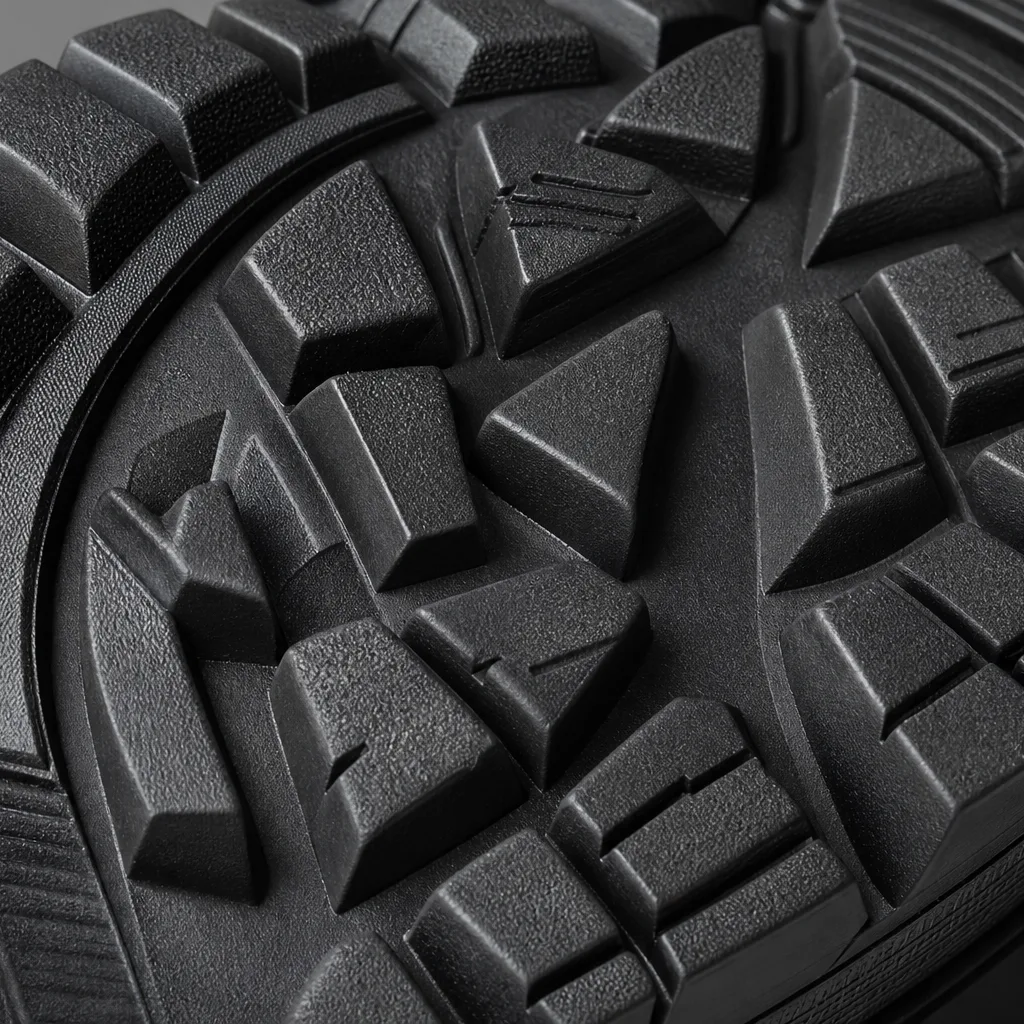
Lug orientation, spacing, depth, siping, channels, heel shape, toe flex, and contact area influence engagement and evacuation. Deep lugs can help in loose material but may reduce contact on hard surfaces or hold snow. Rounded edges and closed channels may look clean yet provide fewer working edges. Prototype the geometry at actual scale and review wear progression.
Select compound for the intended condition
Hardness, elasticity, filler, surface texture, and low-temperature behavior affect how the sole conforms to the ground. A compound that performs at room temperature may change in cold conditions. Work with qualified material and testing partners to define relevant conditioning and methods. Record the exact production compound because small formulation changes can alter results.
Connect testing to responsible claims
Choose methods that reflect the market, product type, and intended statement, then document sample condition and limits. Laboratory results are one part of risk assessment and do not eliminate the need for user caution on ice. Avoid absolute terms such as slip-proof. Keep test reports, production material controls, and retail copy aligned to the same construction.
Decision framework
Buyer checklist
- Define priority surfaces and temperatures
- Prototype lug depth, spacing, and release
- Approve exact production compound
- Use appropriate conditioning and test methods
- Avoid absolute traction guarantees
Continue the specification
Move from research to a controlled brief.
Frequently asked questions
Questions buyers ask next
What outsole pattern is best for snow?
There is no universal pattern. Lug geometry, compound, surface, temperature, contamination, and use all interact, so design and testing should follow the target condition.
Can a snow boot be described as slip-proof?
Absolute guarantees are risky because surfaces and conditions vary. Use claims supported by appropriate evidence and qualified market-specific guidance.