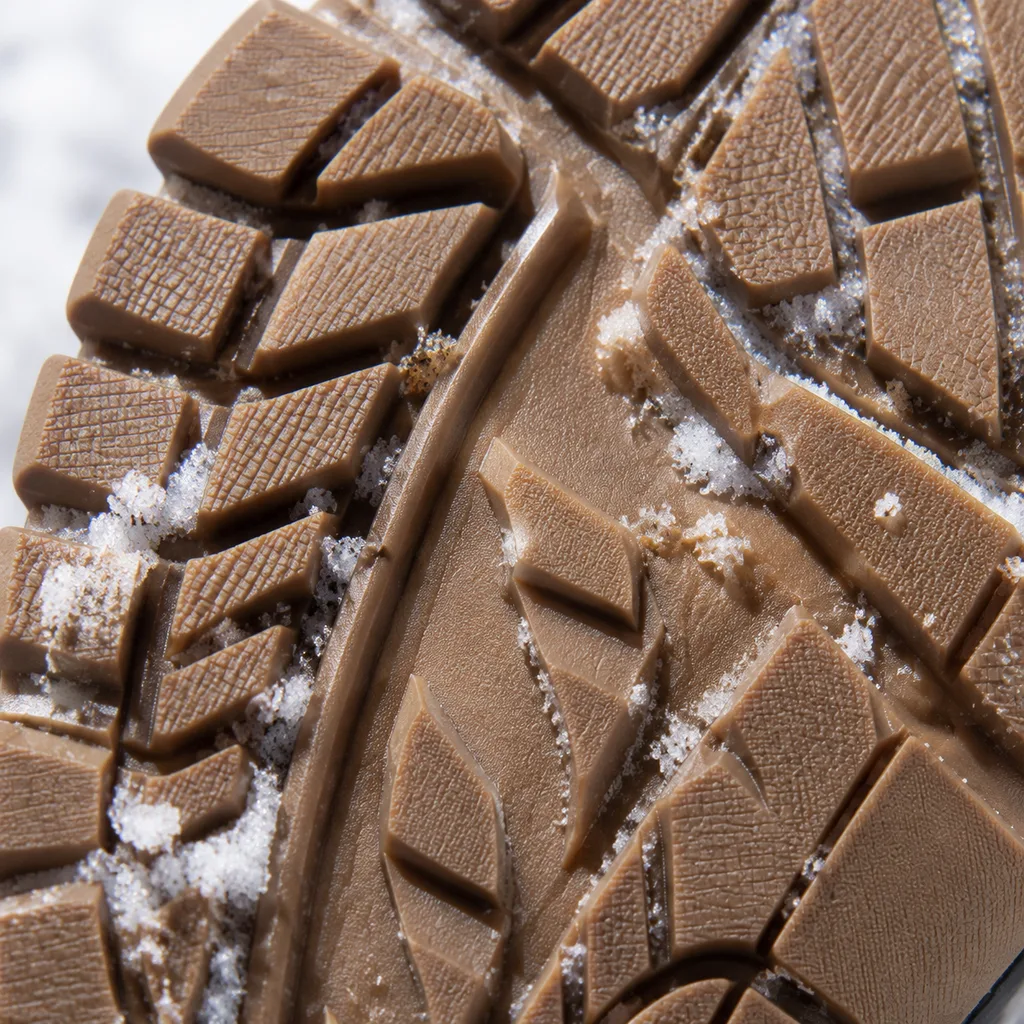
This guide is written for product teams, importers, wholesalers, and brand operators. Use it to structure supplier conversations and document decisions before samples or bulk production move forward.
Rubber outsole compounds
Rubber can support abrasion resistance, tread definition, and a broad range of compound tuning. Results depend on formulation, hardness, fillers, surface, temperature, and tread design. Specify performance through agreed tests and conditioning rather than assuming all rubber behaves the same in cold or wet use.
Thermoplastic rubber, or TPR
TPR can offer efficient molding, color options, and a useful balance of flexibility and cost for many snow boot programs. Cold response, abrasion, weight, shrinkage, and bonding vary by formulation. Evaluate the production compound and size range, not only a showroom outsole.
EVA midsole with rubber contact pods
An EVA-rubber combination can reduce weight and add cushioning while placing more durable material at contact zones. Control compression, exposed EVA wear, pod coverage, bonding, and stability. The contact map should reflect gait and intended surfaces instead of minimizing rubber only to reduce cost.
Polyurethane sole systems
PU systems can provide cushioning, durability, and integrated molding options, but density, reaction control, aging, temperature behavior, and production process require specialist management. Confirm suitability for the intended climate and storage conditions. Review any multi-density or direct-injection process with the actual factory.
Molded waterproof lower-shell compounds
Rubber-like or thermoplastic lower shells can combine outsole and waterproof sidewall coverage. They reduce some lower seams but add mold, fit-volume, flex, bonding, weight, and transition considerations. Validate the complete lower rather than treating the material as a conventional flat outsole.
Decision framework
Buyer checklist
- Approve exact compound, hardness, conditioning, tread, and test plan
- Validate TPR formulation, cold flex, abrasion, weight, and bonding
- Approve contact-zone map, compression, wear, bonding, and stability
- Verify PU process, density, aging, climate suitability, and quality controls
- Test lower-shell compound, mold consistency, flex, bonding, and fit
Continue the specification
Move from research to a controlled brief.
Frequently asked questions
Questions buyers ask next
What should buyers prioritize first from this list?
Choose the outsole from intended surface, temperature, weight, flex, durability, and claim requirements. Material family is only the starting point; compound and geometry determine the actual result.
Does every snow boot program need all five items?
Hybrid outsoles often combine cushioning and durable contact materials. Every interface adds bonding and tolerance controls, so weight savings should be balanced with contact coverage and production repeatability.