This guide is written for product teams, importers, wholesalers, and brand operators. Use it to structure supplier conversations and document decisions before samples or bulk production move forward.
Membrane-backed textile systems
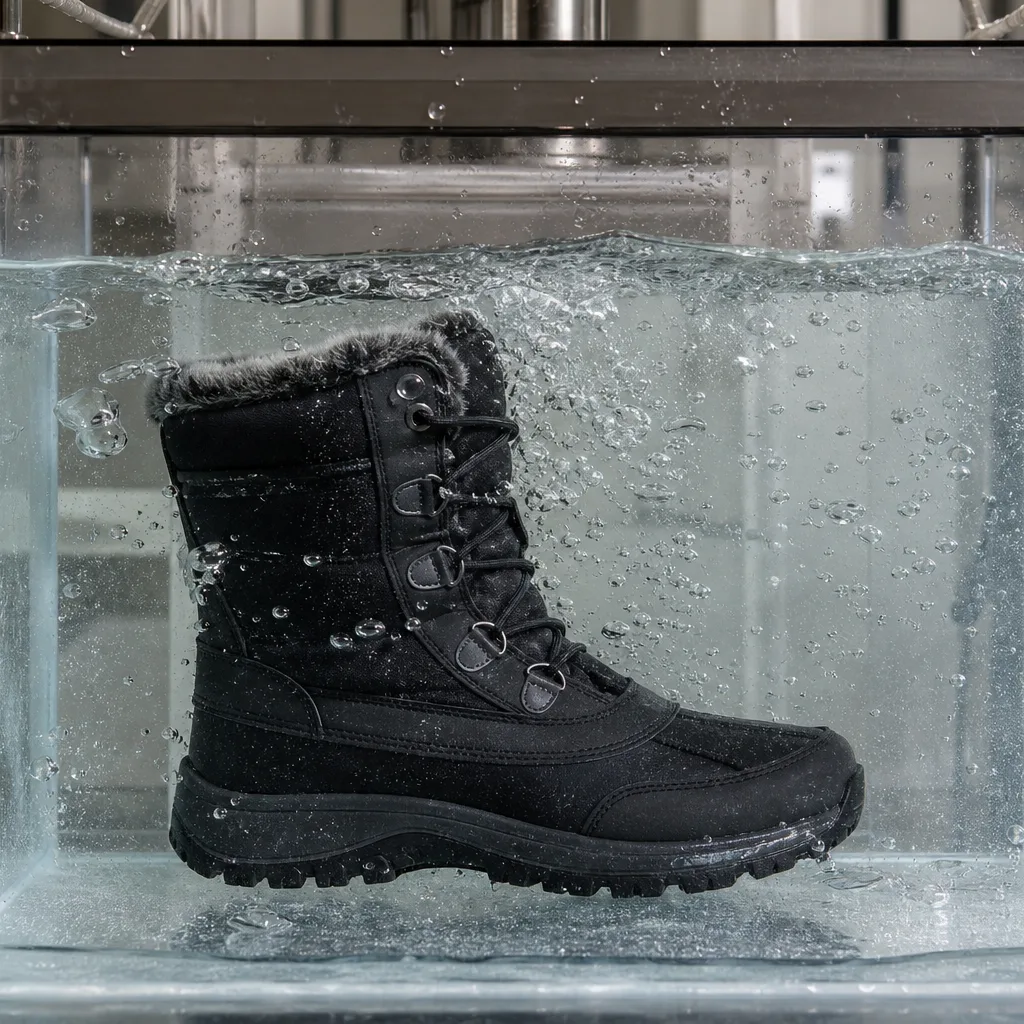
A membrane-backed textile can provide flexible upper coverage while supporting varied colors and textures. Performance depends on lamination quality, seam treatment, pattern design, and lasting. Confirm hydrostatic or finished-product requirements with the supplier and test the actual assembled boot after relevant conditioning.
Coated woven or nonwoven textiles
Coated fabrics can offer a direct water barrier and efficient surface cleaning, but coating flexibility, crease whitening, abrasion, and cold response need review. Needle holes and cut edges remain potential water paths. Select thickness and backing around the intended flex and support zones.
Water-resistant synthetic leather
PU or related synthetic leather can create structured panels and easy-care surfaces. Results vary by base cloth, coating, finish, thickness, and cold-flex behavior. Treat material water resistance as one input; seams, perforations, embossing, and attachments can still allow water entry.
Molded rubber or waterproof lower shells
A molded lower can reduce seams near slush and standing water while adding abrasion protection. Check compound, flex, weight, bonding to the upper, mold consistency, and fit volume. The connection between shell and upper remains a critical transition that requires controlled construction.
Protective films and welded overlays
Films, hot-melt layers, and welded overlays can reinforce splash, abrasion, or seam zones with fewer stitch holes. Compatibility with the base textile, heat, flex, appearance, and peeling risk must be verified. Use overlays strategically rather than assuming more coverage always creates better comfort or durability.
Decision framework
Buyer checklist
- Approve membrane identity, lamination, seam treatment, and finished-boot test
- Check coating flex, abrasion, cold response, seams, and cut edges
- Test the selected synthetic leather and every perforated construction zone
- Validate shell compound, flex, bonding, transition height, and fit
- Approve overlay compatibility, weld settings, flex, and peel resistance
Continue the specification
Move from research to a controlled brief.
Frequently asked questions
Questions buyers ask next
What should buyers prioritize first from this list?
Choose the material system after defining water exposure, flex, appearance, and cost. A membrane textile or molded lower may lead different programs; neither is automatically best without the complete construction brief.
Does every snow boot program need all five items?
Snow boots often combine several materials by zone. The key is to manage transitions, seams, attachments, and flex so the assembled barrier performs consistently rather than relying on one waterproof component.