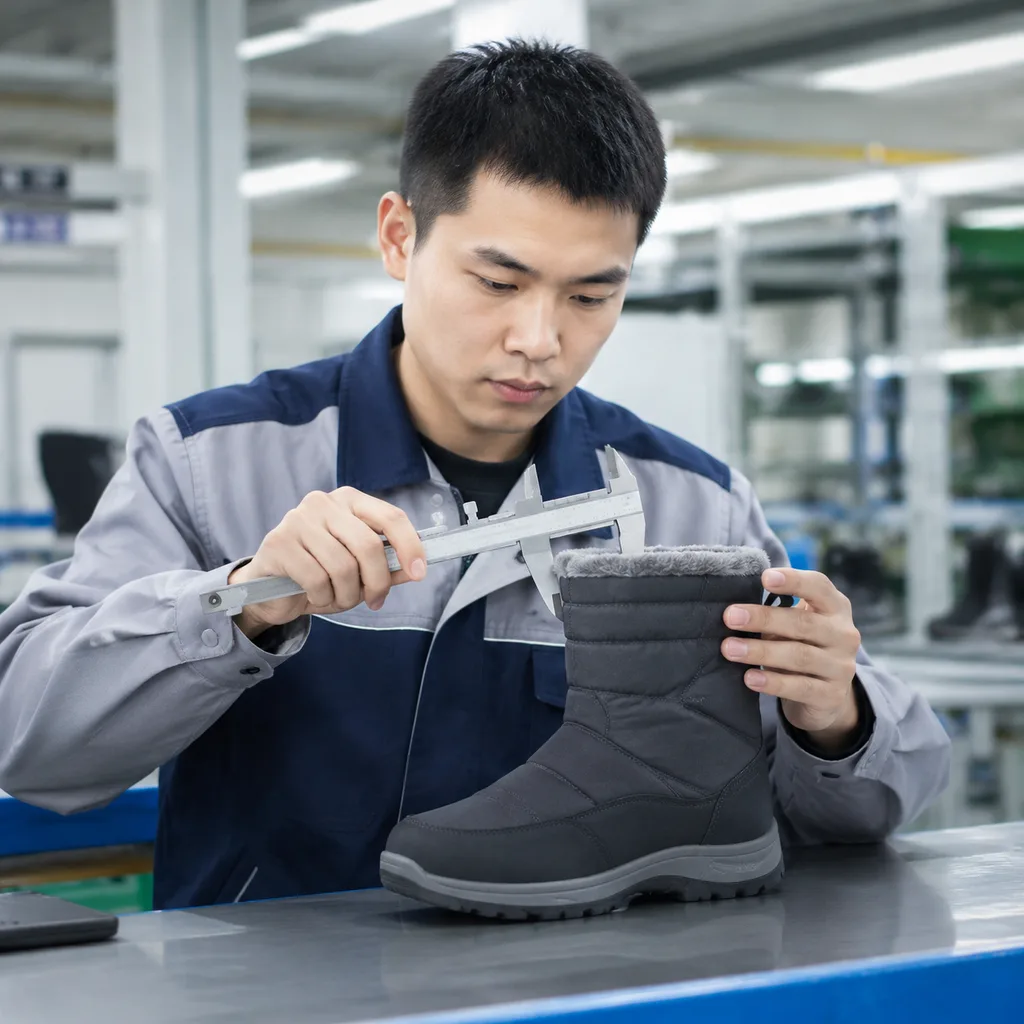
This guide is written for product teams, importers, wholesalers, and brand operators. Use it to structure supplier conversations and document decisions before samples or bulk production move forward.
Upper material cold-flex testing
Synthetic leather, coated textile, films, and welded overlays can stiffen, crack, whiten, or delaminate during low-temperature flexing. Test the exact color, thickness, backing, and finish planned for production. Record conditioning, cycles, recovery, and both visual and structural failure.
Outsole hardness, flex, and crack review
Outsole compounds may become harder or less flexible in cold conditions. Evaluate production-relevant compounds and tread geometry after conditioning, including flex points and thin sections. A material-family name does not predict the response of a specific formulation across temperatures.
Bond and adhesion after cold exposure
Cold can change material stiffness and stress the upper-outsole bond during flex. Review adhesion or controlled flex after relevant conditioning and examine failure location. Connect results to preparation, primer, adhesive, pressure, and cure records so corrective action addresses the process.
Closure and component function
Zippers, hooks, elastic, toggles, lace hardware, molded badges, and pull tabs should operate and remain attached after cold exposure and movement. Check glove-friendly use where relevant. Small components can become brittle or create concentrated stress even when the main upper passes.
Finished-boot flex and fit assessment
Conditioned finished boots reveal how materials interact around entry, gait, toe flex, heel hold, and pressure points. Use controlled wear or mechanical movement as appropriate and record sock, size, duration, and temperature. A cold-stiffened boot may remain intact yet become functionally unsuitable.
Decision framework
Buyer checklist
- Test every critical upper material in production color and construction
- Approve exact outsole compound after defined cold conditioning and flex
- Evaluate bond performance and failure mode after cold conditioning
- Operate and cycle closures and attachments after conditioning
- Assess conditioned finished-boot movement, entry, comfort, and damage
Continue the specification
Move from research to a controlled brief.
Frequently asked questions
Questions buyers ask next
What should buyers prioritize first from this list?
Test the highest-risk material and the finished boot. Material screening identifies weak inputs, while finished-boot evaluation shows whether combined stiffness and construction affect use.
Does every snow boot program need all five items?
A cold-weather plan normally combines material, component, bond, and assembled-product checks. Select conditions with qualified testing partners and avoid claiming suitability beyond the verified range.