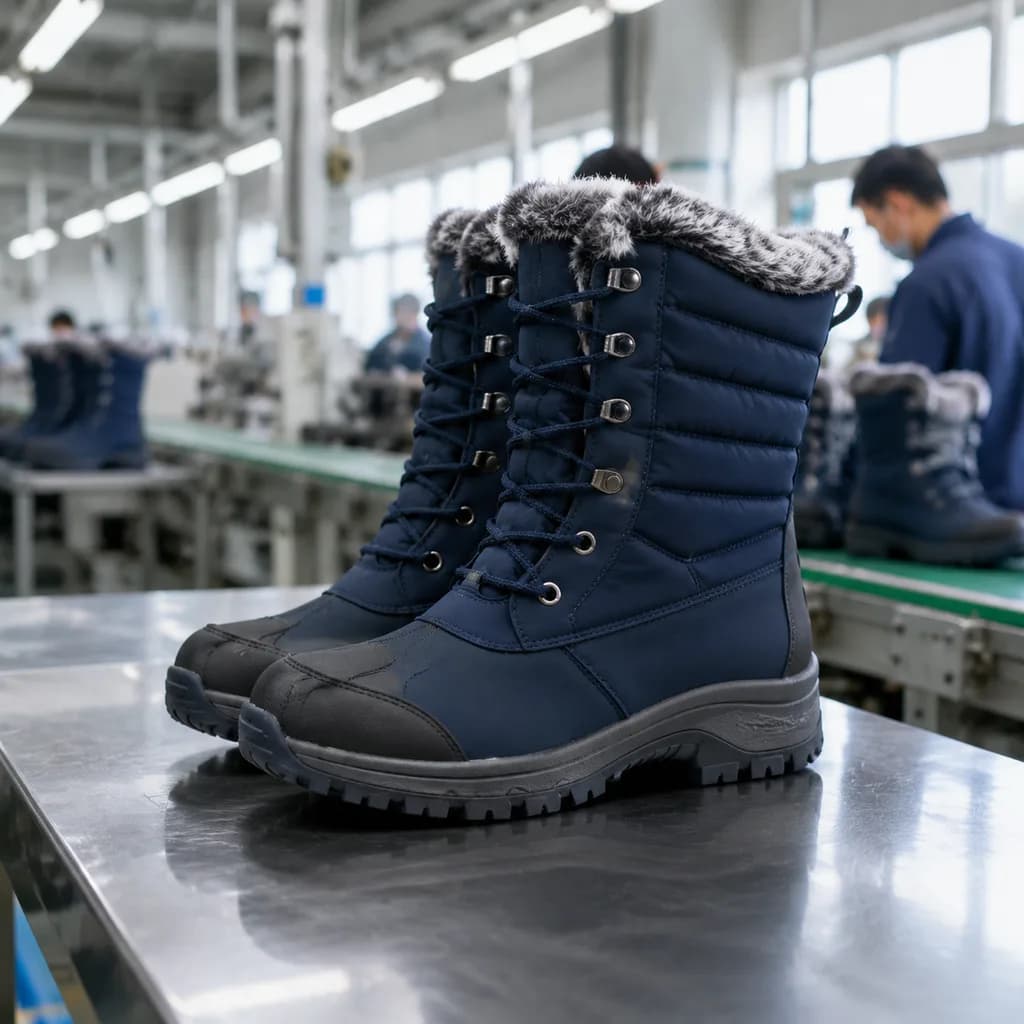
Turn a vague waterproof upper request into a clear RFQ covering face textile, DWR, backing, construction questions, and approval basis.
An RFQ line reading “waterproof nylon upper” compresses several decisions into three words. It mentions a material direction but does not distinguish the face textile from its finish or backing. It also leaves the intended feel, construction questions, and approval basis unstated. A waterproof upper specification for custom snow boots turns that shorthand into separate fields so each response can be checked against the same brief.
The supplied SnowBootWorks materials excerpt groups coated nylon upper, water-resistant fabric upper, and technical textile shell under the Waterproof Textile Upper heading. It describes a woven or laminated synthetic fabric upper, typically nylon or polyester. The upper is described as finished with a durable water-repellent coating and often backed by a waterproof membrane or laminate. The supplied capability excerpt states that SnowBootWorks develops custom snow boots to the buyer's specification, with construction, materials, and approval standards driving decisions. Those statements form the published factual basis below. The proposed RFQ fields, status labels, and supplier questions are editorial recommendations for the buyer.
From shorthand to a decision record
The phrase “waterproof nylon upper” mentions nylon without saying whether it is mandatory or only preferred. It does not identify the required textile form, state whether DWR and backing are separate requirements, or explain how the upper will be approved. For a custom snow boot RFQ, a practical buyer-side split is:
- The face-textile requirement and any attached material reference
- The DWR requirement
- The membrane or laminate backing requirement
- The intended product, weight, flexibility, and cold-weather direction
- Construction questions that the material name does not answer
- The basis the buyer will use for approval
Each field can then carry its own drafting status. In this article, fixed means the buyer requires the stated entry, preferred means a clearly identified alternative may be reviewed, and open means the buyer is requesting a proposal or clarification. These are editorial notation choices for the brief, not published SnowBootWorks program options.
Three fields, kept separate
A waterproof textile upper specification is easier to review when the textile, finish, and backing occupy different lines. The published description supplies vocabulary; the buyer instruction and supplier question determine how that vocabulary is used for the project.
| Decision field | Published description | Buyer instruction | Question for the supplier |
|---|---|---|---|
| Synthetic face textile | A woven or laminated synthetic fabric upper. Nylon and polyester are identified as typical materials. | Enter the buyer's material requirement or attached reference. Record fixed, preferred, or open in a separate status field. | What textile and textile form does the response assume? |
| DWR finish | The upper is described as finished with a durable water-repellent coating. | State the DWR requirement and its decision status. Add any buyer-controlled identification or acceptance basis separately. | What DWR finish is assumed, and how will the proposed material be identified for review? |
| Membrane or laminate backing | The excerpt says the upper is often backed by a waterproof membrane or laminate, so backing is not stated as universal. | State the backing requirement, any buyer-defined type, and its decision status in separate entries. | Is a membrane or laminate included in the proposed definition? If so, how is it identified? Whether another construction can be proposed for this project remains an open supplier question. |
DWR and backing should not be compressed into a single “DWR/membrane” entry. The excerpt describes DWR as a finish and a membrane or laminate as backing. When a membrane-backed snow boot upper is required, write that requirement directly while retaining a separate line for DWR.
What feel is the brief aiming for?
The materials excerpt presents the waterproof textile upper as a lightweight and flexible direction. It associates that direction with everyday snow boots that need to stay supple in the cold. The excerpt does not attach numeric weight, flex, temperature, or acceptance values to those terms.
| Published direction | Recommended RFQ treatment | Buyer approval record |
|---|---|---|
| Everyday snow boot | Use this as the product direction when it matches the project. Otherwise, insert the buyer's intended use. | Record the intended use context without folding fit, insulation, outsole, or other boot systems into the upper-material line. |
| Lightweight | Keep it as a design intention unless weight will control approval. | Add a buyer-defined reference or measurable criterion when a directional word is not sufficient. |
| Flexible | State the desired handling direction for the upper material. | Attach a buyer-controlled reference or written criterion if a particular feel must be reviewed. |
| Supple in the cold | Record the intended cold-weather material direction. | If approval depends on defined conditions, enter those conditions and the evaluation basis as separate buyer requirements. |
The excerpt identifies nylon and polyester as typical materials but does not rank one above the other. For the RFQ, avoid treating either name as evidence of durability, warmth, traction, compliance, or complete-boot performance. Record those matters separately when they are relevant to the project.
Where does ownership change?
SnowBootWorks states that construction, materials, and approval standards drive decisions when developing custom snow boots to a buyer's specification. For the buyer's document, those three classes provide a useful way to separate defined requirements from unresolved questions.
| Decision class | Buyer-defined record | Requested clarification |
|---|---|---|
| Materials | Face-textile requirement, attached references, DWR requirement, backing requirement, intended feel, and the status of each field | Identify the material definition assumed in the response and mark any proposed substitution or unresolved entry beside the affected field. |
| Construction | Upper interfaces and waterproof-construction topics that matter to the project but are not resolved by the material name | State the construction assumptions associated with the proposed upper and identify questions that require agreement. |
| Approval standards | Buyer criteria, material references, review stage, requested documentation, or another buyer-defined evaluation basis | Identify which approval points can be addressed and which remain open before review. |
As an editorial control, record upper-material approval and finished-boot waterproof approval on separate lines unless the buyer has explicitly connected them. The presence of DWR, a membrane, or a laminate should not be used by the buyer as the complete approval basis for the finished boot. The separate sample approval checks article can sit beside this material record when planning the later review stage.
Questions beyond material vocabulary
The supplied material and capability excerpts do not document the methods or criteria below. If any item is material to the project, include it as an open inquiry topic rather than an assumed practice, service, or result.
- Upper seam treatment: Does the project require a defined treatment for seams in the textile upper?
- Internal waterproof construction: Is a separate internal waterproof structure required beyond the named upper material?
- Finished-product test method: Will a defined method govern finished-boot approval, and who will provide or agree that method?
- Numeric waterproof threshold: Has the buyer established a numerical acceptance requirement that must appear in the specification?
- Temperature-performance criteria: Must flexibility or suppleness be evaluated under buyer-defined cold conditions?
Quote-ready upper specification block
The block below keeps published material vocabulary separate from buyer instructions and open questions. Complete only the entries relevant to the project, but preserve every unresolved field so it remains visible during development or quotation.
- Product and use direction
- Buyer entry: [everyday snow boot or another buyer-defined direction]. Intended use context: [entry].
- Upper category or selected direction
- Buyer entry: [entry or attached reference].
- Published typical material vocabulary
- Nylon or polyester.
- Buyer material requirement or attached reference
- [Entry].
- Face-textile decision status
- [Fixed / preferred / open].
- Buyer-required textile form, appearance, or hand
- [Entry or open question].
- DWR requirement
- [Buyer entry].
- DWR decision status
- [Fixed / preferred / open].
- DWR identification or acceptance basis
- [Buyer entry].
- Backing requirement
- [Buyer entry].
- Backing type, if fixed by the buyer
- [Buyer entry].
- Backing decision status
- [Fixed / preferred / open].
- Weight direction
- [Directional wording, buyer reference, or buyer-defined criterion].
- Flexibility direction
- [Directional wording, buyer reference, or buyer-defined criterion].
- Cold-weather suppleness direction
- [Directional wording or buyer-defined conditions and evaluation basis].
- Construction questions
- [Seam treatment, internal waterproof construction, component interfaces, or other relevant questions].
- Upper-material approval basis
- [Written criteria, material reference, review stage, requested documentation, or buyer-defined evaluation].
- Finished-boot approval basis
- [Buyer entry or open question, kept separate from component approval].
- Requested response notation
- Mark each field as confirmed, proposed, or unresolved. Place every assumption or proposed substitution beside the field it affects.
The completed waterproof upper specification for custom snow boots can contain open fields. The important drafting control is that an open field remains labeled as open rather than becoming an unstated assumption in the response.
Send a scoped inquiry
Before sending the brief, check that the textile requirement, DWR, backing, intended feel, construction questions, and approval basis each have a distinct entry.
- Share the current winter footwear definition and any material references controlled by the buyer.
- Ask the respondent to repeat the upper fields, identify assumptions, and mark proposed substitutions beside the affected requirement.
- Ask which development, sampling, or quotation options may apply to the project. Treat these as inquiry categories rather than assumed scope, timing, or outcomes.
Submit the definition through the project inquiry page and request a field-by-field response. That structure gives the buyer a direct basis for identifying what is confirmed, what is proposed, and what still requires a decision.
Evidence layer
Evidence checklist: Waterproof Upper Specification for Custom Snow Boots
Waterproof, water-resistant, and weather-ready are not interchangeable briefs. Start with the exposure your buyer expects, then identify the upper, membrane or coating, seam treatment, gusset, closure, and outsole details that support the claim. The specification should say what is being protected and how the finished boot will be reviewed; it should not rely on a single material name as a shortcut for performance. For this guide, map each supplier response to “From shorthand to a decision record” so a claim is supported by a written specification, sample reference, controlled document, or a clearly marked open question.
Keep marketing language aligned with the approved construction and the test method agreed for the program. If the target market has a required labeling or claim convention, confirm it with the importer or compliance specialist before publishing the claim. Cross-check the response against “Three fields, kept separate” and keep every unresolved point visible in the approval record.
- Exposure scenario and claim wording — scoped to waterproof upper specification for custom snow boots
- Seam, gusset, closure, and upper interfaces — cross-checked against “From shorthand to a decision record”
- Agreed review method and claim documentation — with open risks from “Three fields, kept separate” recorded
Decision framework
Buyer checklist
- For the RFQ, place the face-textile requirement, DWR finish, and membrane or laminate backing in separate fields.
- Use fixed, preferred, and open as buyer-selected drafting statuses, not as documented factory program options.
- Treat lightweight, flexible, and cold-weather supple as directions unless the buyer supplies a separate approval criterion.
- Raise seam treatment, internal waterproof construction, finished-product testing, numeric thresholds, and temperature criteria as open inquiry topics when they matter to the project.
Sources and verification
Evidence used for this guide.
Continue the specification