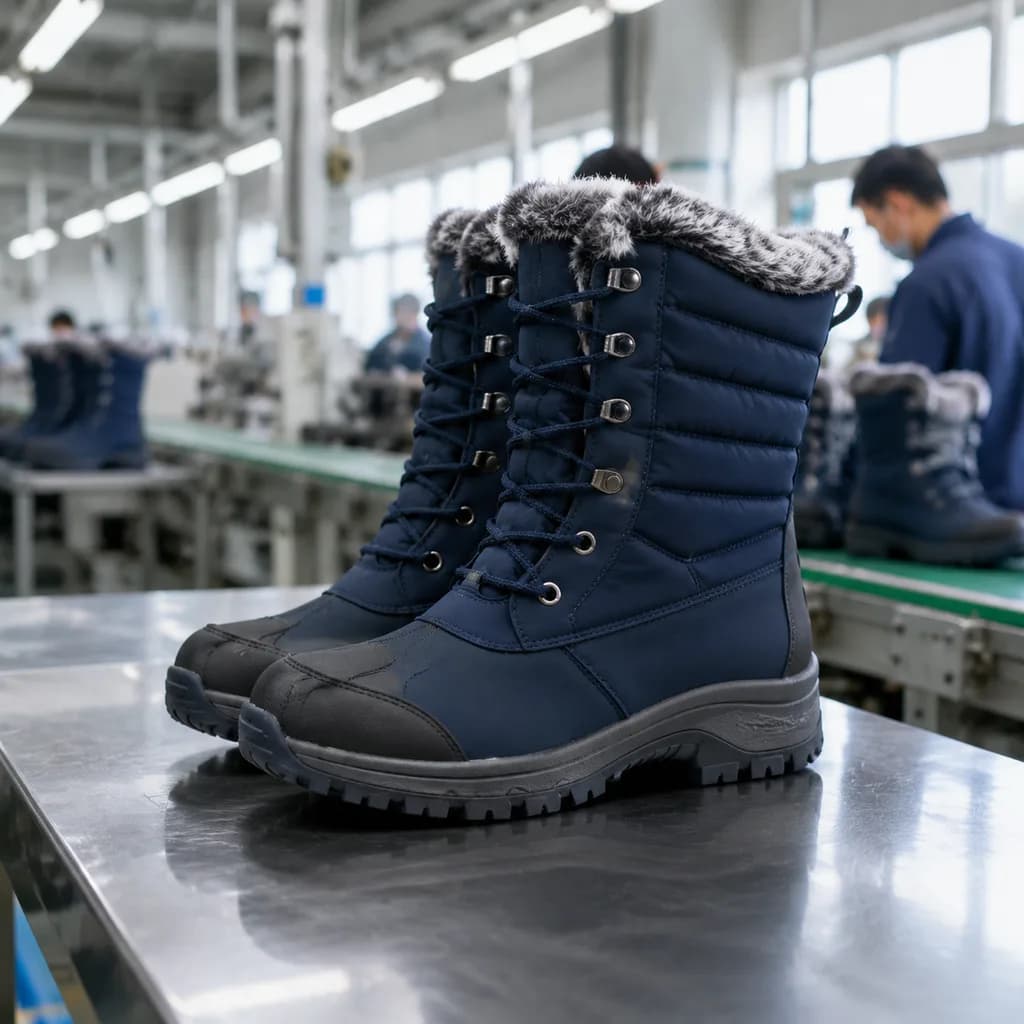
Define shell, fiber, finish, and backing choices for a waterproof textile snow boot specification before a supplier inquiry.
"Waterproof textile" can sound like a complete upper specification. In practice, it can refer to the shell, the surface finish, or a backing layer. A buyer who means one of those elements may receive responses built around another unless the request separates them from the start.
SnowBootWorks' Waterproof Textile Upper material entry describes a material direction rather than a single component. The entry identifies a woven or laminated synthetic fabric upper, typical nylon or polyester fiber directions, a durable water-repellent (DWR) coating, and a waterproof membrane or laminate backing that is often present. The buyer guidance in this article is editorial: it is intended to organize a material conversation, not to treat an upper description as proof of a finished boot outcome.
One Material Label, Four Decisions
The source description can be read as four distinct entries in a brief. Keeping them apart lets a buyer state what is selected, what is preferred, and what still needs discussion.
| Upper element | Documented description | Buyer brief prompt |
|---|---|---|
| Shell construction | Woven or laminated synthetic fabric | Identify whether the requested shell is woven, laminated, or still open. |
| Fiber direction | Nylon or polyester are typical | Record a fiber preference only when the buying team has one. |
| Surface finish | Durable water-repellent (DWR) coating | State whether DWR belongs in the requested upper description. |
| Backing | Often backed by a waterproof membrane or laminate | Describe the backing as required, under consideration, or undecided. |
The qualifier often is material to the brief. It supports asking about a membrane or laminate backing, but it does not make either one an automatic feature of every waterproof textile upper. DWR is likewise a separate stated finish, not a substitute for naming the shell or the backing direction.
Direction Before Component Choice
The material entry describes this as a lightweight, flexible direction for everyday snow boots that need to stay supple in the cold. That establishes the product direction attached to the entry; it does not rank those qualities or set a finished-boot performance level.
For the buyer, the practical recommendation is to write the intended wear direction before selecting every material detail. A concise opening line might identify an everyday snow-boot direction and note whether lightness, flexibility, or cold-weather suppleness is the priority. The team can then mark any component that remains unresolved instead of presenting a preference as a fixed requirement.
This order helps with a common ambiguity. A buyer may know that the collection needs a flexible textile direction while still needing to discuss whether the shell should be woven or laminated. The brief is clearer when it preserves that open decision.
Material Definition and Evidence Are Different Requests
A material brief answers what upper direction is under discussion. An evidence request answers what information the buyer needs to review for its own project. They should sit beside one another rather than being merged into one claim about the material.
| Material-definition track | Separate evidence-request track |
|---|---|
| Shell construction, fiber direction, finish, and backing | The documentation or approval records the buyer needs to request |
| Everyday snow-boot direction and desired material character | The criteria the buyer needs to establish for project review |
The supplied materials, capabilities, and product excerpts do not identify particular certifications, test methods, test outcomes, or regulatory approvals. As an editorial procurement recommendation, a buyer needing any of those items should state the relevant requirement separately and ask for a project-specific response. Adding that request to the inquiry keeps it from being assumed from the words "waterproof textile."
An Inquiry Scope a Team Can Review
SnowBootWorks states on its capabilities page that it develops custom snow boots to a buyer's own specification. The page says construction, materials, and approval standards drive every decision. That framing makes the written scope useful even when some material choices remain open.
The following is editorial buyer guidance for a waterproof textile boot supplier inquiry. It is a way to make internal decisions visible before asking which project options may apply.
- State the chosen shell direction, or identify the shell choice as open for discussion.
- Mark each upper element as required, preferred, or unresolved. Apply that status separately to fiber direction, DWR, and any membrane or laminate backing.
- Include reference materials when they clarify the intended textile appearance or hand, then put the relevant decision into writing.
- Describe the intended product direction in the terms that matter to the collection, including any priority among lightness, flexibility, everyday use, and cold-weather suppleness.
- Name the approval standards the buyer intends to use and identify who will make those decisions.
A short scope can be more useful than a broad label because it distinguishes settled choices from questions that need supplier input. It also gives a team a record of what has changed when the material conversation develops.
Women's Fit Inputs Have a Defined Context
SnowBootWorks' women's snow boot catalog describes fit-led women's winter boot platforms spanning clean urban, quilted, and plush cold-weather directions. For women's retail and private-label winter collections, the catalog directs buyers to decide the target sizing system and fit reference first, then review the product brief.
For that stated women's collection context, the editorial recommendation is to keep the sizing system and fit reference visible in the brief alongside the upper request. This is not general fit guidance for every snow-boot category. It applies only to the women's retail and private-label collection context named in the catalog excerpt.
Questions for the First Discussion
Before contacting a supplier, use the remaining unknowns to focus the discussion instead of repeating every selected material point. These questions can help the buyer identify what needs an answer:
- Which upper decision is a requirement, and which is only a preference?
- What does a reference material suggest that the written scope has not yet named?
- Who will decide the approval standards for the project?
- For a women's retail or private-label winter collection, have the sizing system and fit reference been decided before product-brief review?
- What evidence or project documentation needs to be requested on its own track?
Use the request-a-quote form to share the current winter footwear definition and ask which development, sampling, or quotation options may apply to the project. A useful first message identifies the selected upper direction, the unresolved points, and the separate information the buyer needs to raise.
Evidence layer
Evidence checklist: Waterproof Textile Snow Boot Specification Guide
Material selection should connect performance to the commercial brief. Compare abrasion, flex, grip, weight, cold behavior, appearance, supply continuity, and cost together. An outsole compound or upper textile can look attractive in isolation and still be the wrong choice for the target climate, retail price, or repeat-order plan. Use the sample to record what changed and why. For this guide, map each supplier response to “One Material Label, Four Decisions” so a claim is supported by a written specification, sample reference, controlled document, or a clearly marked open question.
When a substitute is proposed, ask which requirement it preserves and which requirement it changes. Keep the approved material reference, color standard, and component source in the same specification pack so the decision survives a handoff between development and production. Cross-check the response against “Direction Before Component Choice” and keep every unresolved point visible in the approval record.
- Performance requirement and target environment — scoped to waterproof textile snow boot specification
- Cost, weight, appearance, and continuity — cross-checked against “One Material Label, Four Decisions”
- Approved reference and substitution rules — with open risks from “Direction Before Component Choice” recorded
Decision framework
Buyer checklist
- Editorial recommendation: Separate shell construction, fiber direction, DWR, and backing in the material brief.
- Editorial recommendation: Keep material-definition questions separate from project-specific evidence requests.
- For the stated women's retail and private-label collection context, decide the sizing system and fit reference before reviewing the product brief.
Sources and verification
Evidence used for this guide.
Continue the specification