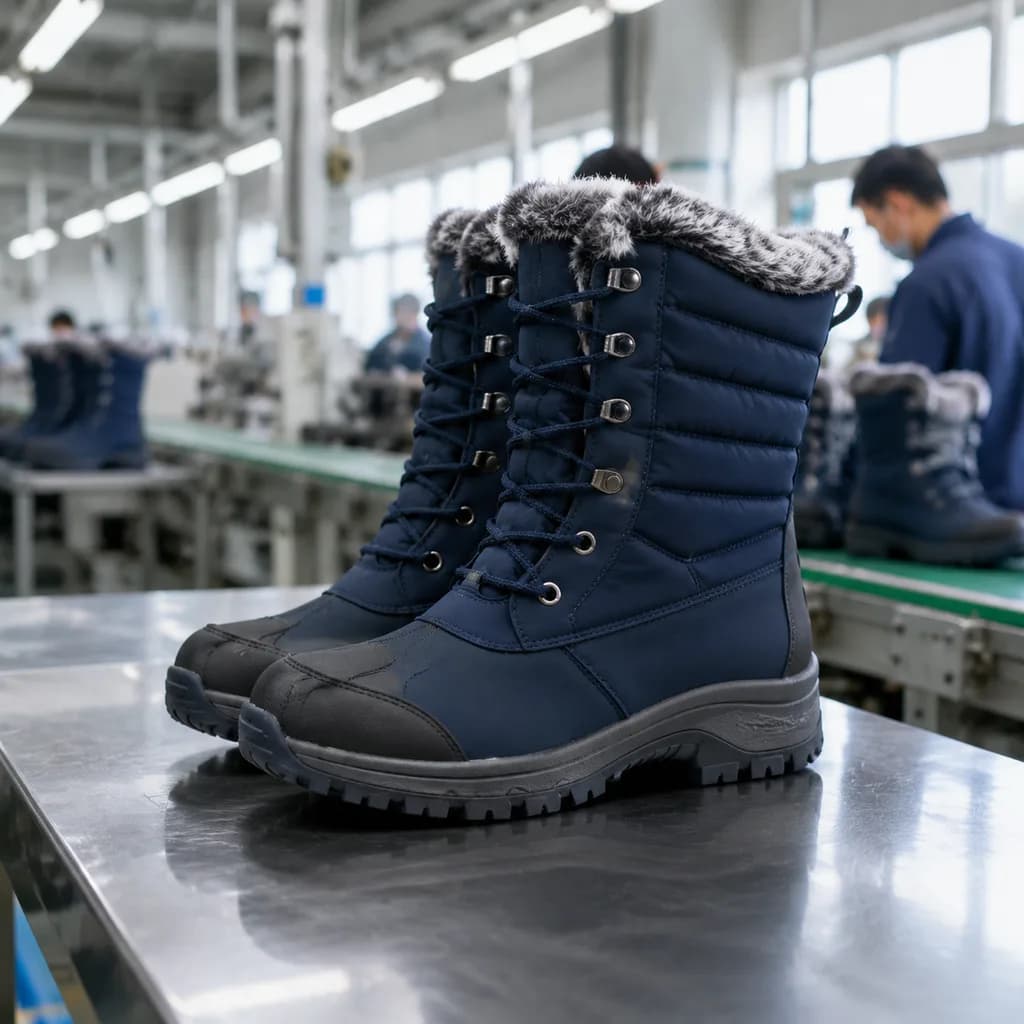
Build a quote-ready custom winter boot brief by defining the product, fit basis, references, responsibilities, and open supplier questions.
Custom winter boots cannot be quoted consistently from a product name alone. The phrase does not define the fit basis, construction intent, material direction, branding scope, quality requirements, or responsibilities behind the request. When those points remain implicit, supplier responses may be based on different product assumptions.
The buyer's first task is therefore to establish one controlled definition. It can contain unresolved decisions, but each open point needs to be visible. A useful handoff shows what is fixed, which references apply, who owns each decision, and what response is requested from the supplier.
Start with a definition record
Before adding features to an inquiry, create a record for the product being discussed. Identify the intended consumer and use context, then record the silhouette, sizing system, fit reference, construction intent, material direction, branding requirements, quality criteria, and any buyer-defined packaging requirements.
These are editorially recommended RFQ fields, not a list of confirmed supplier options. Their purpose is to prevent photographs, descriptive language, and commercial expectations from being treated as interchangeable forms of instruction.
The record also needs a clear request. An initial inquiry might ask which development, sampling, or quotation options may apply to the current definition. That is more precise than requesting a final price before the parties have identified the product on which a price would be based.
Identify the correct starting point
SnowBootWorks documents an OEM manufacturing context in which winter boots are built to the buyer's specification, with the buyer's construction, materials, and quality standards guiding decisions. In that context, the buyer-owned specification leads the inquiry. The handoff should distinguish mandatory requirements from points submitted for supplier review. The stated manufacturing capabilities provide the relevant first-party context for this route.
The documented product-platform context has a narrower scope. The SnowBootWorks product catalog presents fit-led women's winter boot directions for women's retail and private-label collections. It tells buyers in that context to decide the target sizing system and fit reference first. The catalog also identifies clean urban, quilted, and plush cold-weather directions, but it does not establish that every direction applies to every project or footwear category.
| Starting point | Controlling input | Information to make visible |
|---|---|---|
| Buyer-owned OEM specification | The buyer's specification, including its construction, materials, and quality standards | Fixed requirements, governing references, open decisions, and requested review |
| Women's product-platform inquiry | A relevant direction within the stated women's winter boot context | Target sizing system, fit reference, attributes to retain, and questions still open |
Selecting the starting point changes how every later instruction is read. A supplier reviewing a controlled OEM specification has a different task from one being asked to discuss a women's product direction.
Anchor the women's inquiry in fit
Within the catalog's stated women's scope, sizing and fit come before colors, trims, logos, or surface details. The RFQ should name the intended consumer, target sizing system, and fit reference wherever the buyer has already made those decisions.
For a practical fit record, the buyer can include:
- The target sizing system and buyer-selected size range, if established.
- The supplied fit reference or measurement document.
- The attributes of that reference that must be retained.
- Known concerns and questions requiring discussion.
- The person or team responsible for the fit decision.
Grading, tolerances, review methods, and sample evaluation can be raised as project questions where relevant. They are not documented as services by the supplied catalog excerpt. The excerpt's fit instruction is specific to its women's winter boot context and should remain within that scope.
Control the RFQ with one matrix
A product-definition matrix allows product development, design, procurement, quality, and the prospective custom winter boot manufacturer to work from the same record. Each row should expose both the current instruction and the work that remains unresolved.
| RFQ field | Current definition | Reference supplied | Open question | Decision owner | Requested response |
|---|---|---|---|---|---|
| Consumer and use context | State the intended wearer and wearing context | Product brief or range plan | Which requirements remain undefined? | Brand or product team | Identify points for discussion |
| Silhouette | Record the intended height, profile, and closure direction | Sketch, image, or physical reference | Which attributes are fixed or open? | Design team | Review the stated direction |
| Sizing and fit | Name the sizing system and fit basis | Fit reference or measurement document | What further input is required? | Product development | State the relevant next review |
| Construction intent | Describe the intended build at the available level of detail | Specification or reference sample | Which points need feasibility discussion? | Product development | Flag assumptions and missing inputs |
| Upper direction | Separate required attributes from preferences | Swatches, references, or written brief | Which details remain open? | Design or materials team | Identify project-specific review points |
| Lining direction | Record the buyer's current requirements | Swatch, sample, or written brief | What has not yet been selected? | Design or materials team | Clarify the inputs needed |
| Outsole direction | Record appearance, use, and construction intent | Drawing or product reference | What must be clarified before quotation? | Product development | Identify missing decisions |
| Branding | List locations and artwork status | Artwork or placement guide | Which applications need discussion? | Brand team | Review the project request |
| Buyer packaging requirements | Record requirements already set by the buyer | Packaging brief, if available | Which buyer decisions remain open? | Operations or procurement | Request relevant project information |
| Quality requirements | Name the buyer's standards and acceptance criteria | Quality manual or requirement sheet | Which review points require clarification? | Quality team | Identify information needed for assessment |
Unknown entries should stay open. Filling a gap with an assumption makes the document look complete while weakening its value as a comparison record.
Separate outcomes from evaluation inputs
SnowBootWorks describes outdoor retail winter footwear programs as balancing comfort, weather protection, and shelf appeal. This is broad program positioning. It does not provide a rating, certification, laboratory result, temperature threshold, or finished-product performance level.
For RFQ purposes, record desired outcomes separately from the information that may be used to assess them. A request for weather protection, for example, is not by itself a measurable acceptance criterion. The buyer may need to identify relevant construction requirements, material requirements, standards, samples, documents, or approval criteria and then ask what discussion or verification approach may apply to the project.
- Desired outcome
Describe what the buyer wants the product to achieve for its intended consumer or retail program.
- Buyer-defined requirements
List the construction, material, fit, design, and quality points already fixed in the brief.
- Evaluation inputs
Name the references, documents, standards, or approval criteria the buyer expects to use, where applicable.
- Open question
State what the supplier is being asked to review or clarify for the defined project.
This separation keeps visual direction, commercial positioning, and product requirements from collapsing into one instruction.
Give each reference one job
SnowBootWorks presents an example private-label program format in which a brand brief moves from reference samples toward a branded production run. The source presents an example format, not evidence that the same sequence or result applies to every inquiry.
Reference products are most useful when the brief explains exactly what each one controls. Mark the relevant attributes as follow, change, or open. In a hypothetical annotation, the buyer could ask suppliers to follow one sample's general silhouette, change the fit basis, and leave the material direction open for discussion.
Where several references are supplied, assign a separate purpose to each. A photograph selected for color should not silently become the construction reference. Teams preparing for work beyond the initial inquiry can consult the separate guides to the custom snow boot development process and sample approval checks.
Prepare the quotation handoff
The finished brief does not need to pretend that every decision is closed. It needs to present one product definition and make the remaining decisions easy to find.
- Name the product, intended consumer, and market context.
- State whether the inquiry starts from a buyer-owned OEM specification or the relevant women's product-platform context.
- Identify the target sizing system and fit reference where applicable.
- List supplied references and state what each reference controls.
- Separate mandatory requirements, preferences, and open questions.
- Assign owners for fit, design, branding, quality, and commercial decisions.
- Specify whether the requested discussion concerns development, sampling, or quotation options for the current definition.
Share that definition through the quotation request and ask which options may apply to the project. A comparable quote begins with a comparable product definition: the same fixed requirements, the same references, and the same visible questions for every supplier reviewing the inquiry.
Evidence layer
Evidence checklist: How to Brief Custom Winter Boots for Comparable Quotes
OEM, ODM, and private label are not just marketing labels. The practical difference is who owns the starting design, how much the construction changes, and which decisions must be approved before bulk production. Put the decision in writing: reference style, required changes, branding locations, packaging scope, tooling assumptions, and the point at which a sample becomes the production reference. For this guide, map each supplier response to “Start with a definition record” so a claim is supported by a written specification, sample reference, controlled document, or a clearly marked open question.
A strong brief also records what is out of scope. That prevents a fast sample discussion from silently becoming a new mold, a new size run, or a new compliance requirement. Use the same approval language in the quote, sample comments, and purchase documentation. Cross-check the response against “Identify the correct starting point” and keep every unresolved point visible in the approval record.
- Design ownership and permitted adaptations — scoped to custom winter boots
- Branding, packaging, and tooling boundaries — cross-checked against “Start with a definition record”
- Sample approval gates before bulk commitment — with open risks from “Identify the correct starting point” recorded
Decision framework
Buyer checklist
- Choose whether the inquiry starts from a buyer-owned OEM specification or the documented women's product-platform context.
- Use one matrix to record fixed requirements, supplied references, open questions, decision owners, and the requested response.
- Keep desired outcomes separate from the requirements, references, documents, or approval criteria that may be used to evaluate them.
- Assign every reference a defined purpose and identify which attributes should be followed, changed, or left open.
- Share the current product definition and ask which development, sampling, or quotation options may apply to the project.
Sources and verification
Evidence used for this guide.
Continue the specification