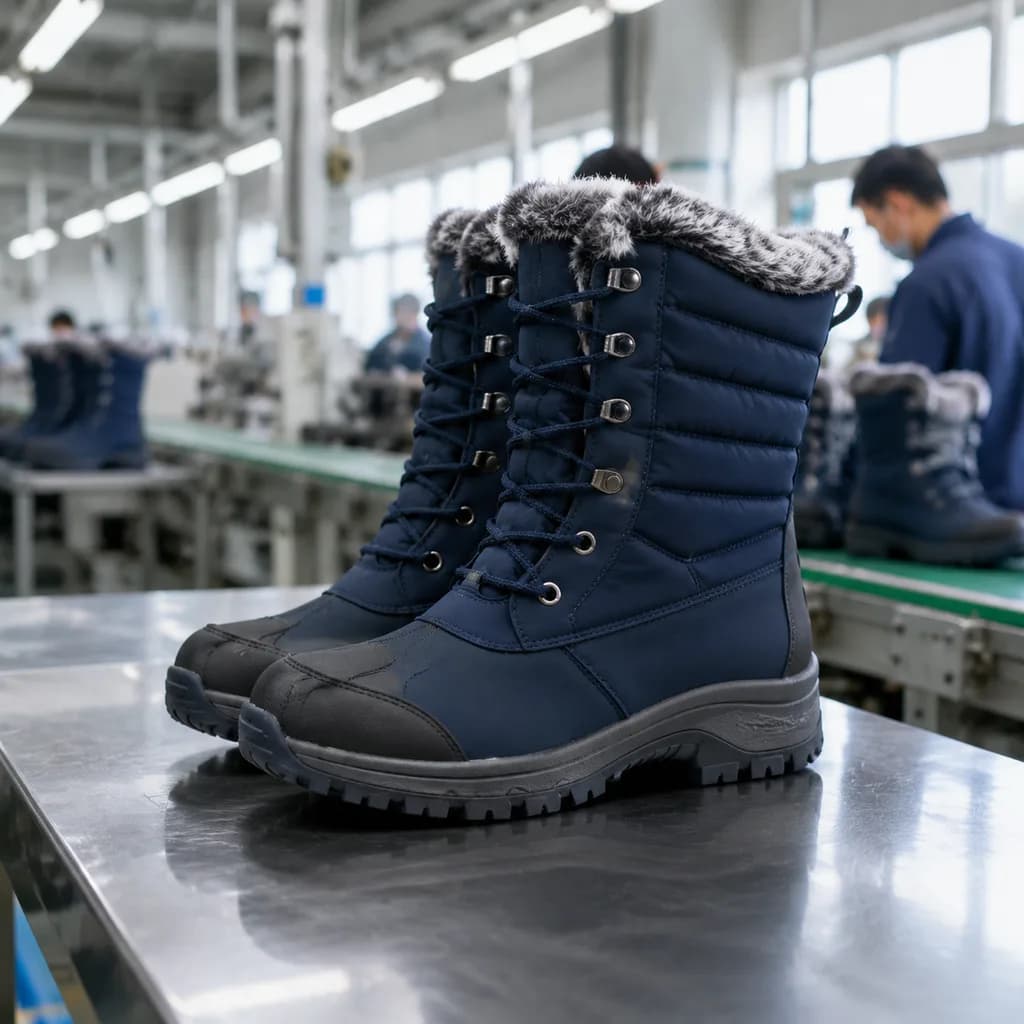
A sourcing brief for custom snow boots, helping buyers separate fixed specifications, fit-led platforms, and waterproof textile directions before quotation.
Custom snow boots can enter a sourcing conversation from more than one direction. A buyer may already have a complete specification. A retail or catalog team may be shaping a women’s winter range around fit and collection role. A product developer may be focused first on a waterproof textile upper and still need to define the finished boot around it.
Those are different starting points. Treating them as the same request can blur who owns the decisions, which details are fixed, and which questions still need review before sampling or quotation. A stronger inquiry makes that status visible early.
The SnowBootWorks excerpts support three narrow anchors for this brief. The capabilities page describes OEM manufacturing for winter boots built to the buyer’s own specification. The product catalog page describes fit-led women’s winter boot platforms for women’s retail and private-label winter collections. The materials page defines a waterproof textile upper in material terms. The decision map below is buyer-side guidance built from those separate excerpts, not a packaged list of SnowBootWorks programs.
Choose the Starting Point Before the Quote
The first sourcing question is not only what the boot should look like. It is which decisions have already been made.
A fixed specification belongs closest to an OEM manufacturing inquiry. A fit-led women’s range needs the wearer, sizing system, fit reference, and retail direction to be clear before every component is settled. A waterproof textile direction can describe the upper material, but it should not be used as shorthand for a documented finished-boot performance result unless project-specific proof exists.
Buyers can sort their brief into three groups: known, open, and non-negotiable. Known items are already decided. Open items need discussion. Non-negotiable items are buyer requirements that cannot move, such as a required sizing system, a buyer-owned quality standard, or a preferred textile upper direction. This is an editorial recommendation for preparing a clearer inquiry.
Use OEM Language Only for a Fixed Specification
SnowBootWorks describes OEM manufacturing as building winter boots to the buyer’s own specification. In that same excerpt, the buyer’s construction drives every decision. The buyer’s materials drive every decision. The buyer’s quality standards drive every decision.
That wording matters because it places the specification with the buyer. If those decisions are still being developed, the request may not be ready to present as a finished OEM package.
For a specification-led request, the buyer should make the fixed parts explicit:
- State whether the boot construction has already been defined by the buyer.
- List only the materials that are fixed in the buyer’s own specification.
- Identify any buyer quality standards that must guide the project.
- Attach or describe a technical package, drawing, product brief, or reference sample if one exists.
- Mark branding, packaging, or retail requirements as fixed only when the buyer has already made those decisions.
This checklist is a buyer organization tool. It should not be read as a separate promise about undocumented services, lead times, testing, capacity, or certification.
Fit-Led Women’s Ranges Start With the Wearer
The product catalog excerpt gives a different route into private label snow boots. It identifies fit-led women’s winter boot platforms for women’s retail and private-label winter collections. It also tells buyers to decide first on the target sizing system and fit reference.
The same excerpt names clean urban, quilted, and plush cold-weather directions. Those phrases can help a buyer describe the retail role of a women’s range. They do not support a claim about every gender, size range, boot category, or style direction.
| Buyer Decision | What to State | Source Boundary |
|---|---|---|
| Fit basis | Target sizing system and fit reference. | The catalog excerpt identifies these as first decisions for buyers. |
| Range direction | Clean urban, quilted, or plush cold-weather, when one of those directions applies. | These are the documented directions for the fit-led women’s platforms. |
| Project maturity | Whether the buyer has a product brief, a reference sample, or only a range gap. | This is buyer-side guidance for separating a platform-led inquiry from a fixed OEM specification. |
A range can be commercially clear before it is technically complete. The buyer may know the consumer, the intended retail position, and the fit reference while still needing to discuss construction or material choices. In that case, the request should say so directly instead of borrowing OEM language too early.
Keep Waterproof Textile in Material Scope
The materials excerpt defines a waterproof textile upper as a woven or laminated synthetic fabric upper, typically nylon or polyester. It says the upper is finished with a durable water-repellent coating. It also says the upper is often backed by a waterproof membrane or laminate.
The excerpt associates coated nylon upper with the waterproof textile upper direction. It separately associates water-resistant fabric upper with that direction. It also associates technical textile shell with that direction. Those terms are useful when the buyer wants to describe a textile-based upper concept.
The same excerpt describes the direction as lightweight and flexible for everyday snow boots that need to stay supple in the cold. It does not provide a waterproof rating, test method, certification, or guaranteed finished-boot performance threshold.
- Material direction
- Use documented material terms such as coated nylon upper, water-resistant fabric upper, technical textile shell, DWR coating, waterproof membrane, or laminate when describing the upper concept.
- Open construction question
- Ask which waterproof construction, lining, insulation, outsole, or related considerations may apply to the project, while keeping those topics framed as questions.
- Proof requirement
- If a standard, test method, certification, or retail compliance document matters, state it as a buyer requirement and ask whether it can be addressed for the project.
This distinction keeps material language from carrying more weight than the excerpt supports. A waterproof textile upper can be a starting direction. Finished-boot proof needs project-specific evidence.
Use Program Pages to Structure the Brief
The case studies excerpt presents a private label program framework for a waterproof winter boot. It says the format shows how a brand brief moves from reference samples to an export-ready, branded production run.
That source can help buyers understand the shape of a private-label brief. It should not be treated as a named customer case, a completed production record, or proof of volume, timeline, export lane, or waterproof performance.
One hypothetical use is enough to show the boundary: a buyer comparing reference samples for a waterproof winter boot could state which sample details they prefer, which branding elements are required, and which waterproof construction questions remain open. Use that structure to organize the inquiry, then keep quantities, timing, logistics, and performance evidence in the project record used for quotation.
Use a Compact Buyer Brief
Before asking which development, sampling, or quotation options may apply, the buyer can prepare a short brief that separates facts from questions. The goal is not to make the project look more complete than it is. The goal is to route the conversation toward the right kind of review.
| Brief Field | What to Include |
|---|---|
| Project type | State whether the inquiry is a buyer-owned OEM specification, a fit-led women’s platform direction, or a waterproof textile upper direction. |
| Fixed specification | List buyer-defined construction, materials, and quality standards only when they are already set. |
| Fit reference | For a women’s range, provide the target sizing system and fit reference. |
| Retail direction | Use clean urban, quilted, or plush cold-weather language only when it matches the intended women’s platform direction. |
| Material direction | Describe the waterproof textile upper using documented material terms, such as coated nylon, water-resistant fabric, technical textile shell, DWR coating, membrane, or laminate. |
| Proof requirements | Name any buyer-required standard, test method, certification, or compliance document as a requirement to discuss. |
| Open questions | List topics such as construction review, material alternatives, branding placement, outsole questions, sampling questions, or quotation inputs as inquiry topics unless they are already documented elsewhere in the buyer’s own brief. |
This format also helps a custom winter boots manufacturer understand what the buyer is asking for without turning questions into promises. A question about insulation, outsole, branding placement, quality control, export logistics, sampling, or quotation is still a question unless the project evidence defines it as a fixed requirement or a confirmed service scope.
Make the First Contact Specific
The first message should share the current winter footwear definition and identify which decisions are already owned by the buyer. For an OEM snow boot manufacturer inquiry, that means naming the buyer’s construction, materials, and quality standards. For a fit-led women’s private-label range, it means naming the target sizing system, fit reference, and retail direction. For a waterproof textile upper inquiry, it means using material language carefully and leaving finished-boot performance questions open until the project has proof.
A useful custom snow boots brief does not need to answer every downstream question before contact. It should show what is fixed, what is open, and what cannot move. From there, the buyer can use the quotation request page to ask which development, sampling, or quotation options may apply to the project.
Evidence layer
Evidence checklist: Custom Snow Boots: Define the Right Starting Point
OEM, ODM, and private label are not just marketing labels. The practical difference is who owns the starting design, how much the construction changes, and which decisions must be approved before bulk production. Put the decision in writing: reference style, required changes, branding locations, packaging scope, tooling assumptions, and the point at which a sample becomes the production reference. For this guide, map each supplier response to “Choose the Starting Point Before the Quote” so a claim is supported by a written specification, sample reference, controlled document, or a clearly marked open question.
A strong brief also records what is out of scope. That prevents a fast sample discussion from silently becoming a new mold, a new size run, or a new compliance requirement. Use the same approval language in the quote, sample comments, and purchase documentation. Cross-check the response against “Use OEM Language Only for a Fixed Specification” and keep every unresolved point visible in the approval record.
- Design ownership and permitted adaptations — scoped to custom snow boots
- Branding, packaging, and tooling boundaries — cross-checked against “Choose the Starting Point Before the Quote”
- Sample approval gates before bulk commitment — with open risks from “Use OEM Language Only for a Fixed Specification” recorded
Decision framework
Buyer checklist
- A custom snow boot inquiry should first define whether the buyer owns a fixed specification, is shaping a fit-led women's range, or is exploring a waterproof textile material direction.
- SnowBootWorks' documented OEM scope is tied to winter boots built to the buyer's own specification, with the buyer's construction, materials, and quality standards driving decisions.
- Fit-led women's platform inquiries should start with target sizing system, fit reference, and retail direction within the documented clean urban, quilted, and plush cold-weather scope.
- Waterproof textile upper language is useful for material selection, but it is not a substitute for project-specific finished-boot performance proof.
Sources and verification
Evidence used for this guide.
Continue the specification