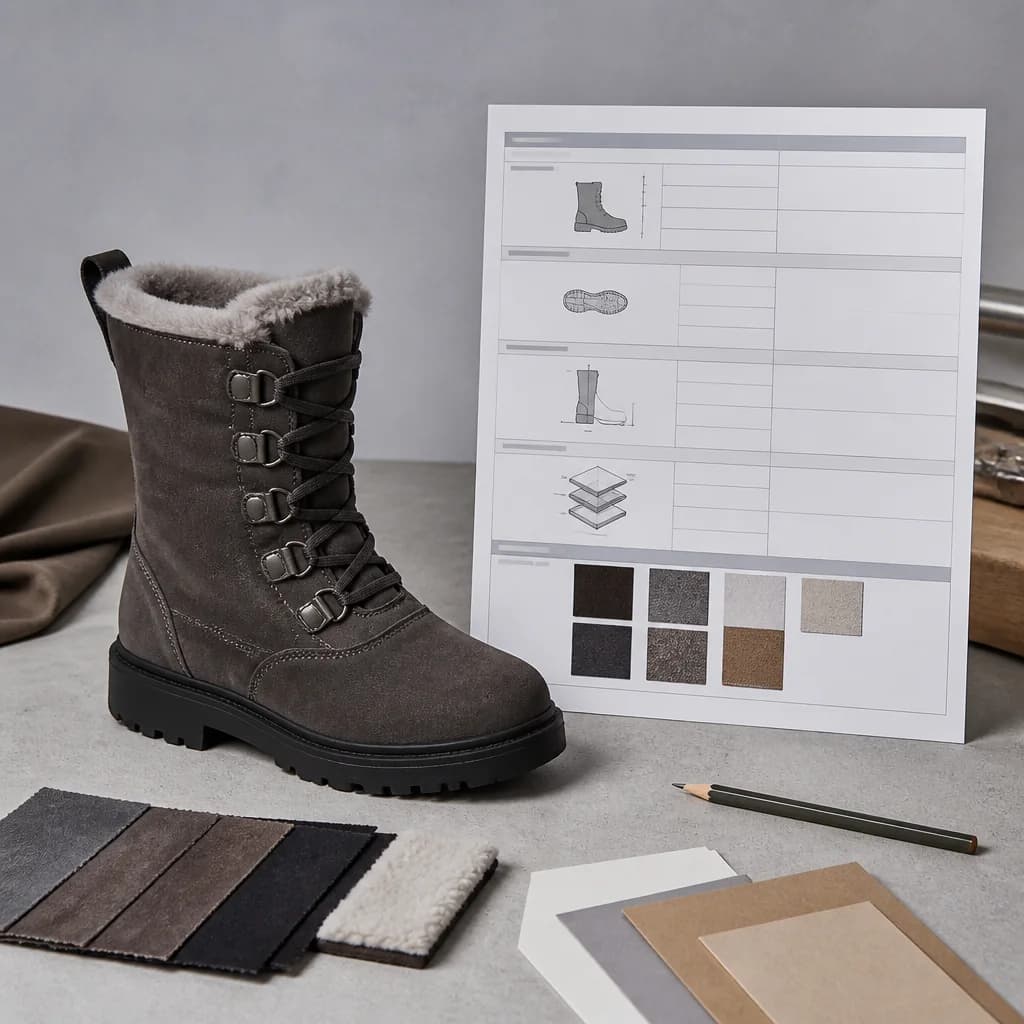
Define platform, fit, construction, materials, approval standards and evidence questions before requesting a private-label waterproof boot quotation.
When a brand asks for private label waterproof women's winter boots with only a style image and the word waterproof, quotation and development teams still lack a shared product basis. Platform, fit reference, construction requirements, material requirements, approval standard and evidence expectations remain open. Until those fields are named, waterproof is an intended product position rather than a complete buying definition. SnowBootWorks documents custom snow boot development to a buyer's specification. Its case-studies page also presents one waterproof private-label program. Neither page defines the technical meaning of waterproof for a new project, so open fields should stay visible instead of being filled by assumption.
The same gap appears when comparing wholesale waterproof women's winter boots. Two briefs can share the headline term while asking for different products, approval bases and supporting records. A requirement trace gives the buyer and prospective supplier one view of what is decided, what controls development and what still needs discussion.
What sits behind the word waterproof?
A usable request needs a product definition and an approval question. The product definition identifies the women's boot being developed, its fit reference and the buyer's construction and material requirements. The approval question identifies the standard against which the buyer expects the requirement to be reviewed and the evidence the buyer wants to discuss.
Leave technical points labeled open until they are decided. If construction is undecided, say so. If an approval standard has not been selected, record that gap. If supporting evidence is required but its availability is unknown, list the expected evidence as a question. That record is more usable than repeating waterproof across a specification with no stated basis.
Which women's platform carries the requirement?
The SnowBootWorks product catalog presents women's winter boot platforms in clean urban, quilted and plush cold-weather directions. Within that catalog context, buyers are told to decide the target sizing system and fit reference first. Those fields identify the product context in which the waterproof requirement will be considered. They do not establish waterproof performance by themselves.
- Platform direction: Name the relevant urban, quilted or plush cold-weather direction, or identify the separate product reference supplied by the buyer.
- Target sizing system: State the system the project is intended to use. Do not leave it implicit in a reference image or product name.
- Fit reference: Identify the source that should guide fit decisions, and distinguish it from references supplied for appearance, materials or weather-protection positioning.
Teams that need more detail on this dependency can review the separate guide to women's snow boot platforms. For the present inquiry, the practical task is narrower: anchor waterproof to one named product basis before discussing how the requirement might be achieved or approved.
Two development starting contexts
First-party pages support two bounded contexts. Treat them as documented starting points for the inquiry, not as a universal route map or a promise that every project follows the same sequence.
A buyer-owned specification
The SnowBootWorks capabilities page states that custom snow boots can be developed to the buyer's own specification, with construction, materials and approval standards driving decisions. In this context, the inquiry should identify which parts of the specification are mandatory, which are preferences and which still need input before they can be finalized.
The reference-sample program
The case-studies page describes one private-label waterproof winter boot program in which a brand brief moves from reference samples toward an export-ready, branded production run. That description documents one program context only. A buyer can state that reference samples are available, then ask whether and how they would apply to the proposed project rather than assuming the same sequence.
If the controlling development input is still undecided, the route brief for women's winter boots can help organize that internal decision. The waterproof trace should then record the chosen input and any limits placed on its authority.
Waterproof requirement trace
Use the matrix below to record women's winter boot waterproof requirements without inventing methods, thresholds or documents. The SnowBootWorks industries page describes outdoor retail winter footwear programs as balancing comfort, weather protection and shelf appeal. That commercial positioning still needs a project-specific definition of weather protection.
Waterproof requirement trace for a sourcing inquiry
| Field | What the buyer should record | Question if unresolved |
|---|---|---|
| Platform direction | The named women's platform direction or buyer-supplied product reference. | Which input should define the base product? |
| Target sizing system | The intended sizing system, stated independently from the style reference. | Which sizing information is needed for the project? |
| Fit reference | The item, specification or other buyer input intended to guide fit. | How should the proposed fit reference be used? |
| Weather-protection position | The exact waterproof wording the buyer intends to use and the product context it is meant to cover. | What must be resolved before that wording can be evaluated? |
| Construction requirements | Only the construction requirements already specified by the buyer. | Which construction decisions remain open for discussion? |
| Material requirements | Mandatory materials, restricted choices and preferences, kept in separate fields. | Which material points need confirmation or alternatives? |
| Approval standard | The buyer's applicable approval standard and internal approval responsibility, if already selected. | Which standard should govern the waterproof requirement? |
| Evidence request | The report, certification, inspection record or other substantiation the buyer expects, without presuming availability. | What evidence can be discussed for this project and claim? |
| Unresolved conflicts | Any disagreement among the style reference, fit reference, material preference and written specification. | Which input takes precedence for each affected field? |
The matrix records the current definition. An explicitly open field is more useful than a precise-looking entry with no agreed source. Quotation and development questions can then refer to the same version of the requirement.
What can be stated versus what must be asked
Three company-specific statements from first-party pages can enter the inquiry. Keep them separate because each has a different scope.
- Custom development context
- SnowBootWorks states that custom snow boots can be developed to the buyer's own specification, with construction, materials and approval standards as decision drivers.
- Waterproof program context
- The case-studies page presents one private-label waterproof winter boot program that moves from reference samples toward a branded production run prepared for export.
- Women's platform context
- The product catalog presents clean urban, quilted and plush cold-weather directions and identifies target sizing system and fit reference as initial buyer decisions.
Questions that remain open
Those pages do not identify test methods, performance thresholds, certifications, sample stages, inspection records or claim-substantiation documents for the proposed boot. Raise the following as inquiry topics:
- Which test method or approval threshold, if any, is relevant to the intended waterproof wording?
- What project-specific evidence can be discussed, and who would be responsible for reviewing it?
- Whether sampling-stage information is relevant and available for the proposed project.
- Which records, if any, would correspond to the buyer's stated approval standard?
Precedence when references conflict
A style reference, fit reference, written specification and material preference may not give consistent instructions. As an editorial recommendation for the buyer, assign authority at field level rather than declaring that one input controls the entire product.
- List every input being submitted and give each one a stable name or document reference.
- Assign each input to the fields it is intended to control, such as platform, fit, construction, materials or appearance.
- State the order of precedence where two inputs address the same field.
- Record conflicts that cannot yet be resolved and carry them into the inquiry as explicit questions.
This structure helps a supplier response address a named discrepancy instead of relying on an unstated interpretation. It is buyer-side recordkeeping guidance, not a documented SnowBootWorks process.
Convert the trace into a project inquiry
Reduce the completed trace to four blocks for submission:
- Product basis
- State the women's platform direction, target sizing system and fit reference.
- Development input
- Identify the buyer's own specification, available reference samples or other supplied inputs, together with their field-level authority.
- Defined waterproof scope
- List the intended wording plus the construction, material and approval requirements that have already been decided.
- Open evidence and commercial questions
- Ask about unresolved technical evidence and which development, sampling or quotation options may apply to the project.
Share that current definition through the project inquiry form. Ask SnowBootWorks which development, sampling or quotation options may apply rather than presuming a service sequence or finished-product outcome. A strong submission makes decided requirements, controlling references and unanswered questions equally visible.
Evidence layer
Evidence checklist: Scoping private label waterproof women's winter boots
OEM, ODM, and private label are not just marketing labels. The practical difference is who owns the starting design, how much the construction changes, and which decisions must be approved before bulk production. Put the decision in writing: reference style, required changes, branding locations, packaging scope, tooling assumptions, and the point at which a sample becomes the production reference. For this guide, map each supplier response to “What sits behind the word waterproof?” so a claim is supported by a written specification, sample reference, controlled document, or a clearly marked open question.
A strong brief also records what is out of scope. That prevents a fast sample discussion from silently becoming a new mold, a new size run, or a new compliance requirement. Use the same approval language in the quote, sample comments, and purchase documentation. Cross-check the response against “Which women's platform carries the requirement?” and keep every unresolved point visible in the approval record.
- Design ownership and permitted adaptations — scoped to private label waterproof women's winter boots
- Branding, packaging, and tooling boundaries — cross-checked against “What sits behind the word waterproof?”
- Sample approval gates before bulk commitment — with open risks from “Which women's platform carries the requirement?” recorded
Decision framework
Buyer checklist
- Treat waterproof as a requirement to be defined, not as a complete product specification.
- Keep platform, sizing, fit, construction, materials, approval standards and evidence expectations in separate traceable fields.
- Submit unresolved technical and commercial points as bounded questions instead of assuming a development sequence or available documentation.
Sources and verification
Evidence used for this guide.
Continue the specification