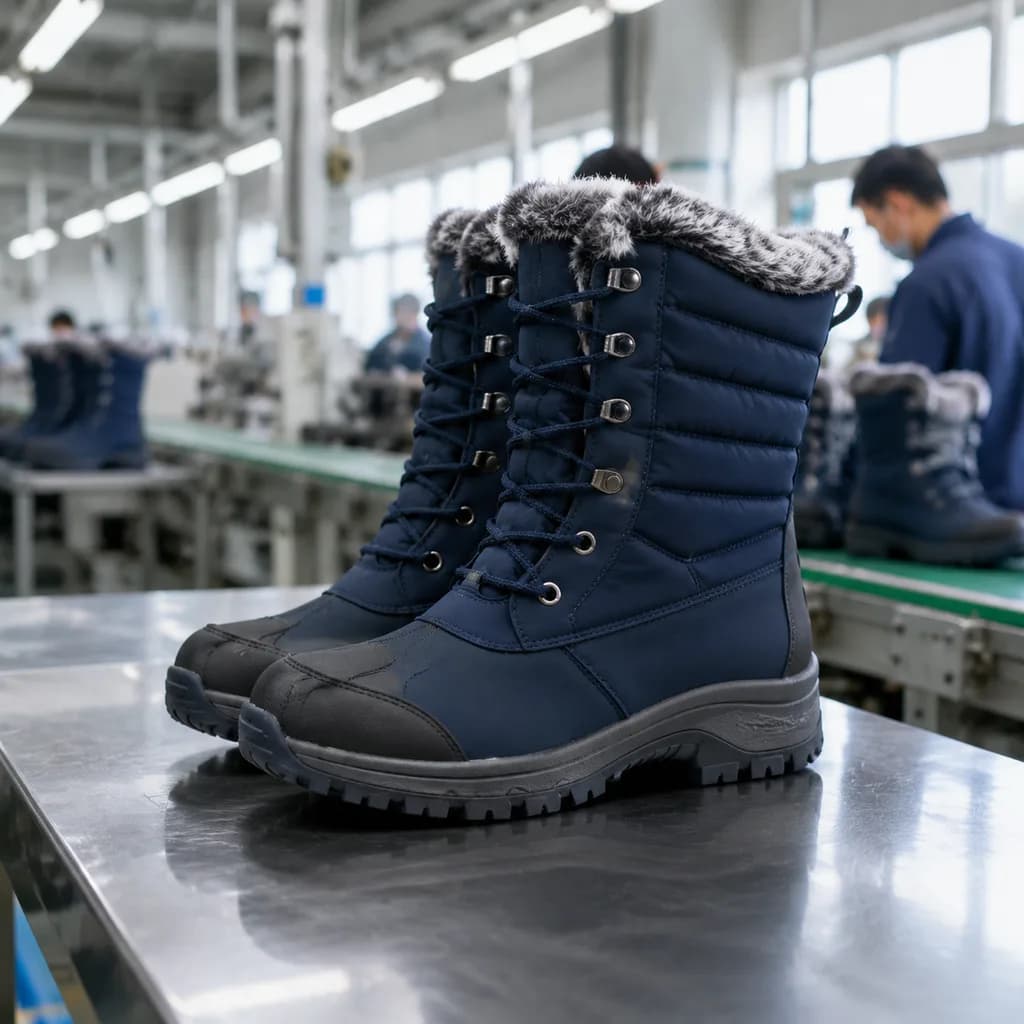
Fit lock ends sizing, not production. Own construction, materials, and approval standards on the private-label path from reference samples to export-ready runs.
Merchandising has already confirmed a sizing system and fit reference for a women's winter program. Platform direction sits inside a fit-led range. Sampling still will not advance. Construction intent, materials direction, and the standards used to release a branded run remain unnamed—and that gap freezes quotation work more often than fit itself.
Private label women's winter boots production approval is the post-fit gate those programs need. Write buyer-owned criteria before the first sample request. Outdoor-retail language can feed comfort, weather protection, and shelf-appeal checks. It should not reopen assortment planning or restyle a platform the program has already chosen.
Fit lock ends sizing—not the production handoff
On the SnowBootWorks products catalog, women's snow boots are presented as fit-led winter boot platforms spanning clean urban, quilted, and plush cold-weather directions. Buyer fit is framed for women's retail and private-label winter collections. The page directs buyers to decide first on the target sizing system and fit reference, then review a product brief.
That order stabilizes last geometry, size-run logic, and how a platform sits in a retail or private-label line. It does not complete a production handoff. Construction method, upper and insulation materials, sole and waterproofing intent, and the standards used to accept or reject samples can still be open. When those fields stay verbal, the first sampling cycle becomes discovery work instead of a controlled release against a written brief.
The stall is often organizational rather than technical. Merchandising holds a fit reference and a platform direction inside the fit-led women's range, while quality, product development, and sourcing still use different pass-fail language for construction and materials. Until those differences become named approval standards, samples cannot converge on an export-ready definition.
Construction, materials, and approval standards as buyer decision drivers
SnowBootWorks describes OEM manufacturing as developing custom snow boots to the buyer's own specification, with construction, materials, and approval standards driving every decision. For a private-label women's program, that trio belongs on the buyer side next to the locked fit reference. It is not a factory form to complete after samples arrive.
- Construction intent. State how the boot is built at decision level: upper assembly approach, waterproof path expectations, sole attachment concept, and structural features that affect fit retention or weather sealing. Keep the language architectural. Do not wait for a factory to invent the build after a vague brief.
- Materials direction. Name the material families and performance roles that matter to the brand: shell, lining, insulation approach, outsole compound family, and any hardware or trim that must follow brand rules. Direction is not a full bill of materials on day one. It is enough constraint that sampling cannot drift across incompatible families.
- Approval standards. Write the gates used to accept reference samples and later production units: visual tolerances, construction checks, materials confirmation against the brief, and branded or labeling requirements for an export-ready run. Approval standards turn retail priorities into pass or fail language reviewers can apply consistently.
Treat any open item inside that trio as a sampling risk. Open construction invites materials drift. Open materials make approval subjective. Missing approval standards let each stakeholder re-judge the same sample with a different yardstick. Women's snow boots OEM construction materials only stabilize when the brand treats both as owned inputs rather than late replies to a fit-only brief.
Private-label waterproof path: brand brief to export-ready run
SnowBootWorks presents a Waterproof Snow Boot Private Label Program overview that shows how a brand brief moves from reference samples to an export-ready, branded production run. That overview is the production-handoff model used here. It is a stage path, not a claim of quantified results or multi-program outcomes.
Read the path as three linked definitions:
- Brand brief. The brief carries the locked fit reference and sizing system, the platform direction within the women's range, construction and materials intent, and the approval standards that govern sample release.
- Reference samples. Samples prove the brief. They should not invent missing decisions. Construction, materials, and approval standards must already be explicit enough that reviewers can accept, conditional-accept, or reject against written gates.
- Export-ready branded production. Production readiness means the branded run can follow the approved reference without reopening platform, fit, construction, or materials ownership. Branding and labeling requirements belong in the approval record before bulk-release language is used.
If construction or materials still change after each sample review, the program remains in brief development rather than production approval. Separating those stages keeps OEM custom work and private-label handoff language honest. Waterproof private label winter boot sampling only becomes controlled when the brief already names the acceptance rule reviewers will apply.
Related program context sits on the case studies page. Manufacturing scope is summarized on capabilities. Catalog context for women's platforms is on products. Outdoor-retail framing is under industries.
Convert outdoor-retail priorities into acceptance rules
For outdoor retail brands, SnowBootWorks frames winter footwear programs as balancing comfort, weather protection, and shelf appeal. Those three phrases are criteria inputs for production approval. They are not a styling menu and not a performance claim set.
| Outdoor-retail priority | Buyer-owned approval criterion | What stays out of the gate until evidence exists |
|---|---|---|
| Comfort | Fit retention against the locked reference, lining hand-feel expectations, and entry or wear comfort checks the brand will run on samples | Temperature ratings, lab comfort scores, or finished-boot test outcomes not defined in the brief |
| Weather protection | Construction and materials intent for water management and cold-weather use, plus sample checks that confirm the intended path | Unsourced waterproof ratings or lab results the program has not named |
| Shelf appeal | Visual and branded presentation rules: silhouette discipline inside the chosen platform direction, color and trim rules, labeling for the export-ready branded run | Assortment expansion, ranked style picks, or a new merchandising architecture |
Comfort, weather protection, and shelf appeal help only when each becomes a named check the buyer owns. Saying weather protection matters without construction and materials intent still leaves sampling without a consistent acceptance rule. Valuing shelf appeal without visual tolerances reopens silhouette debates after fit is already locked.
Keep outdoor retail women's winter footwear priorities as criteria, not as a second assortment brief. Clean urban, quilted, and plush directions on the catalog describe platform span for fit-led women's collections. They are not ranked recommendations. Once the program has chosen its direction inside that range, do not re-shop the full span as a style contest.
What to lock before the first sample request
Before sampling starts, separate what the brand must lock from what can stay open for supplier discussion. The split below is buyer-side procurement guidance drawn from the catalog decide-first fields, the OEM decision drivers, and the private-label brand-brief-to-export path.
Lock on the buyer side
- Target sizing system and fit reference for the women's program.
- Platform direction inside the fit-led women's range, without reopening the full span as a style contest.
- Construction intent at decision level: waterproof path expectations, sole attachment concept, and structural features that affect approval.
- Materials direction by family and role, tied to the comfort, weather-protection, and shelf-appeal checks the brand will actually run.
- Named approval standards for reference samples and for release toward an export-ready branded run, covering visual, construction, materials, and branding checks.
Leave open for supplier discussion
- Detailed process choices that implement the locked construction intent without changing the architecture.
- Material grade options inside the named families, subject to the buyer's approval standards.
- Which development, sampling, or quotation options may apply once the definition is stable enough to discuss next steps.
Outdoor-retail priorities become useful only after the same reviewers rewrite them as the approval criteria applied to every sample. With that lock list in hand, the commercial step is no longer another platform review—it is a scoped inquiry against a stable definition.
Hand the definition forward for the next option set
When fit, construction, materials, and approval standards sit in one definition, share the current winter footwear definition with the manufacturing partner and ask which development, sampling, or quotation options may apply to the project. That question invites a scoped response. It does not convert inquiry topics into guaranteed services.
A clean handoff packet for private label women's winter boots production approval typically includes:
- The locked sizing system and fit reference, plus the platform direction already chosen inside the women's range.
- Construction and materials intent stated as decision drivers, aligned to the OEM specification model.
- Approval standards that turn comfort, weather protection, and shelf appeal into pass or fail checks without inventing unsourced test claims.
- A request to confirm which development, sampling, or quotation options are relevant to that definition. List any packing, carton, or minimum-order questions you still need answered as open buyer questions in the same inquiry, not as assumed factory defaults.
Keep the packet narrow. Do not expand it into a new assortment plan or a multi-route logistics promise. The private-label waterproof overview supports a brand-brief-to-reference-sample-to-export-ready path. Use that path as the production story. Use the inquiry only to learn which option set matches the definition you already own.
If the definition is ready for review, submit it through request a quote and state which development, sampling, or quotation questions remain open. Production approval after fit is a buyer-owned gate. Sampling and quotation work move faster when that gate is named before the first sample leaves the brief stage.
Evidence layer
Evidence checklist: Private Label Women's Winter Boots Production Approval After Fit
OEM, ODM, and private label are not just marketing labels. The practical difference is who owns the starting design, how much the construction changes, and which decisions must be approved before bulk production. Put the decision in writing: reference style, required changes, branding locations, packaging scope, tooling assumptions, and the point at which a sample becomes the production reference. For this guide, map each supplier response to “Fit lock ends sizing—not the production handoff” so a claim is supported by a written specification, sample reference, controlled document, or a clearly marked open question.
A strong brief also records what is out of scope. That prevents a fast sample discussion from silently becoming a new mold, a new size run, or a new compliance requirement. Use the same approval language in the quote, sample comments, and purchase documentation. Cross-check the response against “Construction, materials, and approval standards as buyer decision drivers” and keep every unresolved point visible in the approval record.
- Design ownership and permitted adaptations — scoped to private label women's winter boots production approval
- Branding, packaging, and tooling boundaries — cross-checked against “Fit lock ends sizing—not the production handoff”
- Sample approval gates before bulk commitment — with open risks from “Construction, materials, and approval standards as buyer decision drivers” recorded
Decision framework
Buyer checklist
- Fit lock on sizing system and fit reference stabilizes the women's platform; it does not complete production approval.
- Construction, materials, and named approval standards should be buyer-owned decision drivers before sampling starts.
- Comfort, weather protection, and shelf appeal are useful only when rewritten as approval criteria, not as assortment or performance claims.
- Use the private-label waterproof path (brand brief to reference samples to export-ready branded production) as the production-handoff model.
- Share a stable definition and ask which development, sampling, or quotation options may apply, without treating those topics as guaranteed services.
Sources and verification
Evidence used for this guide.
Continue the specification
Move from research to a controlled brief.
Frequently asked questions
Questions buyers ask next
What still blocks production after a women's winter boot fit reference is locked?
Construction intent, materials direction, and named approval standards. Without those buyer-owned gates, sampling cannot converge on an export-ready branded definition even when sizing and fit are stable.
How should outdoor-retail priorities enter a private-label approval brief?
Translate comfort, weather protection, and shelf appeal into pass or fail checks tied to construction, materials, and visual or branding rules. Do not use them to reopen platform styling or to invent unsourced performance ratings.
What should a buyer request after the winter footwear definition is stable?
Share the locked definition and ask which development, sampling, or quotation options may apply to the project. That invitation scopes commercial discussion; it does not document a service promise by itself.