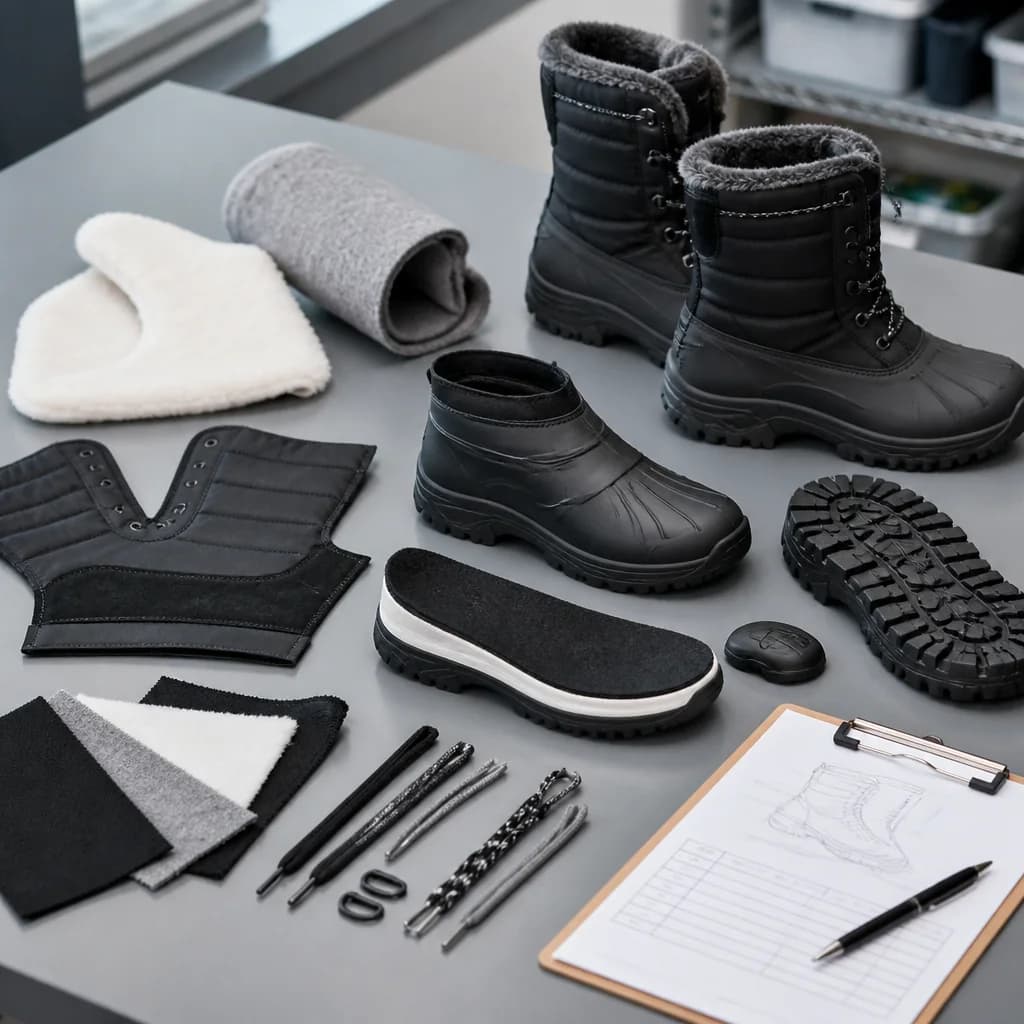
Specify custom women's snow boots construction materials, approval standards, and fit platforms before style lock so OEM and private-label sampling stays controlled.
Wholesale women's winter boots programs often stall when fashion language is ready and the build layer is not. Silhouettes, color stories, and collection names can fill a deck while upper assembly, sole attachment, lining bulk, and weather-facing material choices stay open. For custom women's snow boots construction materials work, those open fields block controlled sampling. Construction method, material stack, and the standards used to approve or reject samples make a quote and a sample path readable. Style follows once that path is set. Until then, quotes stay provisional and sample loops expand without a clear stop rule.
Where women's wholesale briefs stall before sampling
The failure mode is practical. A brand team may know the retail look it wants for private-label winter collections and still leave the manufacturer without a buildable request. On the product catalog side, women's programs are framed around fashion and fit for retail and private-label winter collections, with an explicit first decision on target sizing system and fit reference. That framing only works when construction and materials receive the same seriousness as last and size run.
Without those fields, sampling becomes negotiation by photograph. A factory can interpret "quilted winter boot" several ways. Each interpretation changes shaft bulk, entry ease, insulation thickness, and how a waterproof or water-resistant upper is built. Approval then turns subjective. As an editorial recommendation for the buyer, treat construction, materials, and approval standards as the primary brief rather than items to confirm after a style deck is already labeled final.
OEM decision drivers: construction, materials, approval standards
SnowBootWorks describes OEM manufacturing for custom snow boots as development to the buyer's own specification, with construction, materials, and approval standards driving every decision. That order of work applies cleanly to women's programs. Construction answers how the boot is assembled: upper structure, closure, sole attachment approach, lining strategy. Materials answer what each layer is and how those layers interact for bulk, flexibility, and weather exposure. Approval standards answer which sample attributes are pass or fail, and who signs off.
- Construction. Name structural intent before decorative detail: shaft height band, collar and entry design, whether the upper is intended as a clean urban shell, a quilted cold-weather build, or a plush direction, and how the outsole and midsole stack should support that shape.
- Materials. List candidate upper faces, membranes or coatings if weather protection is required, lining type and thickness intent, insulation approach if used, and sole compound or tread family at a decision level, not as a lab claim.
- Approval standards. Define fit reference, visual tolerances, and the sample stages that can lock a change versus those that only refine it. Keep standards tied to the specification the buyer owns.
These three fields belong on the first inquiry when reviewing an OEM manufacturing capability page, not after styling is treated as finished. If a field is still open, state that fact and name who will close it. Ambiguity invites redesign during sampling.
Fit-led women's platforms as construction constraints
The products page presents fit-led women's winter boot platforms spanning clean urban, quilted, and plush cold-weather directions, and it asks buyers to decide first on target sizing system and fit reference. For women's winter boot fit platforms wholesale, treat those directions as construction constraints on bulk and entry, not as a style ranking. The table below is an editorial recommendation for the buyer: it maps common platform language to build questions the source does not spell out as fixed catalog rules.
| Platform direction | Buyer-side build questions to resolve early | Brief note to lock early |
|---|---|---|
| Clean urban | How much visual bulk is acceptable? How tight should last, upper, and sole profile stay? | Entry method, shaft taper, and lining bulk that still preserves the silhouette |
| Quilted | How will panel layout and stitch mass interact with padding under the outer face? | Quilt density intent, cold-weather layer stack, and whether weather protection sits in membrane, coating, or construction detail |
| Plush cold-weather | Where does collar volume and lining hand-feel trade against entry and walk-off comfort? | Plush coverage zones, sizing-system impact of thicker linings, and outsole grip expectation for winter retail use |
A sizing system and fit reference decided first keep platform choices honest. A plush collar that looks correct on a flat sketch can push the foot out of a size run if the last and lining stack were never aligned. Attach one fit reference (size system, sample size, and any width intent) before debating trim color. Platform language then filters bulk and entry instead of becoming a separate merchandising essay.
Outdoor retail filters on comfort, weather, and shelf appeal
For outdoor retail brands, SnowBootWorks frames winter footwear programs as balancing comfort, weather protection, and shelf appeal. In outdoor retail women's snow boots sourcing, use that balance as a materials and construction filter set rather than as a channel marketing brief.
As an editorial recommendation for the buyer, map comfort to lining hand-feel, collar pressure, flex points, and weight of the sole package. Map weather protection to how the upper is built and finished for wet or cold exposure, without inventing a rating the brief has not yet required. Map shelf appeal to silhouette clarity, material surface, and whether construction details read as intentional at retail distance. When one filter dominates without the others, programs drift: a weather-heavy stack can look bulkier than the urban line planned; a shelf-first upper can under-deliver on entry comfort after wear review by the buyer's own team.
Apply the three filters to each construction choice on the industries outdoor retail path. If weather protection is non-negotiable for a women's line, say which parts of the boot must carry it. If shelf appeal depends on a clean shaft, limit lining bulk and quilting mass early. If comfort is the retail promise, protect flex zones and collar design in the approval standard so sampling cannot trade them away.
Private-label waterproof path versus full custom OEM
Buyers often mix two different request languages in one email. One path is private-label waterproof programming. The case studies page describes a waterproof snow boot private label program as a brand brief that moves from reference samples to an export-ready, branded production run. For private label waterproof women's snow boots, that is a defined route: reference samples first, then branded export-ready production. It does not, by itself, promise a custom engineering exercise from a blank sheet.
The other path is full OEM custom. Capabilities language positions OEM as development to the buyer's own specification, with construction, materials, and approval standards driving decisions. That route expects the buyer to own more of the specification up front: how the boot is built, which materials are in scope, and what "approved" means.
Choose one primary route before sampling starts. A private-label waterproof request that still asks for open-ended construction redesign confuses ownership. An OEM request that only sends a photo and a brand logo stalls for the opposite reason. If the brief is to match a reference and brand it, use private-label waterproof program language and keep changes inside that reference frame. If the brief is to build to a written specification, use OEM language and bring construction, materials, and approval standards as the lead package. Review the case studies overview only as a route illustration for the private-label waterproof program described there, not as a template for every women's style.
Construction-first checklist before any style lock
Use this sequence so the inquiry is manufacturer-readable. Each line is a buyer decision, not a claim about a fixed factory package.
- Route. Private-label waterproof path from reference samples to export-ready branded run, or full OEM to the buyer's own specification.
- Construction intent. Shaft and entry concept, sole attachment approach, and whether the platform leans clean urban, quilted, or plush cold-weather.
- Materials stack. Outer face family, weather-facing treatment intent if any, lining and insulation bulk intent, sole and tread family at decision level.
- Approval standards. What must pass on the first controlled sample, what may iterate, and who signs visual, fit, and construction checks.
- Fit reference. Target sizing system, sample size, and any width or volume notes tied to women's retail or private-label collections.
- Channel balance. How comfort, weather protection, and shelf appeal rank for the first season assortment.
- Open points. Fields still undecided, with an owner and a date, so sampling does not invent defaults.
Only after those items are stable should the team lock decorative trims, full color architecture, and campaign photography language. Style work remains important; it simply stops competing with build control.
Share the winter footwear definition and request applicable options
A construction-led brief is ready for conversation when a manufacturer can see the route, the build decisions, and the approval logic without guessing. Share the current winter footwear definition for the women's program: platform direction, construction and materials intent, fit reference, and how outdoor retail balance (if relevant) ranks comfort, weather protection, and shelf appeal. Then ask which development, sampling, or quotation options may apply to that project. A buyer may also ask which sampling, packing, or quotation information applies; treat those as project-specific questions rather than as a pre-documented service list.
Start from the construction layer, keep private-label waterproof and full OEM languages separate, and use fit platforms as constraints on bulk and entry. That order turns fashion language into a controlled sample path instead of an open redesign. When the package is ready, request a quote with the construction-first definition attached so the next step stays scoped to the decisions already made.
Evidence layer
Evidence checklist: Specify Custom Women's Snow Boots Construction Materials First
OEM, ODM, and private label are not just marketing labels. The practical difference is who owns the starting design, how much the construction changes, and which decisions must be approved before bulk production. Put the decision in writing: reference style, required changes, branding locations, packaging scope, tooling assumptions, and the point at which a sample becomes the production reference. For this guide, map each supplier response to “Where women's wholesale briefs stall before sampling” so a claim is supported by a written specification, sample reference, controlled document, or a clearly marked open question.
A strong brief also records what is out of scope. That prevents a fast sample discussion from silently becoming a new mold, a new size run, or a new compliance requirement. Use the same approval language in the quote, sample comments, and purchase documentation. Cross-check the response against “OEM decision drivers: construction, materials, approval standards” and keep every unresolved point visible in the approval record.
- Design ownership and permitted adaptations — scoped to custom women's snow boots construction materials
- Branding, packaging, and tooling boundaries — cross-checked against “Where women's wholesale briefs stall before sampling”
- Sample approval gates before bulk commitment — with open risks from “OEM decision drivers: construction, materials, approval standards” recorded
Decision framework
Buyer checklist
- Lock construction, materials, and approval standards before fashion language so women's snow boot sampling stays controlled.
- Use clean urban, quilted, and plush platform directions as build constraints on bulk and entry, after the sizing system and fit reference are set.
- Apply outdoor retail balance (comfort, weather protection, shelf appeal) as a filter on materials and construction, not as a separate merchandising brief.
- Choose either a private-label waterproof reference-to-export-ready route or full OEM to the buyer's own specification; do not mix both languages in one request.
- Share the construction-led definition and ask which development, sampling, or quotation options may apply to the project.
Sources and verification
Evidence used for this guide.
Continue the specification
Move from research to a controlled brief.
Frequently asked questions
Questions buyers ask next
What belongs in a construction-first brief for custom women's snow boots?
Name the route (private-label waterproof or full OEM), construction intent, materials stack at decision level, approval standards, fit reference (sizing system and sample size), and how comfort, weather protection, and shelf appeal rank for the channel. Leave decorative style details secondary until those fields are stable.
How do fit-led women's platforms affect materials choices?
Clean urban, quilted, and plush cold-weather directions constrain bulk, entry, lining volume, and how weather-facing layers sit under the outer face. Decide the target sizing system and fit reference first so platform choice does not fight the last and size run.
When is private-label waterproof language appropriate instead of full OEM?
Use private-label waterproof program language when the work is framed as moving a brand brief from reference samples to an export-ready, branded production run. Use OEM language when the buyer owns a written specification and wants construction, materials, and approval standards to drive development.