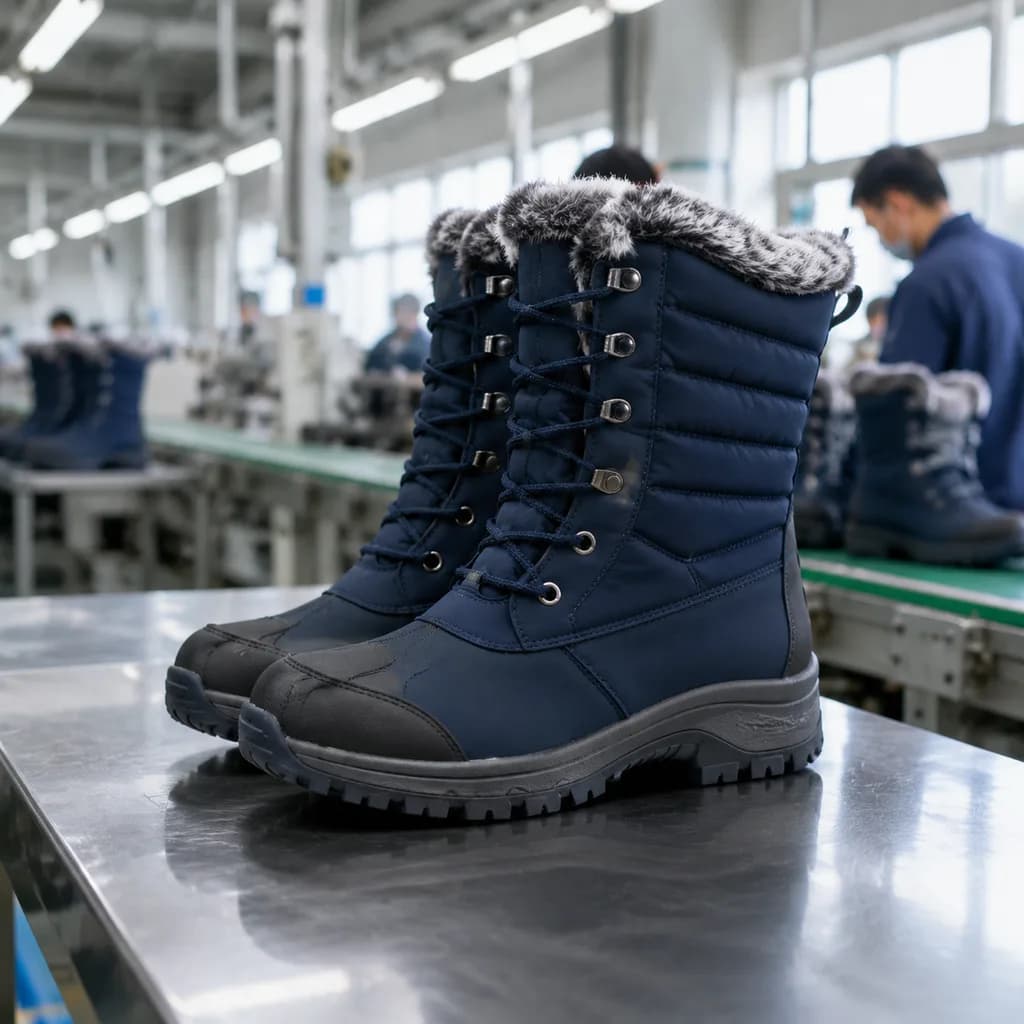
Turn reference samples into a buyer-owned decision register covering construction, materials, fit, approval questions, and project-specific inquiries.
Use a wholesale winter boots approval brief as a decision register for the current product definition. The first page should show what the buyer has decided, what remains open, which reference supports each point, and who can close it. In that format, a boot sample, photograph, swatch, or sketch serves a named decision instead of becoming an attachment that every reviewer must interpret independently.
The structure below is an editorial recommendation for buyers preparing an inquiry. SnowBootWorks provides narrower first-party context on its capabilities page: custom snow boots are developed to the buyer's own specification. The page separately names construction, materials, and approval standards as decision drivers. Our recommendation is to give those subjects dedicated fields and leave unanswered workflow or commercial topics in an open-inquiry column.
The decision register comes first
The opening page should let a reviewer find the current answer to each important product question without searching through emails or image folders. We recommend starting with the following fields.
- Project and version
- Record the current product name or code, brief version, and revision date. This identifies which definition is under review.
- Collection role
- State the intended assortment role and sales channel. Keep this commercial direction separate from the technical and visual references supplied later in the brief.
- Construction direction
- List the construction points the buyer intends to hold and the questions that remain open. Identify any feature that a supplied sample is not intended to define.
- Material direction
- Record material requirements separately from appearance preferences. If a material point is still open, write the decision that the buyer needs to make.
- Fit basis
- Name the target sizing system and fit reference where they apply. Include enough identification to distinguish the selected reference from other samples or versions.
- Decision status
- Mark each point as fixed, open, or not applicable. Apply the status to an individual decision rather than to the brief as a whole.
- Buyer-side owner
- Identify the person or role that can close each open point. This keeps an inquiry response separate from the buyer's own approval authority.
- Project inquiry
- Reserve a field for development, sampling, quotation, minimum-order, packing, and other questions that require a response for the current project.
This layout keeps product definition and supplier inquiry in the same record without presenting an unanswered question as an approved requirement.
Who can close each open point?
A page-level label such as “approved” can hide unresolved details. To avoid that ambiguity, we recommend recording ownership and status beside each decision. A construction point might be fixed while a material selection remains open, even though both appear on the same page.
- Name the decision in terms that can receive a clear answer.
- Record the buyer's current proposed answer, if one exists.
- Identify the buyer-side decision holder.
- Mark the point as fixed, open, or not applicable for the current version.
- Add the next question only when further project information is required.
Use a named role or responsible contact rather than a general department whenever possible. The purpose is to show who can resolve an open point, not to imply that a supplier approves the product on the buyer's behalf.
Reference roles and boundaries
A practical winter boot reference sample brief uses one row per asset and assigns one primary role to that row. A sample may inform several discussions, but each use should be tied to a specific decision. This prevents a visible design cue from being treated as an instruction about unrelated fit, material, or construction points.
Recommended buyer-side reference register
| Reference | Assigned role | Decision informed | Recorded boundary |
|---|---|---|---|
| Reference boot | Visual direction | Named silhouette, proportion, or visible detail | List the visible features being referenced. Do not use the boot as an automatic definition of unseen construction or materials. |
| Fit reference | Fit comparison point | Target sizing system and selected basis for comparison | Identify the reference by source or version so that it cannot be confused with another sample. |
| Detail photograph | Construction or finishing cue | One named component or visible detail | Mark the detail as a requirement, preference, or open question. |
| Material swatch or image | Material direction | A recorded appearance or material characteristic | Limit the instruction to the attributes written in the brief. |
| Brand artwork | Branding reference | A named placement, treatment, or identity question | State which point is current and which details still need buyer review. |
If one asset genuinely informs two decisions, create two entries and state a separate boundary for each. The reference register can then show exactly why a feature appears in the current definition.
Approval language that produces an answer
Broad descriptions such as “premium,” “durable,” or “retail-ready” may express direction, but they do not identify what the buyer intends to review. Our editorial recommendation is to convert that language into project questions with a defined decision owner.
- Construction: Which construction points belong to the current definition, and which remain open for project-specific discussion?
- Materials: Which material characteristics are requirements, which are preferences, and which changes would need buyer review?
- Fit: What target sizing system applies, and which fit reference is the selected comparison point?
- Branding: Which branding details are part of the current definition, and which still await a buyer decision?
- Change control: What proposed change would return the item to the buyer-side decision holder?
- Commercial and export topics: Which minimum-order, packing, destination, documentation, timing, or quotation questions need a project-specific answer?
Each question belongs beside its current status. This gives reviewers a direct view of what can be accepted now and what must remain open during the inquiry.
Fit has its own field
The SnowBootWorks product catalog describes fit-led women's winter boot platforms. It identifies women's retail and private-label winter collections as the buyer fit. Within that scope, the catalog says to decide the target sizing system and fit reference first.
For the buyer's record, we recommend displaying those two decisions near the front of the brief. Add the source or version of the fit reference, the current status, the buyer-side owner, and any question that remains unresolved. Keep visual references in their own fields so a silhouette or material direction is not treated as the sizing definition.
Documented context and open inquiries
Website statements can supply context for the discussion, but project terms still need to be requested against the current definition. The following separation keeps each documented statement within its source scope.
First-party context compared with buyer inquiry topics
| Documented context | Question for the current project |
|---|---|
| The capabilities page says custom snow boots are developed to the buyer's own specification. | Which development or quotation options may apply to the submitted definition, and what additional information is needed to discuss them? |
| The capabilities page names construction, materials, and approval standards as decision drivers. | Which of those decisions are sufficiently defined in the current brief, and which need a further buyer response? |
| The women's product catalog says to decide the target sizing system and fit reference first for the documented women's retail and private-label collection context. | Does the current record identify both fields and the exact reference being used? |
| One program overview describes a private-label waterproof winter boot program moving from reference samples and a brand brief to an export-ready branded production run. | Which development, sampling, minimum-order, packing, and quotation information applies to this project? Request those answers for the present definition rather than deriving them from the program overview. |
The project handoff
For a focused winter footwear development inquiry, send the current brief as the controlling record and keep supporting files connected to its reference register. Before submitting it, check for:
- A current project name or code, version date, and buyer-side contact.
- A concise statement of the collection role and intended sales channel.
- Separate construction and material fields with fixed and open points identified.
- The target sizing system and fit reference where applicable.
- A reference register assigning a role and boundary to every supplied asset.
- Answerable approval questions with a buyer-side owner and current status.
- A direct request to identify which development, sampling, or quotation options may apply.
- Minimum-order, packing, documentation, timing, and delivery topics written only as project questions awaiting confirmation.
Limits of the supplied information
The cited first-party excerpts provide limited context for this buying task. They do not state the following project terms:
- Commercial terms: project-specific minimum order quantities, prices, lead times, or production capacity.
- Workflow: fixed sample stages, a standard approval sequence, or responsibility for buyer approval.
- Verification: inspection procedures, test methods, performance ratings, or certifications.
- Logistics: packing terms, export responsibility, destinations, or delivery commitments.
Keep those items in the open-inquiry portion of the record until they receive a response for the current project. Share the current winter footwear definition through the project inquiry form and ask which development, sampling, or quotation options may apply.
Evidence layer
Evidence checklist: Use a wholesale winter boots approval brief as a decision register
OEM, ODM, and private label are not just marketing labels. The practical difference is who owns the starting design, how much the construction changes, and which decisions must be approved before bulk production. Put the decision in writing: reference style, required changes, branding locations, packaging scope, tooling assumptions, and the point at which a sample becomes the production reference. For this guide, map each supplier response to “The decision register comes first” so a claim is supported by a written specification, sample reference, controlled document, or a clearly marked open question.
A strong brief also records what is out of scope. That prevents a fast sample discussion from silently becoming a new mold, a new size run, or a new compliance requirement. Use the same approval language in the quote, sample comments, and purchase documentation. Cross-check the response against “Who can close each open point?” and keep every unresolved point visible in the approval record.
- Design ownership and permitted adaptations — scoped to wholesale winter boots approval brief
- Branding, packaging, and tooling boundaries — cross-checked against “The decision register comes first”
- Sample approval gates before bulk commitment — with open risks from “Who can close each open point?” recorded
Decision framework
Buyer checklist
- Use the approval brief as a versioned decision register rather than an attachment list.
- Assign each reference a specific role, decision, and boundary.
- Keep the target sizing system and fit reference visible for the documented women's retail and private-label collection context.
- Treat development, sampling, minimum-order, packing, and quotation details as project questions until they are confirmed for the current definition.
Sources and verification
Evidence used for this guide.
Continue the specification