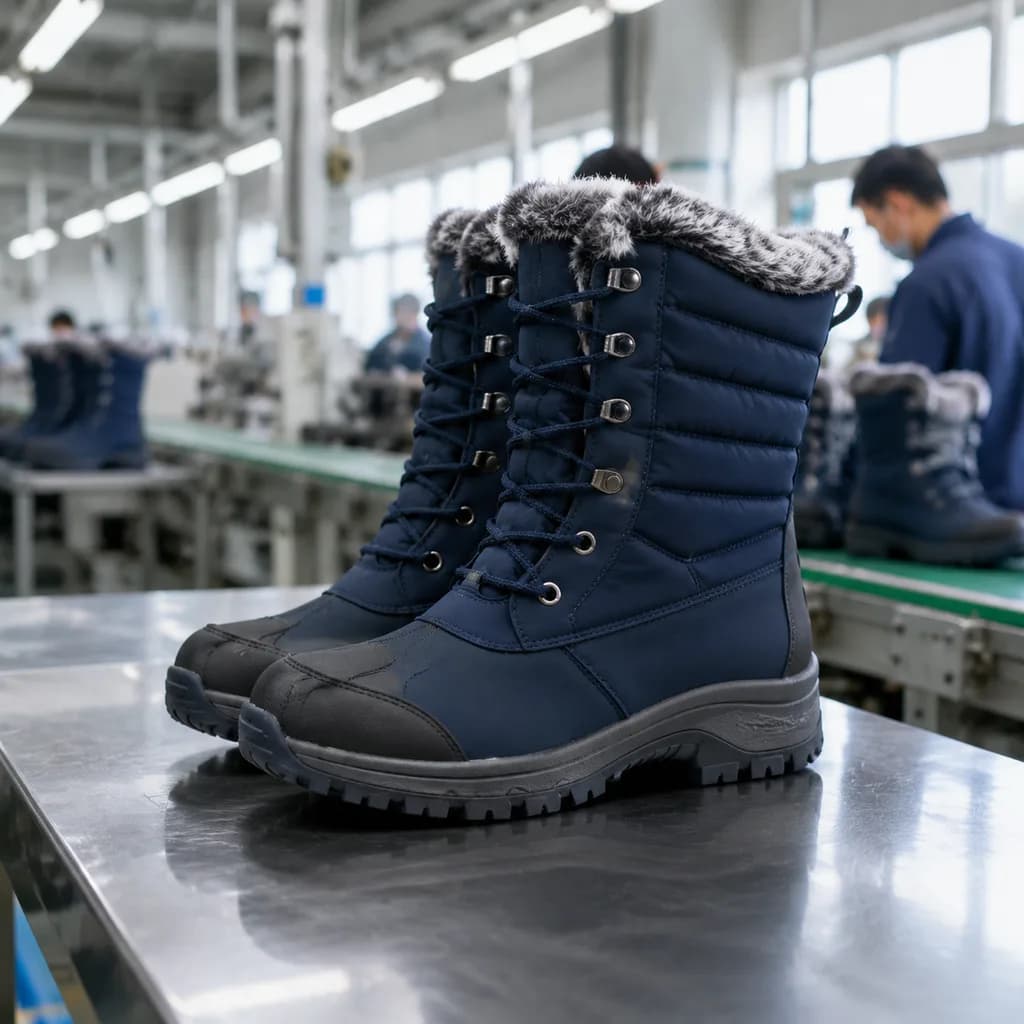
Build a wholesale winter boots development brief that locks sizing, fit reference, construction, materials, and approvals before OEM or private-label sampling.
A wholesale winter boots development brief is the control document that should exist before style boards, price bands, or sample requests. Brands, importers, catalog teams, and product developers often ask for samples while sizing, fit reference, construction path, materials choices, and sign-off rules are still open. The first round then tests a guess instead of a program. This playbook sequences those decisions for snow boot OEM manufacturing and private-label work, using only SnowBootWorks scope for custom OEM specification, private-label program paths, outdoor retail needs, and fit-led women's platforms.
Incomplete definitions waste the first sampling cycle
The usual stall is definitional, not conversational. Teams freeze colors, outsole looks, and retail price targets while lasts, volume, entry method, weather-protection intent, and approval rules remain undecided. When those items stay open, the first sample becomes a debate about what the product should have been.
SnowBootWorks frames OEM manufacturing as developing custom snow boots to the buyer's own specification, with construction, materials, and approval standards driving every decision. That only holds when those three drivers live in one brief before assortment styling or supplier price comparison. Treat the brief as seasonal timing protection: a late definition makes every later round late, no matter how quickly a trial pair can be cut.
Private-label work carries the same risk in another form. A documented private label winter boot program shows a brand brief moving from reference samples to an export-ready, branded production run. Without a clear starting definition, reference samples turn into mood boards instead of controlled checkpoints.
Lock sizing system and winter boot fit reference first
For women's retail and private-label winter collections, SnowBootWorks presents fit-led platforms and asks buyers to decide first on the target sizing system and fit reference, then review the product brief. That order is the practical first decision gate for any wholesale winter program, not only women's lines. Last geometry, ball girth, instep volume, shaft height, and entry method should be named before a style shortlist hardens around a photo that cannot be produced on the last you need.
As an editorial recommendation for the buyer, lock these items in writing before visual assortment work:
- Name the market sizing system you will sell against and the size range you expect to open with.
- Attach one winter boot fit reference: a current commercial pair, a last code you own, graded measurements, or a written fit intent. One controlled reference beats a stack of loosely related competitor photos.
- State toe shape, shaft height band, and entry (lace, zipper, or hybrid) as platform decisions, not late styling notes.
- Only then map visual directions onto the locked platform. Fit-led women's directions on the product catalog span clean urban, quilted, and plush cold-weather directions; treat those as examples of how platform language can sit after fit is fixed.
Product developers who reverse this sequence often find a preferred upper look will not sit on the volume or entry method the retail customer base expects. Fit first reduces reverse-engineering cost. Review fit-led women's directions on the product catalog only after sizing and fit reference language is written down.
Build construction and materials from outdoor retail use
SnowBootWorks describes outdoor retail brands as needing winter footwear programs that balance comfort, weather protection, and shelf appeal. Translate those three retail needs into OEM decisions you own. Do not invent lab methods, insulation grades, or finished-boot ratings the brief does not control.
| Retail need | Specify in the brief | Leave open until your team owns the evidence |
|---|---|---|
| Comfort | Fit reference, cushioning intent, shaft comfort, lining hand-feel targets | Any insulation grade or comfort claim without a defined test path |
| Weather protection | Where water-resistance or waterproof intent sits (upper, membrane, seam, bootie), snow-contact zones, collar or gaiter expectations | Named test methods, pass/fail numbers, or certifications your compliance team has not selected |
| Shelf appeal | Silhouette family, material hand, color story, branding zones, packaging direction | Assortment width beyond platforms you can approve this season |
Under OEM manufacturing, construction and materials sit beside approval standards as decision drivers. Write them as buyer-owned choices: construction routes you will accept, textile versus leather or hybrid uppers, lining type, outsole compound direction, and hardware finish rules. Keep each choice scoped to what you will approve. Outdoor retail language about balance is a program design target for your brief, not a tested result.
Industry context for outdoor retail programs is summarized on the industries page. Align merchandising language with the technical section of the brief, then let construction and materials carry the load in sampling.
Define approval standards before samples arrive
When approval standards live only in email threads after sample arrival, teams evaluate samples against shifting criteria. SnowBootWorks OEM language puts approval standards on equal footing with construction and materials. Put them in the brief from the first shared draft.
As an editorial recommendation for the buyer, include at least the following process items so sampling checks the program you intend to produce:
- Who signs fit, materials, construction, and final pre-production (roles or names, not an unnamed team).
- Which sample stages you expect and what each stage is allowed to change.
- Measurement tolerances on critical points tied to the fit reference.
- Visual standards for shade variation, stitching quality, logo placement, and packaging checks.
- What fails a sample outright versus what triggers a controlled revision.
- How comments are recorded so late verbal notes cannot override the brief.
If your compliance group will require third-party tests later, name that as a planned gate in the brief rather than discovering it after tooling or bulk material commits. Manufacturer responsibility remains developing custom snow boots to the specification and approval standards you supply; the list above is buyer-side process design, not an expansion of that scope.
Capability detail for OEM scope sits on the manufacturing capabilities page. Read it as the ceiling for how construction, materials, and approval language can drive decisions, then keep your brief inside that ceiling.
Map OEM and private-label stages after the product is defined
SnowBootWorks documents a private label waterproof winter boot program as a path in which a brand brief moves from reference samples to an export-ready, branded production run. Mirror that sequence in your wholesale winter boots development brief so internal stakeholders share one program map.
As an editorial recommendation, structure the buyer-side brief around the documented overview below. These steps organize your program language; they do not add factory stages beyond the case-study path.
- Brand brief. Fit reference, sizing system, construction and materials intent, approval standards, branding zones, and target channels.
- Reference samples. Controlled checks against the brief. Each round should close specific open items listed in the approval section.
- Branded and packaging confirmation. Logos, labels, hangtags, and packaging validated against the same standards that govern the boot. Record those checks in the brief so branding does not arrive as an afterthought.
- Export-ready production run. Packing, marking, and shipment language aligned with the importer or retailer's inbound rules, still driven by the locked specification.
Use the case-study framing as sequence discipline: brief first, then reference samples, then branded and export-ready stages. It is a program overview, not a promise of timeline, volume, or waterproof performance for your SKU. Program language is available under case studies for teams that need a shared internal reference.
If the project is pure OEM rather than private label, keep the same early discipline. The difference is branding ownership and when packaging decisions enter, not whether fit and construction should be locked before sampling.
What to send for development, sampling, or quotation
When the brief is ready enough to share, package a current winter footwear definition and state which development, sampling, or quotation options may apply to the project. Do not treat sampling, packing, or quotation topics as fixed service menus unless your counterpart confirms them for your program. Ask which options apply. Do not assume commercial quantities, MOQs, or lead times that are not already documented for your account.
A practical request package often includes:
- One-page program summary: channel (outdoor retail, wholesale, private label, or mixed), gender or platform family, and season.
- Target sizing system and fit reference attachments.
- Construction and materials intent, written as decisions you own, with open questions clearly marked.
- Approval standards and sample-stage plan.
- Branding and packaging direction if private label applies.
- Assortment sketch limited to platforms already covered by the fit and construction gates.
- A short list of questions: which development path fits, which sampling stages are relevant, and what quotation inputs are still required from your side.
That package keeps style and price comparison downstream of definition. It also gives engineering and commercial contacts one document instead of a chain of fragmented notes. For teams ready to share a definition, use the request a quote path and include the brief sections above so the conversation starts on fit, construction, materials, and approvals rather than on an undefined assortment board.
A wholesale winter boots development brief succeeds when the first sample can fail or pass against rules written before the sample existed. Keep the document short enough that every stakeholder can read it, and strict enough that late comments cannot silently rewrite construction, materials, or fit. Sequence beats speed: sizing and fit reference, then outdoor-use construction and materials, then approval standards, then OEM or private-label stage mapping, then a clean development or quotation request. That order is the procurement control most winter programs skip, and the one that protects the season when they do not.
Evidence layer
Evidence checklist: Wholesale Winter Boots Development Brief: Fit Before Quotes
OEM, ODM, and private label are not just marketing labels. The practical difference is who owns the starting design, how much the construction changes, and which decisions must be approved before bulk production. Put the decision in writing: reference style, required changes, branding locations, packaging scope, tooling assumptions, and the point at which a sample becomes the production reference. For this guide, map each supplier response to “Incomplete definitions waste the first sampling cycle” so a claim is supported by a written specification, sample reference, controlled document, or a clearly marked open question.
A strong brief also records what is out of scope. That prevents a fast sample discussion from silently becoming a new mold, a new size run, or a new compliance requirement. Use the same approval language in the quote, sample comments, and purchase documentation. Cross-check the response against “Lock sizing system and winter boot fit reference first” and keep every unresolved point visible in the approval record.
- Design ownership and permitted adaptations — scoped to wholesale winter boots development brief
- Branding, packaging, and tooling boundaries — cross-checked against “Incomplete definitions waste the first sampling cycle”
- Sample approval gates before bulk commitment — with open risks from “Lock sizing system and winter boot fit reference first” recorded
Decision framework
Buyer checklist
- Write sizing system and fit reference before style shortlists so lasts and entry are not reverse-engineered from photos.
- Translate outdoor retail needs (comfort, weather protection, shelf appeal) into construction and materials choices you own, without inventing test claims.
- Put approval standards and sample-stage rules in the brief so sampling evaluates a locked program.
- Mirror private-label sequence discipline as buyer brief structure: brand brief, reference samples, branded confirmation, export-ready run.
- Share a current winter footwear definition and ask which development, sampling, or quotation options apply; do not invent MOQs or lead times.
Sources and verification
Evidence used for this guide.
Continue the specification
Move from research to a controlled brief.
Frequently asked questions
Questions buyers ask next
What should be locked before requesting wholesale winter boot samples?
At minimum: target sizing system, fit reference, construction and materials intent, and approval standards with clear sign-off roles. Style boards and price bands should follow those gates so the first sample checks a defined program.
How does a private-label winter boot program sequence differ from pure OEM in the brief?
Both need the same early definition of fit, construction, materials, and approvals. Private label additionally tracks branding and packaging through reference samples into an export-ready branded production run; pure OEM may keep branding ownership and packaging timing different while still locking the product specification first.
What belongs in a development or quotation request package?
A one-page program summary, sizing and fit reference, construction and materials intent with open questions marked, approval and sample-stage plan, branding direction if private label applies, a limited assortment sketch, and questions about which development, sampling, or quotation options apply to the project.