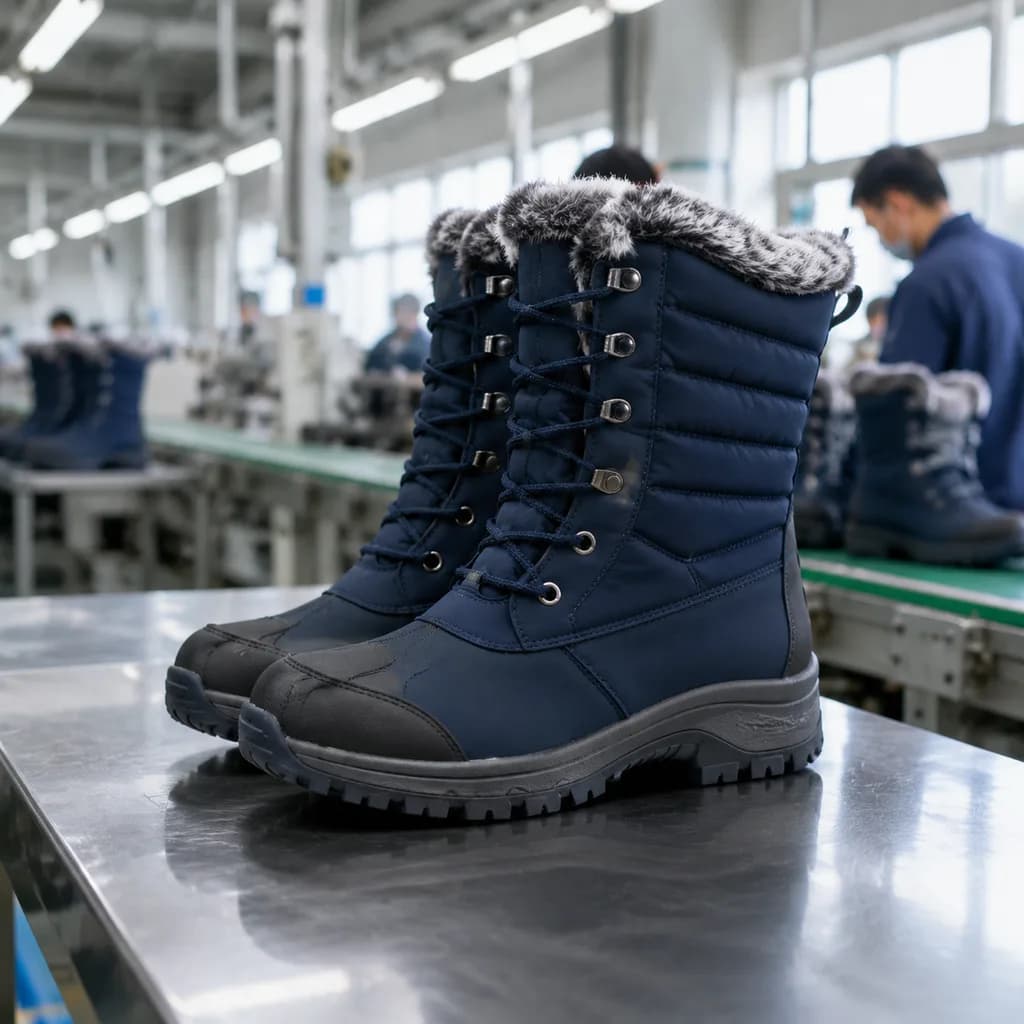
Choose a private label women's snow boot fit reference, record the sizing decision, and prepare a focused supplier inquiry.
When a private-label program already has a visual direction for a women's winter boot, the private label women's snow boot fit reference is often still open. That gap leaves the brief open to interpretation before development, sampling, or quotation conversations begin. The SnowBootWorks product catalog is direct on sequence: decide the target sizing system and fit reference first, then review the product brief.
Style direction alone does not answer which sizing system the buyer intends to use or which reference should anchor the fit discussion. Naming those choices early gives the team a tighter starting point without treating the catalog entry as a finished fit definition for the project.
The fit reference is a separate buying decision
SnowBootWorks describes fit-led women's winter boot platforms for women's retail and private-label winter collections. Within that entry, the catalog lists clean urban, quilted, and plush cold-weather directions. Those names identify platform directions. They do not select a sizing system or name a fit reference for a particular buyer.
Treat the fit reference as its own decision: which reference the buyer wants associated with the named platform. Record the target sizing system separately so the way sizes are identified is not inferred from a familiar boot or an internal style name. Inside the buyer's own process, it also helps to note who may select the reference, who can change its status, and who needs the current record. That keeps a current choice distinct from an unresolved internal question before the product brief is reviewed.
Name the platform before attaching the reference
A fit reference is easier to discuss when it is tied to a stated platform direction. If the buyer is considering the catalog's clean urban direction, record that direction beside the reference. Keep a quilted direction's reference record separate. Apply the same discipline to a plush cold-weather direction.
No measurements, grading rules, or tolerances are required at this stage. The practical recommendation for the buyer is simply to associate each reference with one named platform and state its current decision status—current choice, option under review, or awaiting an internal decision.
| Decision record | What the buyer can state | Why it remains separate |
|---|---|---|
| Women's boot platform | The catalog direction or the buyer's internal platform name. | It identifies the product direction to which the other records belong. |
| Target sizing system | The women's winter boot sizing system selected for the named platform, or that the decision remains open. | It records the buyer's sizing designation decision. |
| Fit reference | The reference selected or being considered for the named platform, along with its status. | It records the buyer's chosen anchor for the fit discussion. |
| Open points | Questions that require an internal decision or a supplier discussion. | They remain visible instead of being presented as settled specifications. |
This table is a decision aid for a private label snow boot product brief. It captures association and status only. It does not establish a size run, conversion method, measurement set, tolerance, grading approach, or final fit result.
Carry the fit decision into the product brief
The capabilities page describes SnowBootWorks as developing custom snow boots to a buyer's own specification. Construction, materials, and approval standards drive every decision. That statement identifies broader decision drivers. It does not describe project-specific fit methods.
One practical way to place the fit decision in the product brief is to give it a short, defined entry alongside the rest of the buyer's current information:
- Platform
- State the intended women's boot direction so the reference has a clear product context.
- Target sizing system
- Record the buyer's selected sizing system in its own entry.
- Fit reference
- Identify the reference clearly enough for the buyer's team to distinguish it from other references.
- Decision status
- Show whether the reference is current, under review, or awaiting an internal decision.
- Discussion points
- List questions for the next conversation without presenting unanswered items as finished specifications.
Keeping these items together helps the buyer show what has been decided without suggesting that one reference settles the rest of the custom boot definition. Construction, materials, and approval standards remain separate decision areas in the capabilities description.
Use reference samples within the stated scope
The SnowBootWorks case-studies page describes a private-label waterproof winter boot program in which a brand brief moves from reference samples to an export-ready, branded production run. That establishes the role of reference samples in the program overview.
The overview does not say how a particular sample was evaluated, changed, approved, or tested. A buyer can still label a sample's role in the internal record—for example, whether it is the current fit-reference candidate for the named platform or one of several references under review. When the sample leaves a question unanswered, keep that question as an open point for the next discussion. That limited use connects the sample to the actual decision at hand. It avoids treating a reference sample as a complete definition of the platform, target sizing system, construction, materials, or approval standards.
Questions for an initial inquiry
Once the buyer has named the platform, target sizing system, fit reference, and open points, the current definition can be shared through the request-a-quote page. The inquiry can ask for clarification without assuming which options are available for the project.
- Is the current winter footwear definition sufficient to begin a discussion of the named platform, target sizing system, and fit reference?
- Which development or sampling options may apply after the current definition is reviewed?
- Which additional project details may be needed before a quotation discussion is useful?
- Which fit-reference questions should the buyer resolve internally before expanding the wider product brief?
These remain project questions for a women's snow boot sampling inquiry, not stated service promises or commercial terms. The product catalog supplies the fit-led platform context. The capabilities page supplies the custom-specification context. The case-studies page supplies the bounded reference-sample context. Together they give the buyer a concise basis for asking what may apply to the current project.
Scope of the current record
The available material supports one immediate sequence: decide the target sizing system and fit reference before reviewing the product brief. It does not provide measurements, sizing conventions, size ranges, conversion guidance, grading rules, fit tolerances, testing methods, sample timing, manufacturing locations, commercial quantities, pricing, or final fit outcomes. It also does not establish which development, sampling, or quotation options apply to an individual project.
The next buyer action is straightforward. Share the named platform, target sizing system, fit-reference identity, and unresolved questions through the inquiry form. Ask which current options may apply to that winter footwear definition. The useful first exchange is one where the fit decision is stated clearly and the remaining decisions stay visible.
Evidence layer
Evidence checklist: Private label women's snow boot fit reference
OEM, ODM, and private label are not just marketing labels. The practical difference is who owns the starting design, how much the construction changes, and which decisions must be approved before bulk production. Put the decision in writing: reference style, required changes, branding locations, packaging scope, tooling assumptions, and the point at which a sample becomes the production reference. For this guide, map each supplier response to “The fit reference is a separate buying decision” so a claim is supported by a written specification, sample reference, controlled document, or a clearly marked open question.
A strong brief also records what is out of scope. That prevents a fast sample discussion from silently becoming a new mold, a new size run, or a new compliance requirement. Use the same approval language in the quote, sample comments, and purchase documentation. Cross-check the response against “Name the platform before attaching the reference” and keep every unresolved point visible in the approval record.
- Design ownership and permitted adaptations — scoped to private label women's snow boot fit reference
- Branding, packaging, and tooling boundaries — cross-checked against “The fit reference is a separate buying decision”
- Sample approval gates before bulk commitment — with open risks from “Name the platform before attaching the reference” recorded
Decision framework
Buyer checklist
- Decide the target sizing system and fit reference before reviewing the product brief.
- Record the platform, sizing-system decision, fit reference, and open points as separate entries.
- Use the inquiry to share the current definition and ask which project-specific development, sampling, or quotation options may apply.
Sources and verification
Evidence used for this guide.
Continue the specification