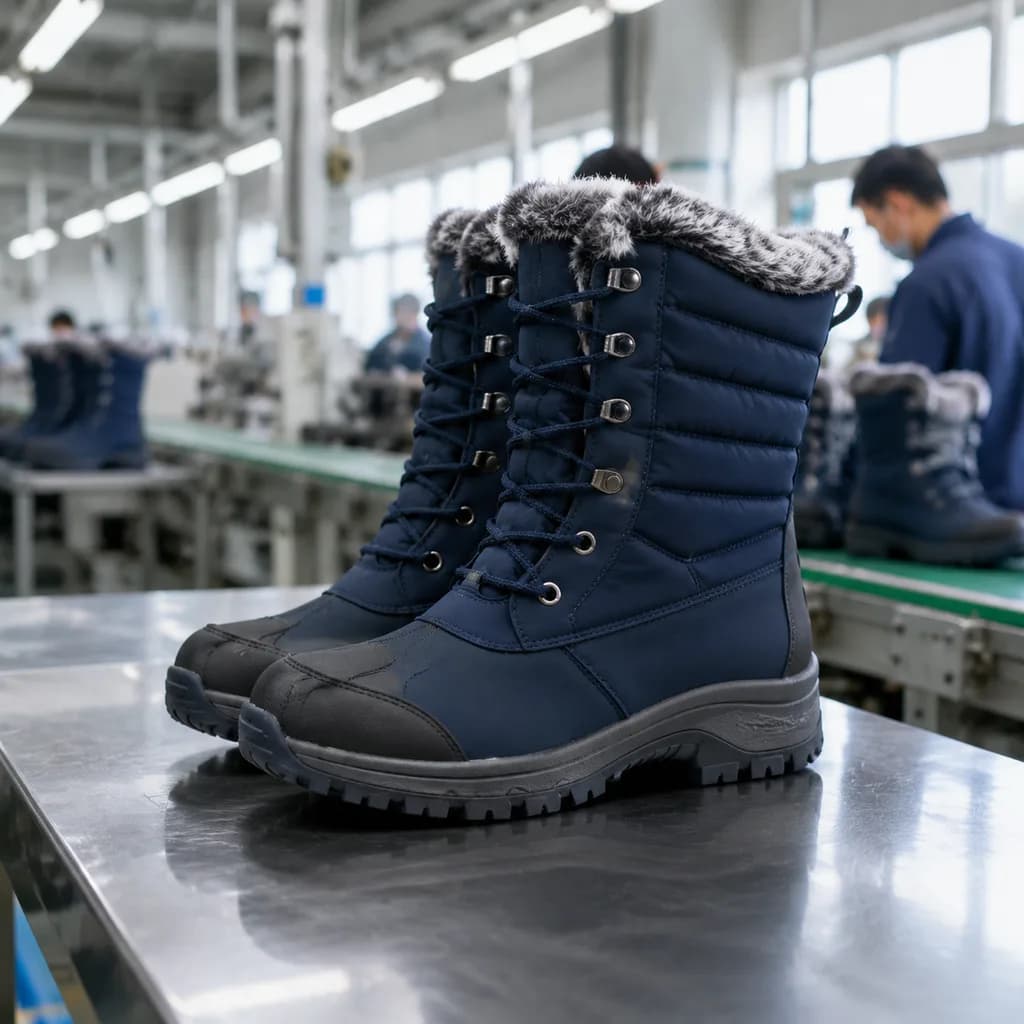
Map private label waterproof snow boots from brand brief and reference samples to an export-ready branded run. Decision order for outdoor retail buyers.
Private label waterproof snow boots stall when waterproof is treated as a merchandising claim instead of a controlled program. Brands, outdoor retailers, and catalog teams need a clear order of decisions: what the brand brief settles first, which reference samples control construction and materials, and how approval standards close the loop before branding and export handoff.
Lab methods, membrane systems, seam treatments, and commercial quantities stay open until your team locks a current winter footwear definition and asks which development, sampling, or quotation options apply. The path below is decision order only—what to settle, in which sequence, so construction does not fight a frozen sample.
Private-label waterproof is a program definition, not a feature line
On the case studies page, SnowBootWorks presents a private label waterproof winter boot program showing how a brand brief moves from reference samples to an export-ready, branded production run. That framing is the practical buying problem. Waterproof is not a free-floating construction request you can append after silhouette, consumer use, and branding are already frozen. It is the program type that sets the order of decisions.
When buyers treat waterproof only as a claim, reference samples often freeze the wrong last, shaft height, or intended use. Construction then has to fight the sample rather than serve the brief. Work the path as a handoff sequence: brief first, role-labeled samples second, construction and materials third, approval standards as the gate, and branded export production as the end state you can quote against.
What the brand brief must settle before reference samples take over
The private-label path above assumes a brand brief exists before samples become control objects. The brief is buyer-owned. The published program overview does not supply a fixed template, MOQ, or timeline. As an editorial recommendation for the buyer, settle the items below before samples start to drive construction and materials:
- Consumer use and retail channel: cold-weather outdoor retail, urban winter, catalog, or mixed assortment, stated in plain language rather than as a claim alone.
- Silhouette and coverage intent: shaft height, closure type, and whether the boot is built primarily for snow contact, wet pavement, or mixed conditions.
- Brand identity on the product: logo placement rules, label language, hangtag role, and whether private-label branding must appear on packaging as well as the boot.
- Weather-protection priority relative to comfort and shelf appeal, so outdoor retail tradeoffs are ranked before samples lock a look that cannot carry the protection story.
- Approval authority: who signs construction, materials, and pre-production samples, and which sample roles are binding versus directional.
- Items your team will keep open for later: test method, membrane or coating approach, insulation package, and commercial quantity, unless internal compliance has already set those boundaries.
If those items stay vague, reference samples become inspiration boards. A waterproof private-label path needs samples to become control objects, not mood boards.
Reference samples as the control object for construction and materials
The case-study program overview ties the brand brief to reference samples, then to an export-ready branded run. Once the brief is clear, reference samples are the shared control for construction and materials. Label every sample by role so the factory and your product team are not arguing about different objects under one vague name.
- Mark fit or last references separately from waterproof or weather-protection references. A sample that solves volume and walkability is not automatically the control for upper construction.
- Mark construction or materials references as the objects that construction and materials decisions will follow. If a sample is only for color or trim direction, say so on the sample tag and in the brief.
- Mark branding and packaging references separately from performance construction so logo placement and hangtags do not silently redefine the waterproof build.
- Record what each sample is allowed to freeze and what it must not freeze. A buyer may keep insulation, outsole compound, or test protocol open while still locking shaft shape and upper stack direction.
Role labeling is a buyer discipline. It keeps one attractive sample from becoming an accidental full specification.
Construction, materials, and approval standards as the three decision drivers
With sample roles written down, the next filter is how the build will be decided. SnowBootWorks describes OEM manufacturing for custom snow boots developed to the buyer's own specification, with construction, materials, and approval standards driving every decision. That language maps onto the private-label waterproof path after the brief and reference samples are clear. It does not, by itself, document a membrane brand, a seam method, or a finished-boot test result.
Use the three drivers as a decision filter:
- Construction: How the upper, bottom unit, and weather-protection stack will be built relative to the role-labeled references. Keep construction language tied to the sample roles you already defined.
- Materials: Which material classes are in scope for the upper, lining, insulation package, and outsole, and which remain open pending supplier options or your compliance list.
- Approval standards: What must be true for a sample to pass, who signs, and which later changes reopen construction or materials. Without written approval standards, waterproof remains a claim rather than a controlled build.
Any waterproof performance claim without a documented test method or acceptance criterion is out of scope here and should stay out of the quotation package until your team supplies that boundary. For custom waterproof snow boots OEM work, keep construction, materials, and approval standards as the only decision drivers that quote requests can follow. Review the published capabilities language when you want that OEM framing in one place, then bring your locked brief rather than a feature list.
When outdoor retail priorities fight each other inside one brief
For outdoor retail brands, SnowBootWorks describes winter footwear programs that balance comfort, weather protection, and shelf appeal. In a waterproof winter boot private label program, those three priorities often compete inside the same brief. If you do not rank them, the sample that looks strongest on shelf can quietly defeat weather protection, or a heavy protection stack can defeat wear comfort and return rates.
| Priority | What it usually protects | What it can over-weight if left unranked |
|---|---|---|
| Comfort | Wear time, fit perception, return risk on first wear | Soft hand-feel or lighter builds that weaken weather-protection intent |
| Weather protection | The waterproof private-label story and wet-condition use | Stiffer construction, heavier materials, or cost that hurts shelf appeal |
| Shelf appeal | Color, proportion, branding visibility, catalog photography | A look-first sample that freezes construction before protection is defined |
Rank the three in the brand brief before reference samples freeze silhouette and materials direction. The industries page states the balance for outdoor retail; it does not assign a fixed ranking. That ranking is a buyer decision. One practical pattern is to name a primary and a secondary priority, then state the third as constrained rather than free—for example, weather protection primary, comfort secondary, shelf appeal constrained by the first two. Write the ranking where construction and materials teams can see it.
What export-ready branded production means at handoff
In the published private-label waterproof program overview, the end state is an export-ready, branded production run that follows from the brand brief and reference samples. That is the only end-state language this article uses. It does not invent logistics steps, packing lists, lead times, or document sets.
For the buyer handoff, export-ready branded production means the following are locked enough to support a production conversation:
- Brand brief items that define use, silhouette intent, branding rules, and priority ranking among comfort, weather protection, and shelf appeal.
- Role-labeled reference samples that control construction and materials without freezing open commercial or test questions by accident.
- Construction, materials, and approval standards written so a production sample can pass or fail without reopening the entire brief.
- Branding intent clear enough that the production run can carry private-label marks without a late redesign of upper or packaging surfaces.
Sampling path, MOQ discussion, packing detail, and quotation scope depend on your project. Raise them as questions; they are not fixed service promises here. When your current winter footwear definition is ready, share it and ask which development, sampling, or quotation options may apply to the project. Keep the request tied to the brief, the sample roles, and the three decision drivers so the conversation stays on export-ready branded winter boots rather than on an undefined waterproof claim.
Evidence layer
Evidence checklist: Private Label Waterproof Snow Boots: Brief to Export
OEM, ODM, and private label are not just marketing labels. The practical difference is who owns the starting design, how much the construction changes, and which decisions must be approved before bulk production. Put the decision in writing: reference style, required changes, branding locations, packaging scope, tooling assumptions, and the point at which a sample becomes the production reference. For this guide, map each supplier response to “Private-label waterproof is a program definition, not a feature line” so a claim is supported by a written specification, sample reference, controlled document, or a clearly marked open question.
A strong brief also records what is out of scope. That prevents a fast sample discussion from silently becoming a new mold, a new size run, or a new compliance requirement. Use the same approval language in the quote, sample comments, and purchase documentation. Cross-check the response against “What the brand brief must settle before reference samples take over” and keep every unresolved point visible in the approval record.
- Design ownership and permitted adaptations — scoped to private label waterproof snow boots
- Branding, packaging, and tooling boundaries — cross-checked against “Private-label waterproof is a program definition, not a feature line”
- Sample approval gates before bulk commitment — with open risks from “What the brand brief must settle before reference samples take over” recorded
Decision framework
Buyer checklist
- Treat private label waterproof snow boots as a brief-to-export program path, not a merchandising feature line.
- Lock buyer-owned brief items before reference samples freeze silhouette, use, or branding intent.
- Label reference samples by role so construction and materials have a clear control object.
- Drive decisions with construction, materials, and approval standards; leave undocumented waterproof test claims out of scope.
- Rank comfort, weather protection, and shelf appeal so outdoor retail priorities do not fight inside one brief.
Sources and verification
Evidence used for this guide.
Continue the specification
Move from research to a controlled brief.
Frequently asked questions
Questions buyers ask next
What should a brand brief cover before waterproof private-label samples are shared?
Define consumer use and channel, silhouette and coverage intent, branding rules, the ranking among comfort, weather protection, and shelf appeal, and who holds approval authority. Leave test methods and commercial quantities open unless your team has already set them.
When is a private-label waterproof program ready for an export-oriented production conversation?
When the brief, role-labeled reference samples, and construction, materials, and approval standards are locked enough to support branded production without reopening the whole definition. Then ask which development, sampling, or quotation options apply to that definition.