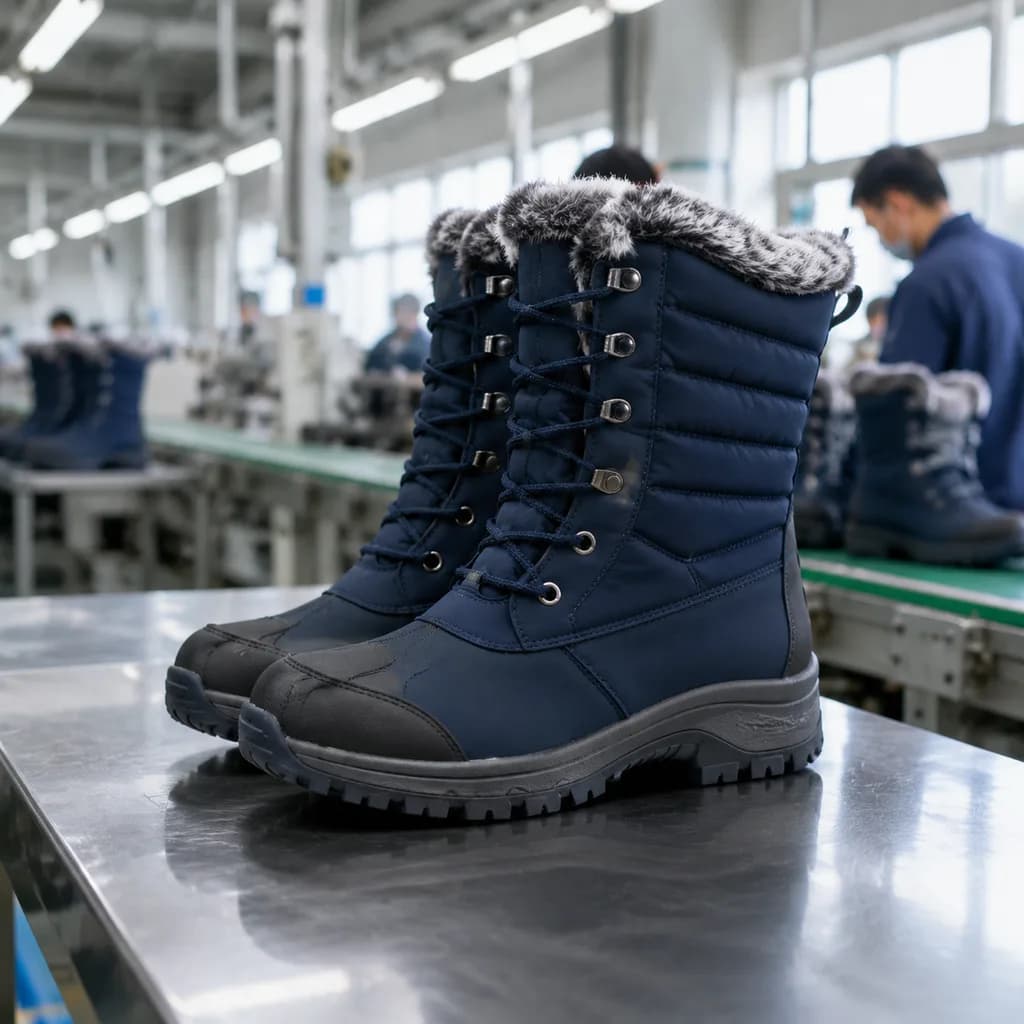
Build a wholesale snow boots sample approval brief: map observed details, required outcomes, open choices, and approval criteria before sampling.
Teams often ship a physical boot to a manufacturer and treat that object as the full request. The sample is useful, but it is incomplete. A wholesale snow boots sample approval brief is the written decision record that states what must match the reference, which commercial outcomes are required, which construction and material choices remain open, and which acceptance rules the buyer owns. Without that record, two factories can interpret the same boot differently and return samples that look related only until review day.
SnowBootWorks frames OEM custom snow boot manufacturing as development to the buyer’s own specification, with construction, materials, and approval standards driving every decision. A private-label waterproof program overview shows a brand brief moving from reference samples to an export-ready, branded production run. Neither page documents a fixed sampling sequence, timing, cost, or lab pass/fail slate. This article is buyer-side editorial guidance: how to convert a reference into a brief those drivers can actually use.
When a reference boot stops being enough
A reference can show silhouette, proportion, visible hardware, color family, and handfeel under your review lighting. It cannot, on its own, lock last direction, bottom construction, membrane strategy, insulation level, sizing system, brand marks, packaging rules, or the criteria that accept or reject a sample. If stakeholders only say “make it like this,” those gaps move onto whoever quotes or samples first.
Keep the physical sample in the file as evidence of commercial intent. Then write a snow boot reference sample specification as the governing document: the object feeds observations; the brief states requirements, open decisions, and acceptance rules. Editorial recommendation for the buyer: treat every “like this” comment as a prompt to fill fields a manufacturer can act on, not as a finished engineering package.
What buyers own before anyone quotes
A clean brief separates decisions you can define now from questions you will ask later. Construction direction, material direction, brand requirements, and OEM winter boot approval criteria belong in the first group when your team can name them. Development path, sampling path, and quotation path belong in the second group as options that may apply to the project, not as a fixed service menu already settled by this article.
| Define now (buyer-owned) | Ask later (project inquiry) |
|---|---|
| Which commercial priorities this style family must win first | Which development options may apply to this definition |
| Reference identification and what the reference is allowed to govern | Which sampling options may apply, and on what commercial terms for this project |
| Construction outcomes and open construction decisions | How quotation options should be structured for locked versus open items |
| Material direction with careful modality (typically, often, or required) | Whether a named material stack is available for the stated end use |
| Target sizing system and fit reference when women’s retail or private-label collections apply | How size runs, grading, or sample size sets would be handled if those topics become relevant |
| Brand marks, packaging, and export-ready branded-run criteria you require | Logistics, packing, MOQ, price, and lead-time information for the actual project |
| Acceptance criteria and sign-off roles | Revision loops, sample stages, or documentation formats proposed after the brief is read |
The case-study overview’s waterproof private-label program is useful end-state language: a brand brief moving from reference samples to an export-ready, branded production run. Use that path as program path, not as proof of a standard logistics service level or a universal order pattern. Specification-driven OEM context sits on the capabilities page; program context sits on the case studies page.
Styling cues versus construction requirements
Styling cues travel easily from a reference: shaft height impression, toe shape, logo placement, stitch contrast, outsole visual mass. Construction choices often do not. Because custom OEM work is driven by construction, materials, and approval standards under the buyer’s specification, separate those layers on the page.
- List styling cues as observations only. Note silhouette family, trim, color blocking, and hardware look without treating them as engineering instructions.
- Name construction topics that must be decided or deliberately left open. Typical buyer-owned topics include upper build approach, seam and closure strategy, bottom attachment intent, insulation direction, and weight priorities. Do not invent a method the manufacturer must use unless your team owns that requirement.
- State required outcomes for each construction topic. Editorial examples: “primary weather-use priority for wet-cold urban use” or “collar comfort for all-day wear under trousers.” Keep outcomes commercial unless your compliance team already mandates named methods.
- Attach the acceptance rule. Who signs, against which reference, and what fails review. If weather-related acceptance is required, say who owns the method and what documentation you expect. This article does not document a published factory test slate.
That split keeps comments such as “the sole looks heavier” from turning into an uncontrolled rebuild of the whole package. Visual mass can stay a styling cue; sole construction needs its own development decision and its own acceptance line.
How material direction should read
Material language is where briefs most often overclaim. SnowBootWorks’ materials page describes a waterproof textile upper as a woven or laminated synthetic fabric upper, typically nylon or polyester, finished with a durable water-repellent (DWR) coating and often backed by a waterproof membrane or laminate. It is presented as a lightweight, flexible direction for everyday snow boots that need to stay supple in the cold. That text is a material direction, not a finished-boot rating and not a promise that every upper uses the same stack.
Write the material section in two layers:
- Direction you want discussed: for example, waterproof textile upper in the nylon or polyester family, with DWR finish, and with membrane or laminate backing as a topic to confirm rather than assume.
- Performance you still must validate: finished-boot weather behavior, handfeel after cold exposure, and retail durability criteria remain buyer-owned validation questions unless your team has already specified methods and thresholds.
A worked material row can look like this. Observable detail: soft shell-like handfeel on the reference. Required outcome: lightweight everyday winter use that remains flexible in cold. Open decision: confirm whether membrane or laminate backing is required for this channel. Acceptance criterion: accept only if handfeel and visual finish match the attached reference under our review lighting, and if weather-related checks we specify are completed. More material context sits on the materials page. Keep wording aligned with the source: typically and often are not the same as always or certified.
Where fit belongs in women’s collections
For women’s retail and private-label winter collections, SnowBootWorks’ product catalog frames buyer fit around deciding first on a target sizing system and fit reference. Fashion and fit women’s snow boots are presented as fit-led platforms spanning clean urban, quilted, and plush cold-weather directions. That sequence is scoped to women’s retail and private-label winter collections in the catalog excerpt. Do not extend it as a universal rule for every gender or category without your own process.
When those collections are in scope, fold fit into the same reference-to-brief matrix used for construction and materials (see the next section). Capture what you measured on the reference, the commercial fit story you need, anything still under internal debate, and who signs off against which sizing system and physical fit reference. Platform direction (clean urban, quilted, or plush cold-weather) can sit beside the fit reference as family intent. It does not replace the sizing system decision.
Example fit row for internal assembly only: required commercial story is a plush cold-weather volume; open items are grading and half-size policy; acceptance names EU sizing, a size-38 physical fit reference, and the merchant who signs first review. Product-family context is on the product catalog; the brief still owns fit acceptance language.
A practical reference-to-brief matrix
Editorial tool for the buyer, not a factory form: after the decisions above are drafted, score each major attribute (upper, lining, sole, collar, branding, packaging, and fit when in scope) in four columns. Fill every row before asking which development, sampling, or quotation options may apply.
| Column | What belongs here | What does not belong here |
|---|---|---|
| Observable reference detail | What the team can see, measure, or describe from the physical sample or approved photo set | Assumed performance numbers, unstated construction methods, or “same as market” claims |
| Required outcome | Commercial result the style must deliver (for example, retail silhouette, weather-use priority, brand identity) | Open process choices still under development |
| Open development decision | Choices the buyer has not locked and expects to resolve through development discussion | Items already fixed by retailer or compliance rules |
| Approval criterion | How the team will accept or reject a sample for that attribute | Vague preference language with no recheckable rule |
Empty cells invite sampling feedback to invent content. If a choice is not locked, write that it is open and will be decided after the first construction discussion. If fit is critical, name the sizing system, the fit reference size, and the collar or volume range you will recheck, rather than leaving acceptance as “must feel right.”
One hypothetical packet for internal assembly only: a buyer attaches a women’s quilted reference, ranks weather-use priority above pure fashion silhouette, names EU sizing with a size-38 fit reference boot, records textile upper direction as nylon or polyester with DWR and membrane-or-laminate as open, and lists brand-mark and carton label rules as required for an export-ready branded run. Quantities, prices, and timings stay outside this article’s evidence and should be requested as project-specific information.
Handoff: private-label end state and open questions
Before you send the file, check that the packet can stand without a verbal tour of the reference. For a usable wholesale snow boots sample approval brief, include at least:
- Reference ID, photos, and a short statement of what the reference is allowed to govern versus what it only suggests.
- Completed four-column rows for construction, materials, fit (when in scope), branding, and packaging.
- Construction direction and open construction decisions written as outcomes plus questions.
- Material direction with careful modality, plus a clear line between material stack and finished-boot validation you still own.
- Target sizing system and fit reference when women’s retail or private-label winter collections are in play.
- Acceptance criteria, sign-off roles, and failure rules for each critical attribute.
- Brand and export-ready branded-run requirements if private label is the end state.
- Unresolved questions labeled as unresolved, including which development, sampling, or quotation options you want discussed.
If the end state is private label, the private label snow boot sample brief should also name brand-mark placement rules, packaging requirements, and what “export-ready branded production run” means for your team. That language mirrors the program path on the case-study overview; it does not prove a standard logistics service level for every order.
When the packet is ready, share the current winter footwear definition and ask which development, sampling, or quotation options may apply. Use the request a quote form for that handoff. The brief does not replace commercial negotiation. It makes negotiation and sampling comments refer to the same decision record.
Evidence layer
Evidence checklist: How to Draft a Wholesale Snow Boots Sample Approval Brief
OEM, ODM, and private label are not just marketing labels. The practical difference is who owns the starting design, how much the construction changes, and which decisions must be approved before bulk production. Put the decision in writing: reference style, required changes, branding locations, packaging scope, tooling assumptions, and the point at which a sample becomes the production reference. For this guide, map each supplier response to “When a reference boot stops being enough” so a claim is supported by a written specification, sample reference, controlled document, or a clearly marked open question.
A strong brief also records what is out of scope. That prevents a fast sample discussion from silently becoming a new mold, a new size run, or a new compliance requirement. Use the same approval language in the quote, sample comments, and purchase documentation. Cross-check the response against “What buyers own before anyone quotes” and keep every unresolved point visible in the approval record.
- Design ownership and permitted adaptations — scoped to wholesale snow boots sample approval brief
- Branding, packaging, and tooling boundaries — cross-checked against “When a reference boot stops being enough”
- Sample approval gates before bulk commitment — with open risks from “What buyers own before anyone quotes” recorded
Decision framework
Buyer checklist
- Write a wholesale snow boots sample approval brief that separates observed reference detail, required outcomes, open development decisions, and buyer-owned acceptance rules.
- Convert the reference object into a snow boot reference sample specification so manufacturers are not left to invent construction and material choices.
- Keep OEM winter boot approval criteria on the buyer side: who signs, against which reference, and what fails review.
- State waterproof textile upper language with source modality (typically nylon or polyester, DWR finish, often membrane or laminate) and keep finished performance as a validation question.
- For a private label snow boot sample brief end state, name brand, packaging, and export-ready branded-run requirements, then ask which development, sampling, or quotation options may apply.
Sources and verification
Evidence used for this guide.
Continue the specification
Move from research to a controlled brief.
Frequently asked questions
Questions buyers ask next
Why is a reference boot not enough for a wholesale snow boots sample approval brief?
A reference shows visible intent. Construction choices, material direction, sizing inputs, branding, and acceptance rules still need buyer language. Without that record, suppliers fill gaps differently and samples become preference debates.
How should buyers describe a waterproof textile upper in a snow boot reference sample specification?
State a material direction using careful modality: woven or laminated synthetic, typically nylon or polyester, with DWR finish, and membrane or laminate backing as typical or open rather than assumed for every upper. Keep finished-boot weather validation separate unless your team has already named methods and thresholds.
What belongs in a private label snow boot sample brief end state?
Define brand brief completeness, what reference samples must settle, and what export-ready branded production means for packaging, marks, and acceptance gates you own. Ask which development, sampling, or quotation options may apply; do not treat those inquiry topics as fixed terms until the project response says so.