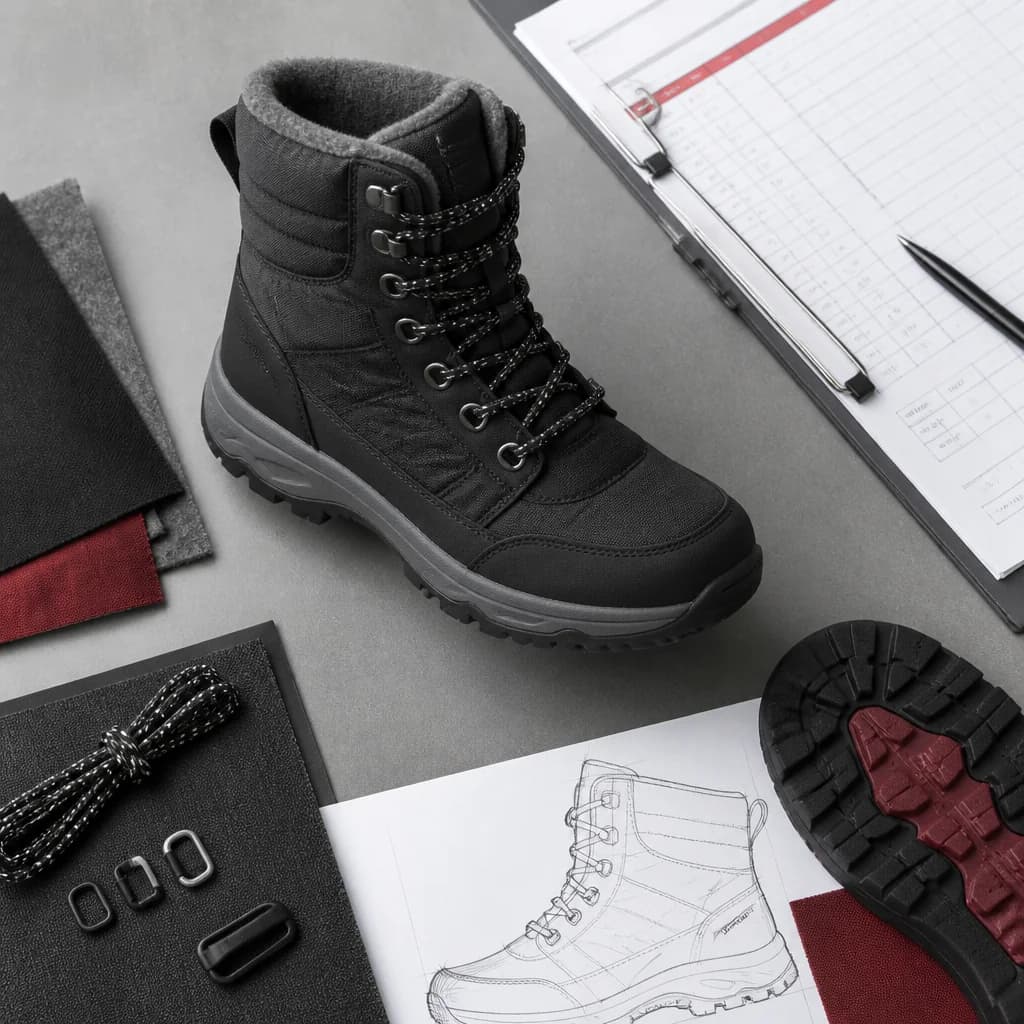
Create one buyer approval record for snow boot samples, separating reference input, fit baseline, requested materials, decision status and open questions.
Visual acceptance can be recorded while fit, material identity, construction details or the basis for approval remains open. A wholesale snow boot sample approval checklist should therefore give each decision its own field and status. In the buyer record proposed here, reference input, requested specification, approval basis and unanswered questions are kept separate.
SnowBootWorks presents OEM manufacturing as development of custom snow boots to the buyer's own specification, with construction, materials and approval standards driving every decision. That statement provides the company-specific context for this article. The matrix, review order, status terms and buyer-side decision roles below are editorial recommendations for buyers; the cited pages do not state that SnowBootWorks supplies or follows this exact workflow.
Define the approval scope
Begin by naming the decision requested from the sample. Product direction, fit, material selection, construction and appearance can each require review, but they should not share a status when the approval basis differs. The buyer's snow boot sample approval criteria should identify what is being decided and what remains outside the current review.
A recommended decision header contains these fields:
- Sample identity
- Record the buyer's sample name, version or other identifier used to distinguish it from earlier or later submissions.
- Decision requested
- State the specific product question that reviewers are expected to resolve.
- Approval basis
- Name the written requirement, selected component, reference attribute or buyer-defined review method used for the decision.
- Excluded decisions
- List visible or related matters that are not included in the current approval.
- Open questions
- Record the information the buyer still needs before assigning a final status to the relevant field.
Keep approval at the same level as the decision. Acceptance of an upper's visual direction, for example, should be entered separately from the buyer's decisions about its fiber, coating, backing or performance requirement. This prevents a broad approval label from replacing component-level decisions.
Separate the reference from the request
SnowBootWorks describes a private label waterproof winter boot program showing how a brand brief moves from reference samples to an export-ready, branded production run. The description applies to the program presented on that page. It does not establish a standard route for every project or make a reference sample the complete product specification.
For the buyer's record, divide reference information into three fields: what the reference demonstrates, what the buyer requests and what remains undecided.
| Record field | Recommended entry | Review note |
|---|---|---|
| Reference input | Identify the sample, image, drawing, brief, swatch or component being used for comparison. | Name the particular attribute it demonstrates, such as shape, fit reference, construction direction, material character or color placement. |
| Requested specification | Write the buyer's requirement for the sample under review independently of the reference. | Avoid using "same as reference" unless the attributes to be matched are listed individually. |
| Undecided or unconfirmed | Enter attributes that have not received a buyer decision or still require supplier information. | Leave the field open instead of allowing an unspecified feature of the reference to become the default requirement. |
When several references contribute to a private-label snow boot development brief, assign each one a narrow purpose. One reference might inform the silhouette while another informs a component direction. The record should not carry every visible attribute from either reference into the request unless the buyer names it.
Set the fit baseline before appearance
On SnowBootWorks' women's snow boot product entry, the buyer-fit guidance says to decide the target sizing system and fit reference first. That statement is specific to the women's snow boot platforms presented on the page. For a women's sample review, those two items can anchor the fit section of the buyer's record.
- Name the target sizing system. Record the system the buyer intends to apply rather than inferring it from markings on a reference or development sample.
- Identify the snow boot fit reference. Name the physical reference product, buyer-approved last or other buyer-selected internal standard used for comparison.
- Identify the sample under review. Record its identifier and marked size, followed by any buyer-selected review conditions needed to interpret comments consistently.
- Write comparative comments. Replace a broad reaction such as "too tight" with the location of the issue, the applicable reference and the requested change or question.
Give appearance its own decision line even when fit and appearance are reviewed together. A positive response to silhouette, quilting or trim placement should not become the recorded basis for accepting fit.
Clarify waterproof textile wording
Under its waterproof textile upper direction, SnowBootWorks lists coated nylon upper, water-resistant fabric upper and technical textile shell. It describes this direction as a woven or laminated synthetic fabric upper, typically nylon or polyester, finished with a durable water-repellent (DWR) coating and often backed by a waterproof membrane or laminate.
The words "typically" and "often" limit the scope of that description. The buyer's record should therefore confirm the intended fiber, fabric structure, coating and backing rather than assigning every listed attribute to every textile upper.
| Material wording | Recommended clarification questions |
|---|---|
| Coated nylon upper | Is nylon the required fiber designation? What coating is intended? Which face, backing or layer is included in the material approval? |
| Water-resistant fabric upper | What substrate and fabric construction are requested? Is water resistance being used as a material description, a performance requirement or both? What approval basis will the buyer use? |
| Technical textile shell | Is the requested shell woven or laminated? Which fiber, durable water-repellent (DWR) coating, membrane or laminate details still require confirmation for the project? |
Keep material identity and performance requirements in separate fields. The material field can name the component and requested layer structure. A separate performance field can state the buyer's requirement, its approval basis and the information needed for a decision. The supplied sources do not provide a test method, rating or finished-boot performance result.
Assemble the approval record
The recommended matrix brings the decision fields into one working record. Add or remove rows to match the buyer's internal authority and product definition.
| Decision area | Reference input | Requested specification | Approval basis | Buyer decision owner | Current status | Open supplier question |
|---|---|---|---|---|---|---|
| Product direction | Name the reference and the specific attribute it demonstrates. | Define the intended category, silhouette or product direction. | Use the written buyer brief or a designated reference attribute. | Record the buyer-side role authorized to decide. | Enter a status limited to product direction. | Identify any interpretation point that requires a response. |
| Fit baseline | Name the applicable fit reference. | Record the target sizing system and requested comparison. | Use the buyer-defined fit reference and review conditions. | Record the responsible fit or product role. | Enter a fit-specific status. | Ask which sizing or fit information remains to be confirmed. |
| Upper material | Identify the swatch, sample or material wording received. | Separate the requested fiber, fabric construction, coating and backing. | Use a written material definition or designated component reference. | Record the responsible materials or product role. | Enter a material-specific status. | Ask for clarification of any unnamed substrate, coating or layer. |
| Construction | Name only the reference attributes relevant to construction. | Record the requested construction details. | Use the written specification, drawing or defined reference attribute. | Record the role authorized to approve construction. | Enter a construction-specific status. | List unresolved construction questions. |
| Appearance | Name only the visual attributes used for comparison. | Record the requested silhouette, color placement or trim direction. | Use the buyer brief, drawing or designated visual reference. | Record the role authorized to approve appearance. | Enter an appearance-specific status. | List unresolved visual interpretation questions. |
Define the status vocabulary within the document. A buyer might use pending review, approved, revision requested or blocked by an open question. Each term should indicate what the buyer has decided without allowing an overall status to override unresolved rows.
The decision-owner field should identify the buyer-side role with authority over that row. Procurement, product development, fit and brand teams can contribute comments, while the record shows which role assigns the decision status.
Convert open fields into inquiry topics
Use the unresolved fields to prepare the supplier inquiry. The handoff should make each missing answer traceable to a component or buyer decision rather than presenting a general request for sample feedback.
- Share the current winter footwear definition and the decision the sample must support.
- Identify each reference and the particular attribute it demonstrates.
- State the target sizing system and applicable fit reference.
- Describe the requested construction and material direction, with broad textile terms expanded into component questions.
- Name the buyer's approval basis and decision owner for each area.
- Include the current status and the exact questions preventing a buyer decision.
Send the current record through the project inquiry and ask which development, sampling or quotation options may apply. MOQ and packing details can also be framed as questions. The cited sources do not provide project quantities, pricing, timing or a prescribed sampling route, so those fields should remain open until project-specific information is returned.
Make the handoff at row level: identify the reference attribute, requested requirement, approval basis, current status and question still blocking the buyer's decision. This keeps the sample as one input to the specification instead of asking it to serve as the complete specification.
Evidence layer
Evidence checklist: Wholesale Snow Boot Sample Approval Checklist in One Record
OEM, ODM, and private label are not just marketing labels. The practical difference is who owns the starting design, how much the construction changes, and which decisions must be approved before bulk production. Put the decision in writing: reference style, required changes, branding locations, packaging scope, tooling assumptions, and the point at which a sample becomes the production reference. For this guide, map each supplier response to “Define the approval scope” so a claim is supported by a written specification, sample reference, controlled document, or a clearly marked open question.
A strong brief also records what is out of scope. That prevents a fast sample discussion from silently becoming a new mold, a new size run, or a new compliance requirement. Use the same approval language in the quote, sample comments, and purchase documentation. Cross-check the response against “Separate the reference from the request” and keep every unresolved point visible in the approval record.
- Design ownership and permitted adaptations — scoped to wholesale snow boot sample approval checklist
- Branding, packaging, and tooling boundaries — cross-checked against “Define the approval scope”
- Sample approval gates before bulk commitment — with open risks from “Separate the reference from the request” recorded
Decision framework
Buyer checklist
- Give each requested sample decision its own approval basis, buyer-side owner and status.
- Record reference input, requested specification and unresolved questions in separate fields.
- For the women's snow boot platforms described by SnowBootWorks, identify the target sizing system and fit reference first.
- Expand broad waterproof textile wording into buyer questions about fiber, fabric construction, coating, backing and approval basis.
Sources and verification
Evidence used for this guide.
Continue the specification