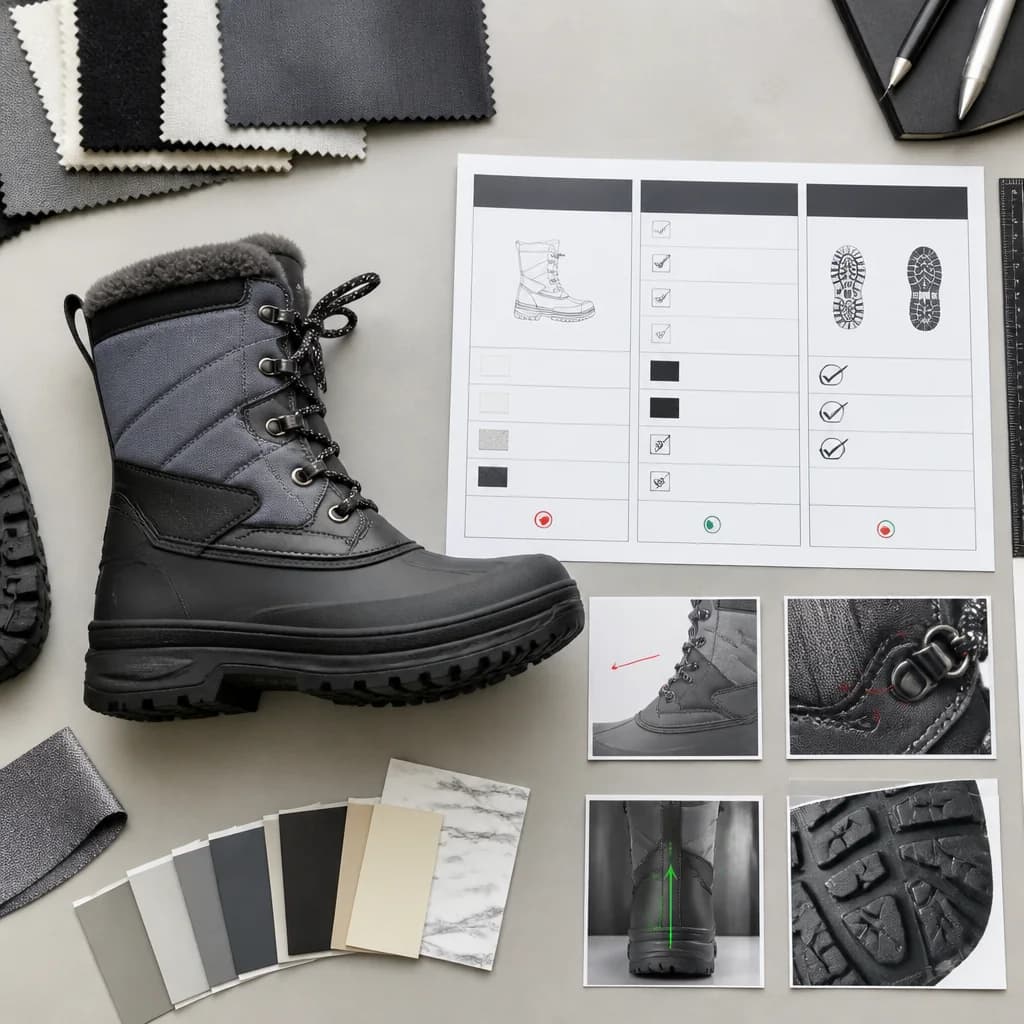
Turn a reference boot into a copy, change and verify matrix covering fit, material direction, construction questions and approval notes.
In a hypothetical review, a buyer may want to retain a boot's panel relationship, change its color and verify the material used beneath the visible surface. A single instruction to follow the reference would mix three different decisions. A wholesale snow boot reference sample checklist can separate them by assigning each relevant attribute one status: copy, change or verify.
Copy identifies the feature or relationship the buyer wants to retain. Change records an intentional departure from the reference. Verify holds an unresolved question about fit, construction, materials, approval criteria or another part of the product definition.
The sample does not define the brief
The SnowBootWorks capabilities page says that custom snow boots are developed to the buyer's own specification. It identifies construction, materials and approval standards as inputs that drive development decisions. A reference boot may contribute to that specification, but the buyer still needs to define what the reference is intended to communicate.
The case-studies page documents one private-label waterproof winter boot program in which a brand brief moves from reference samples to a branded, export-ready production run. That example establishes that reference samples were used in the documented program. It does not establish reference samples as the starting point or process for every project.
The matrix in this article is an editorial recommendation for buyer preparation. It is not presented as a SnowBootWorks form, service or mandatory factory procedure. Recommended fields below should therefore be adapted to the buyer's product and current decision stage.
Three statuses for each decision
For a clearer snow boot factory brief, the editorial recommendation is to give each attribute its own row. A component may have more than one row when its position, appearance and material identity have different statuses.
Copy, change and verify matrix
| Attribute | Copy | Change | Verify |
|---|---|---|---|
| Silhouette or panel relationship | Identify the selected shape, proportion or panel relationship to retain. | Describe the visible departure requested by the buyer. | Record any aspect whose purpose or construction remains unclear. |
| Surface appearance | Record the color relationship, texture or finish selected from the reference. | Name the requested appearance and the reference used to explain it. | Leave material identity open when appearance does not establish it. |
| Fit | State whether the boot is intended to act as a fit reference. | Describe where the requested fit direction differs. | List unresolved decisions about sizing system, fit reference or intended wearing context. |
| Construction | Identify only the construction feature deliberately selected for retention. | Give each requested construction revision a separate entry. | Record hidden or uncertain details for discussion instead of inferring them from the exterior. |
| Approval basis | Name the attribute and the criterion the buyer intends to review. | Attach a review note to the requested departure. | Identify the missing information or buyer decision. |
For example, panel position may be marked copy while panel color is marked change and material identity remains under verify. The statuses describe the buyer's intentions, not the entire physical component.
It is also useful to distinguish what the buyer observed from what the buyer is requesting:
- Observed
- Information visible or otherwise available on the reference. An uncertain material or hidden construction detail should not be recorded as established fact.
- Requested
- The specific feature, relationship or departure the buyer wants considered in the proposed product.
- Unresolved
- Information or a buyer-side decision that is still missing and remains under verify.
As editorial guidance, buyers can support these entries with an identifier for each reference, photographs of the cited areas and notes about visible wear, alterations or missing components. The photographs document the object; the matrix explains which parts of it matter to the current request.
Fit needs its own reference record
The SnowBootWorks women's snow boot catalog describes fit-led women's winter boot platforms and tells buyers considering those platforms to decide the target sizing system and fit reference first. The source states this instruction within that women's catalog context. It does not describe it as a formal requirement for every snow boot category.
When fit is relevant to the proposed product, the following buyer-preparation fields can separate visible design direction from the intended fit definition.
Recommended fit-reference fields
| Field | Reference record | Buyer decision |
|---|---|---|
| Target sizing system | Note any size information visible on the supplied reference. | Enter the sizing system intended for the proposed range. |
| Fit reference | Identify the boot, standard or other reference supplied for fit discussion. | State which reference the buyer's product team has selected. |
| Role of the sample | Classify it as a visual reference, fit reference or both. | Specify the decisions it is intended to inform. |
| Requested fit direction | List the areas being compared. | Describe where the proposed product should retain or depart from the selected fit reference. |
| Open fit points | Record questions the physical sample does not settle. | Keep each question under verify until the intended direction is defined. |
The visual reference and fit reference may serve different purposes. Recording those roles separately reduces the chance that an appearance note will be treated as a fit instruction or that a fit comment will be applied to unrelated visual features.
Waterproof-textile shorthand needs detail
The SnowBootWorks waterproof textile upper entry names coated nylon upper, water-resistant fabric upper and technical textile shell as material directions.
The same entry describes a woven or laminated synthetic fabric upper. It says the fabric is typically nylon or polyester and is finished with a durable water-repellent (DWR) coating. It also says the textile upper is often backed by a waterproof membrane or laminate. The conditional wording is important because the source does not state that every textile upper has that backing.
Waterproof textile upper decision fields
| Decision field | Documented material description | Recommended buyer entry |
|---|---|---|
| Upper direction | Coated nylon upper, water-resistant fabric upper or technical textile shell | Mark the selected direction as observed, requested or unresolved. |
| Fabric form | Woven or laminated synthetic fabric | Enter the requested form when known; otherwise place the choice under verify. |
| Typical fiber | Nylon or polyester | Record the fiber direction separately from color, texture and finish. |
| Surface treatment | Durable water-repellent coating | State whether DWR is included in the requested upper-material direction. |
| Conditional backing | Often backed by a waterproof membrane or laminate | Mark the backing as requested, excluded or unresolved according to the buyer's current definition. |
These fields describe upper-material direction. As an editorial recommendation, any desired finished-boot performance should be recorded separately. A fabric description, DWR entry, membrane or laminate choice does not by itself define a finished-boot result.
Approval notes belong beside changes
Approval standards are among the development inputs identified on the capabilities page. Within this buyer-owned checklist, the recommended approach is to pair each requested change with a concise note describing what the buyer intends to review.
- Describe one departure. State the requested difference from the reference and place unrelated changes in separate entries.
- Name the review basis. Point to an annotated photograph, selected material, fit reference, color reference or another buyer-defined criterion.
- Set the scope. Specify whether the note concerns appearance, fit, material direction, construction or another defined attribute.
- Record decision ownership. Identify the buyer-side person or role expected to accept the point or return comments.
An approval note should not hide an unresolved decision. When the buyer has not selected the material, construction direction, fit reference or review basis, the corresponding point remains under verify.
The inquiry handoff
The completed matrix can serve as an index to the buyer's current custom snow boot specification checklist. The recommended inquiry package distinguishes settled directions from requested departures and open questions.
- State the intended product category, use context and current brand direction.
- Identify each reference and state whether the physical sample is available.
- Include photographs and condition notes for the areas cited in the matrix.
- Attach the copy, change and verify entries, separating attributes that have different statuses.
- Add the target sizing system and fit reference when relevant to the selected platform or product direction.
- Record requested material direction separately from attributes merely observed on the sample.
- List construction questions that remain unresolved after the buyer's review.
- Include approval notes for requested changes and identify buyer-side owners for open decisions.
Share the current product definition through the project inquiry page and ask which development, sampling or quotation options, if any, may apply to the proposed snow boot project.
Evidence layer
Evidence checklist: Wholesale Snow Boot Reference Sample Checklist
OEM, ODM, and private label are not just marketing labels. The practical difference is who owns the starting design, how much the construction changes, and which decisions must be approved before bulk production. Put the decision in writing: reference style, required changes, branding locations, packaging scope, tooling assumptions, and the point at which a sample becomes the production reference. For this guide, map each supplier response to “The sample does not define the brief” so a claim is supported by a written specification, sample reference, controlled document, or a clearly marked open question.
A strong brief also records what is out of scope. That prevents a fast sample discussion from silently becoming a new mold, a new size run, or a new compliance requirement. Use the same approval language in the quote, sample comments, and purchase documentation. Cross-check the response against “Three statuses for each decision” and keep every unresolved point visible in the approval record.
- Design ownership and permitted adaptations — scoped to wholesale snow boot reference sample checklist
- Branding, packaging, and tooling boundaries — cross-checked against “The sample does not define the brief”
- Sample approval gates before bulk commitment — with open risks from “Three statuses for each decision” recorded
Decision framework
Buyer checklist
- Assign copy, change or verify to each relevant attribute instead of applying one instruction to the entire reference boot.
- Separate observations about the physical sample from the buyer's requested product direction and unresolved decisions.
- Record the target sizing system, fit reference and role of the physical sample as distinct fit fields when relevant.
- Break waterproof-textile shorthand into upper direction, fabric form, fiber, surface treatment and conditional backing decisions.
- Pair each requested change with a buyer-defined review note while keeping undecided points under verify.
Sources and verification
Evidence used for this guide.
Continue the specification