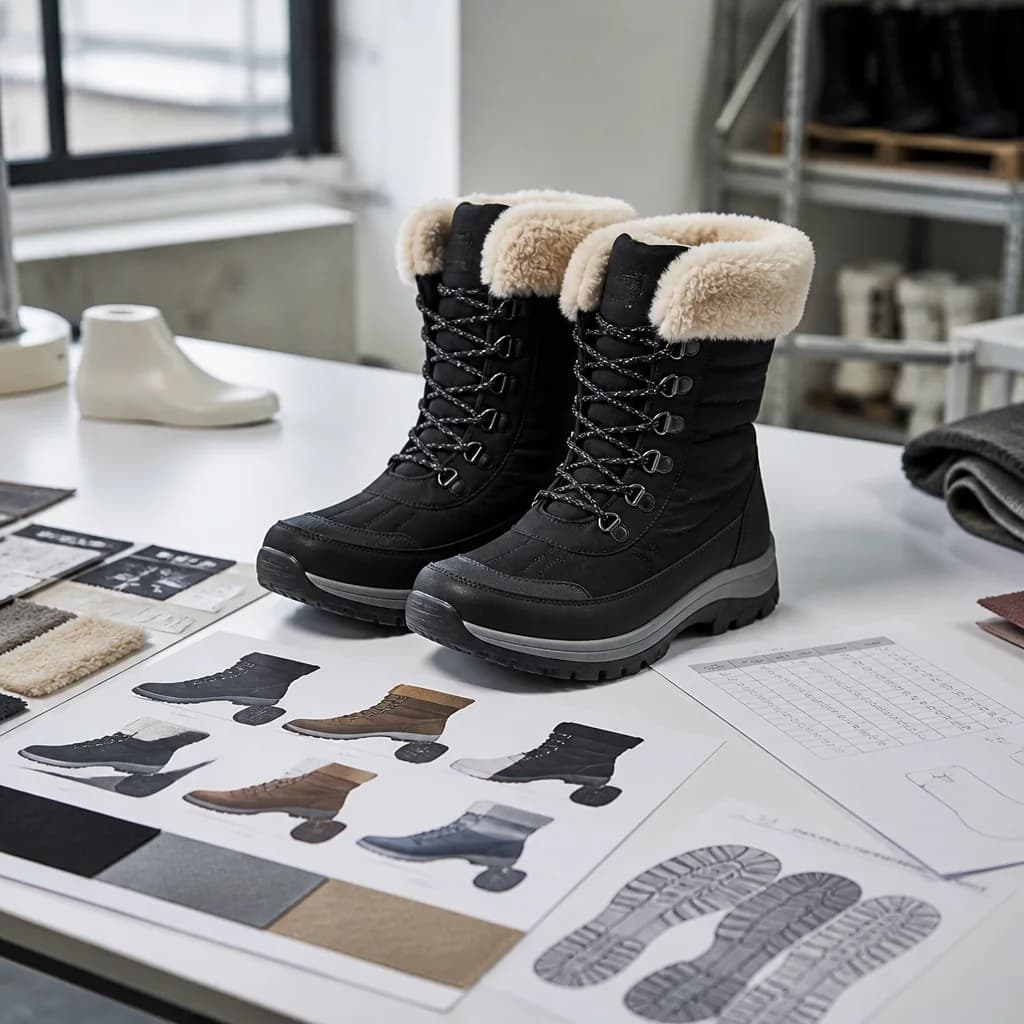
Decide who owns construction, materials, and sample approvals for private label women's waterproof winter boots before fashion freezes reference sampling.
Private label women's waterproof winter boots succeed or stall on a commercial question: who writes construction, materials, and approval standards before reference samples are ordered. Fashion still matters for women's retail assortment, but samples that only match a lookbook leave export-ready branded production unproven.
SnowBootWorks publishes two related routes. A case-studies program overview for a Waterproof Snow Boot Private Label Program shows how a brand brief moves from reference samples to an export-ready, branded production run. A capabilities OEM statement describes developing custom snow boots to the buyer's own specification, with construction, materials, and approval standards driving every decision. Treat those as two buyer-side control choices. Style boards can inform taste early; they should not replace the controlling document that sampling must test.
Choose who writes the controlling document
Keep each route inside its published wording. Ownership here means which document your team treats as controlling—not a legal transfer of IP, finished-boot lab results, or export compliance.
| Buyer control model | Documented sequence or driver | What the buyer still defines |
|---|---|---|
| Private-label waterproof route | Brand brief moves from reference samples to an export-ready, branded production run (case-studies program overview for a Waterproof Snow Boot Private Label Program) | Brief completeness, what each reference sample may prove, and readiness criteria for a branded production run |
| OEM custom-spec route | Custom snow boots developed to the buyer's own specification, with construction, materials, and approval standards driving every decision (capabilities OEM manufacturing statement) | The specification itself: construction choices, material callouts, and the pass/fail standards at each gate |
Read the private-label overview on the case studies page as a path, not as MOQs, timelines, or outcomes. Read the OEM statement on the capabilities page as process language only: construction, materials, and approval standards drive every decision when custom snow boots are developed to the buyer's own specification.
If the brand will hand over a brief and judge reference samples against that brief on the way to a branded production run, treat the private-label map as primary. If the brand will write construction, materials, and approval standards as the controlling specification, treat OEM custom-spec control as primary. Mixed programs fail when one team assumes private-label sample judgment while another assumes OEM-level specification control without writing either down.
Brand brief, reference samples, branded production readiness
The Waterproof Snow Boot Private Label Program overview shows how a brand brief moves from reference samples to an export-ready, branded production run. That is the full documented private-label sequence. It does not enumerate construction menus, packaging rules, labeling checklists, MOQs, or lead times. Use it as three buyer-controlled gates.
- Brand-brief completeness. A brief that only lists colorways and shaft height cannot support reference samples meant to advance a women's snow boots private label program toward branded production. Put waterproof construction intent, material constraints you will not freely substitute, fit reference, branding elements, and the standards that will stop a sample into the brief before the first round is ordered.
- Reference-sample criteria. Decide what each sample round is authorized to prove. Style confirmation, fit confirmation, and construction confirmation are different authorizations. Mixing them into one vague approval creates false greens.
- Export-ready branded production readiness. The program overview ends at an export-ready, branded production run. Define channel-specific readiness items you own—brand marks, labeling, packaging—before treating a run as ready. Those items are buyer-defined requirements, not factory claims drawn from the case-studies excerpt.
If your team is closer to OEM control, the same discipline appears as specification control rather than sample mood checks. Freeze fashion direction only after the gates that sampling can actually test are written down.
Construction, materials, and approval standards the buyer names
Under OEM framing on the capabilities page, construction, materials, and approval standards drive every decision. For teams comparing OEM construction and material callouts against a private-label brief, the buyer still has to name the constraints samples will check. The steps below are buyer-owned practice, not finished-boot performance claims or lab results.
- State waterproof construction intent in production language. Ask internally whether the brief means a membrane stack, sealed seams, a waterproof leather or synthetic upper strategy, a bootie construction, or another method your team already uses. Avoid single-word labels that leave attach methods and seam plans open. Those option names are buyer questions, not a SnowBootWorks method menu.
- List material families sampling may not freely substitute. Upper face, membrane or coating approach, insulation family if cold weather is part of the brief, lining, midsole or footbed, outsole compound class, and hardware finishes all change cost, lead risk, and visual read. Mark which items are locked versus open to supplier proposal.
- Write approval standards as pass/fail gates for wholesale winter boots. Separate visual brand checks from construction checks. If a sample can pass color and last shape while failing seam-sealing intent, write that distinction before the first round.
- Map each standard to a sample round. Reference samples exist to confirm program intent. If a gate requires a production-representative construction, say so. Do not expect a style-only sample to prove waterproof construction control.
Do not invent temperature ratings, IP claims, or certification marks that are not already in your compliance file. If your category team requires a named standard, put that standard in the brief as a buyer requirement. Sampling can only check what the brief owns.
Fit lock for fit-led women's platforms
Fit-led women's platforms on the products catalog still require an early sizing decision. The page states that buyers should decide first on the target sizing system and fit reference for women's retail and private-label winter collections, then review the product brief. That order sits inside either control model rather than replacing it.
As general product-development practice—not a factory-tested claim—waterproof construction can affect last volume, shaft flex, and sock-system assumptions. Freezing a fashion last or a competitor size chart without stating the fit reference that production must match produces samples that look right in photos and fail on foot. The sizing lock is therefore not a styling afterthought. Write it before reference samples are judged on a private-label waterproof route, and treat it as part of the specification that drives OEM decisions.
Suggested buyer sequence: choose the control model; name construction, materials, and approval standards; lock target sizing system and fit reference; only then freeze clean-urban, quilted, or plush direction details that depend on shaft volume and collar build. Style boards can inform taste earlier. They should not outrank the fit reference when samples will be graded for export-ready branded production.
Where wholesale programs stall after styling freezes
On the products catalog, fit-led women's winter boot platforms span clean urban, quilted, and plush cold-weather directions, with buyer fit stated for women's retail and private-label winter collections. That language helps assortment talks. It becomes a failure mode when those directions stand in for waterproof construction control and approval standards.
Outdoor retail brands face a parallel pressure. The industries page frames winter footwear programs as balancing comfort, weather protection, and shelf appeal. Shelf appeal shows in a lookbook; weather protection does not. When merchandising locks shelf appeal first, sampling is asked to reverse-engineer waterproof intent from a fashion sample.
As a hypothetical stall pattern, not a documented order, the sequence often runs like this: a women's collection brief lists colorways, shaft height preferences, and trim language; a reference sample is ordered against a competitor boot or a past-season style; only after fit and photo reviews does the team ask what waterproof means for production approval. Tooling talks and material holds may already have started. Reopening construction control then restarts the clock without improving decision quality.
Outdoor retail balance as buyer tradeoff guidance
For outdoor retail brands, the industries page describes winter footwear programs that balance comfort, weather protection, and shelf appeal. After route control and fit reference are set, use that published balance as a decision frame—not as a source-ranked hierarchy. The checklist below is an editorial recommendation for the buyer, drawn from that balance language only.
- Name weather protection as a construction package in the brief. If the assortment promises wet-snow or slush use, carry waterproof construction and material constraints before merchandising finalizes trim that fights seam plans.
- Treat comfort as fit reference plus internal stack. Comfort claims without a sizing system and fit reference are untestable in sampling. Insulation and lining choices belong with that fit lock, because stack height changes fit.
- Keep shelf appeal as the visible layer on a stable platform. Clean-urban lines, quilted surfaces, and plush collars read on shelf. They should decorate a construction and fit lock, not redefine them every review cycle.
That guidance uses the balance language on the industries page. It does not add certifications, climate statistics, or performance numbers the source does not state.
Product-brief review and open inquiry topics
Documented scope on the products page includes reviewing the product brief for fit-led women's platforms after the target sizing system and fit reference are decided. Documented OEM scope on the capabilities page is development of custom snow boots to the buyer's own specification with construction, materials, and approval standards driving decisions. Open inquiry topics remain separate from that ceiling.
A buyer may ask which development, sampling, or quotation options apply to a given women's waterproof program. Asking does not convert those topics into a pre-documented service menu with fixed MOQs or timelines. Useful questions to bring to a review include:
- Which control model matches our controlling document: private-label brand brief with reference-sample path, or OEM specification where construction, materials, and approval standards drive decisions?
- Which construction and material items are locked for first sampling, and which may be proposed?
- What is the fit reference and target sizing system for the women's platform before style freezes?
- Which sample rounds are authorized to judge waterproof construction versus brand appearance?
- What channel readiness items must be true before we treat a branded production run as export-ready for our market?
Share your current winter footwear definition, including waterproof construction intent and fit reference, when you are ready to discuss which development, sampling, or quotation options may apply. Use the request a quote path to open that conversation with a brief that already owns the gates above rather than a style board alone.
Evidence layer
Evidence checklist: Who Writes Specs for Private Label Women's Waterproof Winter Boots
OEM, ODM, and private label are not just marketing labels. The practical difference is who owns the starting design, how much the construction changes, and which decisions must be approved before bulk production. Put the decision in writing: reference style, required changes, branding locations, packaging scope, tooling assumptions, and the point at which a sample becomes the production reference. For this guide, map each supplier response to “Choose who writes the controlling document” so a claim is supported by a written specification, sample reference, controlled document, or a clearly marked open question.
A strong brief also records what is out of scope. That prevents a fast sample discussion from silently becoming a new mold, a new size run, or a new compliance requirement. Use the same approval language in the quote, sample comments, and purchase documentation. Cross-check the response against “Brand brief, reference samples, branded production readiness” and keep every unresolved point visible in the approval record.
- Design ownership and permitted adaptations — scoped to private label women's waterproof winter boots
- Branding, packaging, and tooling boundaries — cross-checked against “Choose who writes the controlling document”
- Sample approval gates before bulk commitment — with open risks from “Brand brief, reference samples, branded production readiness” recorded
Decision framework
Buyer checklist
- Decide brand-brief or OEM custom-spec control before freezing women's fashion direction for private label women's waterproof winter boots.
- Keep the private-label sequence inside brand brief, reference samples, and export-ready branded production; expand completeness criteria only as buyer guidance.
- Under OEM framing, construction, materials, and approval standards drive every decision, and the buyer still writes those callouts.
- Lock target sizing system and fit reference for fit-led women's platforms before judging waterproof reference samples.
- Ask which development, sampling, or quotation options apply only after the product brief owns those gates.
Sources and verification
Evidence used for this guide.
Continue the specification
Move from research to a controlled brief.
Frequently asked questions
Questions buyers ask next
What is the difference between private-label waterproof control and OEM custom-spec control?
Private-label waterproof control, as shown in the case-studies program overview, centers on a brand brief moving from reference samples to an export-ready branded production run. OEM custom-spec control, as stated on the capabilities page, centers on developing custom snow boots to the buyer's own specification with construction, materials, and approval standards driving every decision. The buyer still writes the controlling document in both models.
Why should women's fashion direction wait until after waterproof specs?
Clean-urban, quilted, and plush directions define visual platforms, but they do not name waterproof construction, material constraints, or approval standards. Freezing style first leaves reference samples unable to confirm program intent for an export-ready branded run.
What should a buyer decide first on fit-led women's platforms?
According to the products catalog, decide first on the target sizing system and fit reference for women's retail and private-label winter collections, then review the product brief. That lock should sit inside the waterproof control sequence, not replace it.