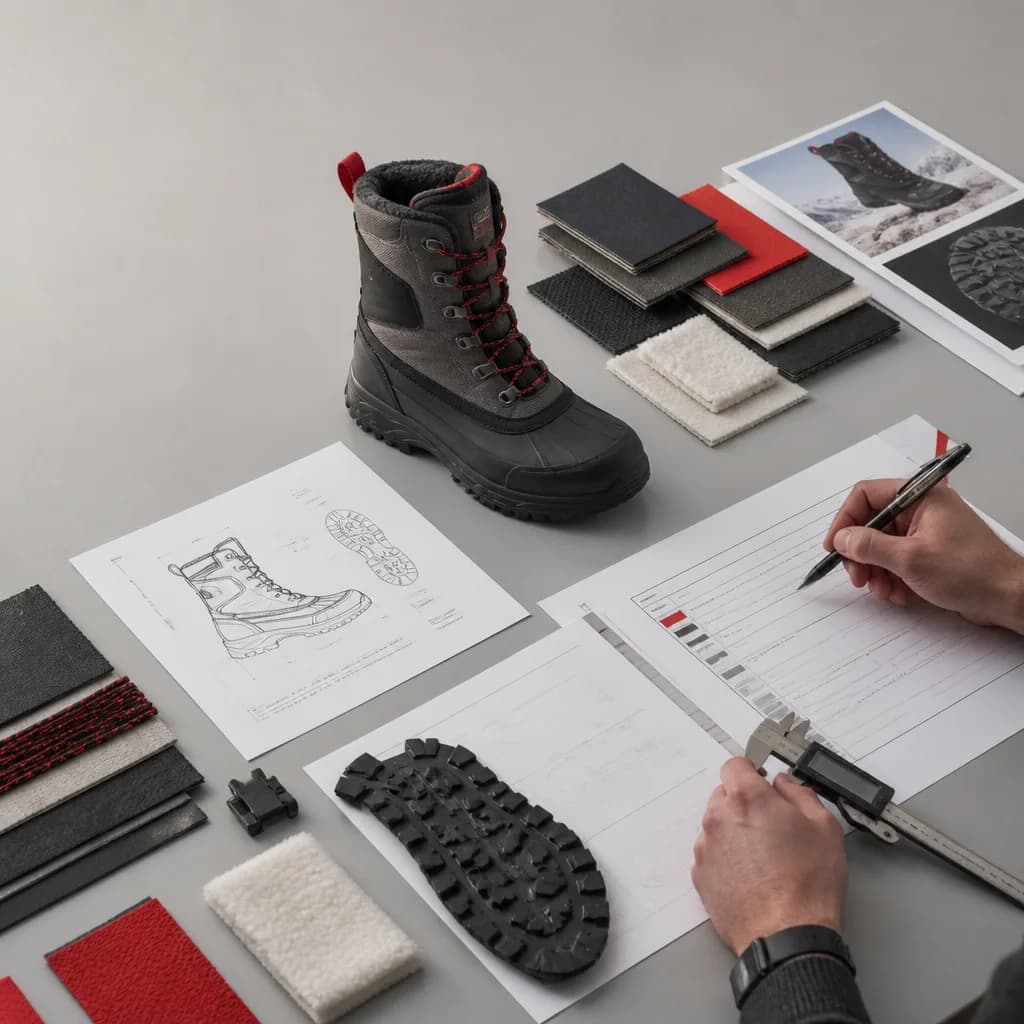
Structure a snow boot OEM RFQ scope around a defined quote basis, limited reference roles and a separate queue for unresolved decisions.
A pricing request can move forward before every product question is settled, but the buyer still needs to show which instructions control the inquiry. A snow boot OEM RFQ scope should separate the present quote basis from the product choices still waiting for a decision. Otherwise, a written specification, a reference boot, a marked-up image and a private-label brand note can appear to carry the same authority even when each was meant to do a different job.
SnowBootWorks states that its OEM manufacturing capability develops custom snow boots to a buyer's own specification, with construction, materials and approval standards driving decisions. The framework below is an editorial recommendation for buyers. It is intended to organize product-definition authority for an inquiry; it is not a complete inventory of every commercial, legal, logistics or purchasing input that may be needed for pricing, and it is not presented as a documented SnowBootWorks checklist, service or workflow.
The Quote Basis Comes First
Begin with the instructions the buyer is prepared to use for the current commercial discussion. That group can be called the fixed layer. It should be narrower than the full development conversation because unresolved alternatives do not belong in the quote basis unless the buyer clearly labels them as accepted options or assumptions.
In one hypothetical RFQ, the written specification names a material direction, a supplied boot is meant only to show appearance, and fit is still unresolved. Under this buyer-managed method, the material direction belongs in the fixed layer, the sample is assigned only to appearance, and fit is kept in an open decision queue.
- Fixed layer
- The requirements the buyer authorizes as the basis for the present pricing discussion.
- Assigned reference
- A sample, image or document given authority over one specifically named attribute.
- Open decision
- A product choice that has not been added to the quote basis.
- Quotation assumption
- A provisional condition the buyer is willing to discuss for pricing while keeping it distinct from an approved product requirement.
Give the fixed layer a date or revision identifier. If the buyer changes direction later, the new instruction can identify what it replaces.
Fields That Belong in the Locked Definition
Construction, materials and approval standards are documented starting categories because SnowBootWorks identifies them as inputs to custom manufacturing decisions. Buyers can add program-specific fields when they are relevant, but each field should show whether the instruction is selected, provisional or still open.
Buyer-side structure for fixed and open product inputs
| Scope field | Enter in the fixed layer when | Keep in the open layer when |
|---|---|---|
| Construction | The buyer has selected and documented the current construction requirement. | Alternative constructions are still being compared or require discussion. |
| Materials | The buyer has named the selected material direction and any already accepted alternatives. | Options, substitutions or material questions remain unranked. |
| Approval standards | The buyer has documented the review criterion and its governing reference. | The criterion or buyer-side decision owner has not been established. |
| Sizing and fit | The applicable sizing system and the limited role of any fit reference are known. | Fit direction or category-specific sizing inputs remain under review. |
| Private-label brand direction | The current brand requirement has buyer approval and belongs in the inquiry. | Brand placement, treatment or related choices remain unsettled. |
For a private label snow boot specification, include branding only when it is relevant to the program and its status is clear. Do not place competing alternatives in the fixed layer without stating whether they are accepted options or undecided choices.
Reference Samples Need Narrow Authority
A reference can be useful without controlling the whole product. The buyer-side recommendation is to assign each reference to the attribute it is meant to communicate and keep unrelated attributes under their own written instructions or in the open queue.
- Fit reference
- Assign only the fit characteristics expressly identified by the buyer. Construction, materials, appearance and branding remain outside its role unless separately assigned.
- Appearance reference
- Name the visual attribute or design direction being communicated. Do not treat it as authority for fit, hidden construction or material composition.
- Construction reference
- Identify the specific construction feature the buyer wants to communicate. Other product requirements retain their existing status.
SnowBootWorks' case-study page describes one private-label waterproof winter boot program in which a brand brief moves from reference samples toward an export-ready, branded production run. That statement is limited to the featured program. It does not establish a standard path for every SnowBootWorks inquiry.
For buyer-side control, record the artifact identifier, its distinguishing description or revision, its assigned attribute and the written requirement connected to that role.
Requested Precedence for the RFQ
Once references and written inputs have defined jobs, the buyer can state the requested precedence for the inquiry. The purpose is not to dictate what a supplier must accept in a future quotation. It is to make the buyer's intended quote basis visible and to invite the receiving team to identify any deviation or conflict.
Requested instruction authority for the present inquiry
| Input | Assigned authority | Conflict record to request |
|---|---|---|
| Current written specification | Controls the requirements it explicitly addresses. | Name the buyer-approved revision that replaces it. |
| Reference with a defined role | Controls only the attribute named in that role. | Use the applicable written requirement when one exists; otherwise mark the attribute as open. |
| Markup or clarification | Has the status assigned by the buyer. | State whether it revises the specification or remains a comment. |
| Open decision | Has no authority over the fixed layer. | Record the buyer decision before adding it to a later revision. |
A broad label such as "use as reference" is not enough. The record should say whether the artifact communicates fit, appearance, construction or another attribute.
The Decision Queue Keeps Open Points Visible
The open layer needs enough structure for discussion without making unfinished choices look approved. This is an editorial recommendation for buyers, not a documented SnowBootWorks deliverable.
- Decision required: Name the construction, material, approval, fit or brand question that remains open.
- Buyer-side owner: Identify the team or role authorized to settle it.
- Requested discussion: Ask which development, sampling or quotation options may apply to that point.
- Pricing status: State whether the buyer considers the decision necessary before pricing or wants to discuss a clearly labeled assumption.
- Revision action: Move the approved instruction into a new version of the fixed layer when the buyer has made the decision.
Words such as "preferred," "suggested" or "approximate" do not reliably communicate authority. If a point is unsettled, mark it as open and state what must be decided.
Quotation Assumptions Are Not Approval Standards
The commercial request and the approval record answer different questions. The commercial request states what the buyer wants considered for pricing. The approval record states which standards or review criteria the buyer has already defined. SnowBootWorks identifies approval standards as one of the inputs driving custom manufacturing decisions, but the supplied capability statement does not specify an approval sequence or a standard number of revisions or sample rounds.
- Quotation basis: List the fixed requirements, assigned references and any clearly labeled assumptions for the current pricing discussion.
- Quotation assumption: Keep the condition visibly provisional until a buyer-approved revision adds it to the specification.
- Approval expectation: Record only the standards or review criteria the buyer has already established.
- Open question: Return unresolved approval points to the decision queue and ask whether they need to be settled before pricing.
Under this editorial method, accepting an assumption for a pricing discussion does not give it authority as a product requirement.
Category Checks Before Submission
Outdoor retail programs
SnowBootWorks describes outdoor retail winter footwear programs as balancing comfort, weather protection and shelf appeal. For an inquiry in that context, the buyer can identify which of those priorities already control the fixed layer and which tradeoffs remain open. The source attaches that combination to outdoor retail programs rather than every snow boot category.
Women's snow boot programs
The SnowBootWorks women's snow boot catalog presents fit-led platforms for women's retail and private-label winter collections. In that category-specific context, it tells buyers to decide the target sizing system and fit reference first.
A buyer working in the women's category can record whether those inputs are fixed, assigned to a limited reference or still open. Buyers in other categories should define the applicable sizing system and fit reference separately rather than treating the women's catalog direction as universal guidance.
Submitting the Current Scope
Present the fixed and open layers as separate parts of the same inquiry:
- Issue the current quote definition with a visible date or revision identifier.
- List each reference separately and name the attribute it is authorized to communicate.
- Record unresolved choices in the decision queue with a buyer-side owner, pricing status and requested discussion.
- Open the inquiry through the request-a-quote page, share the current definition, identify the references and ask whether and how they may be considered for the project.
- Ask which development, sampling or quotation options, if any, may apply to the project.
The submission should show what currently governs the request, what each reference means and what remains available for discussion.
Evidence layer
Evidence checklist: Snow Boot OEM RFQ Scope: Fixed Inputs and Open Decisions
OEM, ODM, and private label are not just marketing labels. The practical difference is who owns the starting design, how much the construction changes, and which decisions must be approved before bulk production. Put the decision in writing: reference style, required changes, branding locations, packaging scope, tooling assumptions, and the point at which a sample becomes the production reference. For this guide, map each supplier response to “The Quote Basis Comes First” so a claim is supported by a written specification, sample reference, controlled document, or a clearly marked open question.
A strong brief also records what is out of scope. That prevents a fast sample discussion from silently becoming a new mold, a new size run, or a new compliance requirement. Use the same approval language in the quote, sample comments, and purchase documentation. Cross-check the response against “Fields That Belong in the Locked Definition” and keep every unresolved point visible in the approval record.
- Design ownership and permitted adaptations — scoped to snow boot OEM RFQ scope
- Branding, packaging, and tooling boundaries — cross-checked against “The Quote Basis Comes First”
- Sample approval gates before bulk commitment — with open risks from “Fields That Belong in the Locked Definition” recorded
Decision framework
Buyer checklist
- Buyer-side recommendation: separate the requirements authorized for pricing from product choices that remain open.
- Buyer-side recommendation: limit each reference to a named attribute instead of giving it authority over the whole product.
- Buyer-side recommendation: label quotation assumptions separately until a recorded revision makes them product requirements.
- Buyer-side recommendation: preserve category-specific boundaries when using sizing, fit or retail-program examples.
Sources and verification
Evidence used for this guide.
Continue the specification