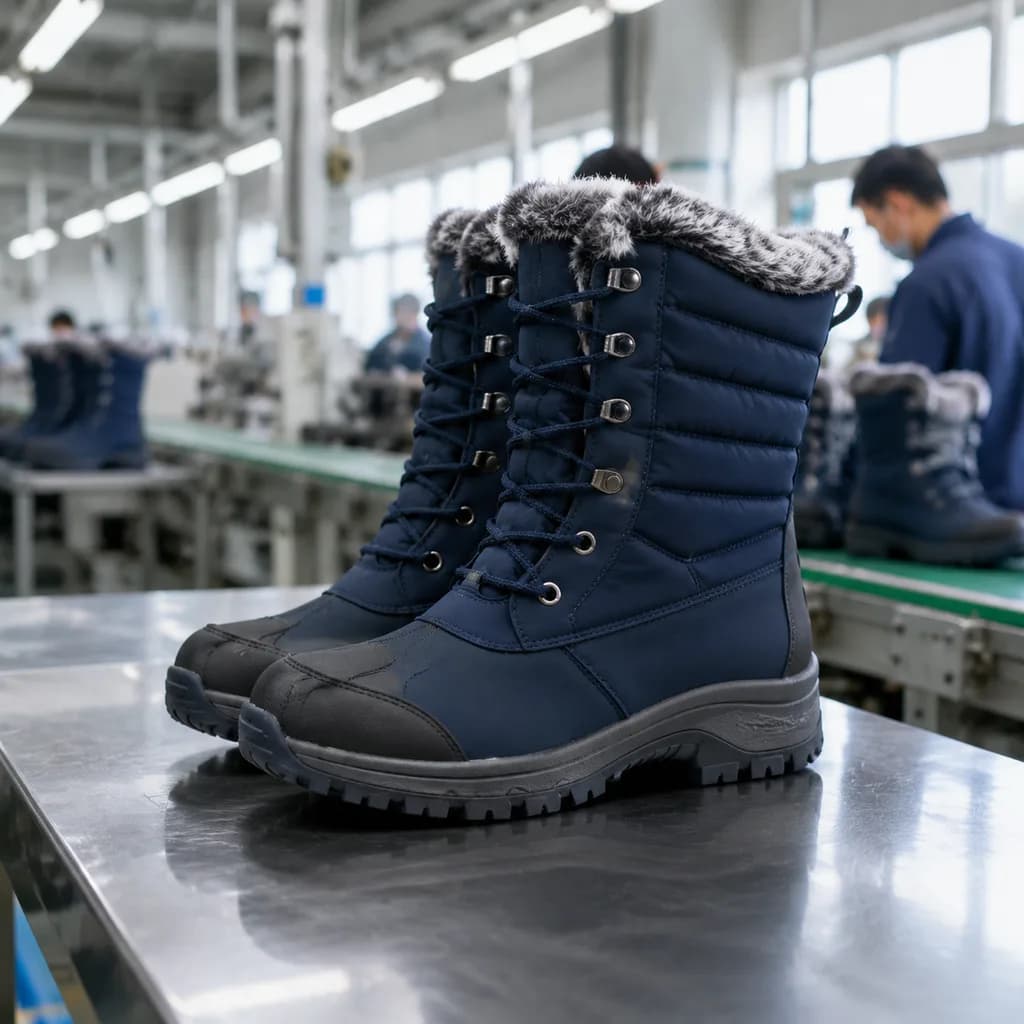
Private label winter boot sampling process: lock fit and sizing, sequence waterproof private-label development, then set OEM approval standards.
Procurement teams often treat wholesale winter boots as a catalog-and-price request. That habit breaks the private label winter boot sampling process before a last, upper, or sole unit is ever cut. Without a locked sizing system, fit reference, and named approval standard, samples become discovery tools instead of production gates. This article sequences only the pre-production locks supported by SnowBootWorks program language: fit first, then construction and materials approval, then branded export readiness. It does not invent timelines, MOQs, or QC station lists.
Why wholesale winter boot sampling fails before production starts
The common failure is stage confusion, not style selection. Buyers request samples to compare looks and unit cost while the sizing system, fit reference, and pass/fail rules remain open. Each revision then reopens construction, insulation stack, outsole geometry, and brand marking. Cost tables shift because the product definition is still moving.
That problem differs from assortment planning or waterproof-feature mapping. Assortment asks which silhouettes belong in a line. Waterproof claims ask which membrane or seam path supports a market statement. Sampling as a production gate asks something narrower: what must be fixed so a sample can accept or reject a factory interpretation of a brief.
On the SnowBootWorks product catalog path for women’s retail and private-label winter collections, the stated buyer decision order starts with target sizing system and fit reference before a product brief review. Treating that order as optional is an editorial risk buyers take when they reverse the sequence for speed. The rework cost shows up later as mismatched samples, repeated tooling questions, and inconsistent size runs across reorders.
Lock the sizing system and fit reference before any sample request
For fit-led women’s winter boot platforms spanning clean urban, quilted, and plush cold-weather directions, the catalog language places sizing and fit ahead of style confirmation. That first-party path is documented for women’s retail and private-label winter collections. As an editorial recommendation for the buyer, apply the same decision order to other private-label winter programs where retail grading will matter, even when the rest of the line is still open, without reading the catalog excerpt as a universal factory rule for every gender or channel.
- Name the target sizing system the retail or wholesale channel expects, including any house size conversion rules you already use.
- Designate a physical fit reference: a current in-line boot, a competitor sample you control, or a graded last direction your team already trusts. State what acceptable fit means on that reference for toe room, instep, shaft circumference, and heel hold.
- Separate fit approval from aesthetic approval. A sample can look correct and still fail the fit reference.
- Only after those locks are written should the team request construction samples against a wholesale winter boot development brief.
The catalog does not publish size runs, last codes, or commercial quantities. Those remain buyer-specified inputs. If your team cannot point to a single fit reference that will govern all sample rounds, pause sampling and finish that decision first.
What a private-label waterproof program actually sequences
SnowBootWorks describes a Waterproof Snow Boot Private Label Program as a private label waterproof winter boot program showing how a brand brief moves from reference samples to an export-ready, branded production run. That is the full documented arc available in the case-study overview: brand brief, reference samples, then branded production ready for export.
What the overview does not supply is a day-by-day checkpoint calendar, intermediate sample types, or a fixed list of laboratory tests. Treat those as evidence gaps. Buyers who need a fuller timeline should write the missing gates into the brief rather than assume a factory default process.
A practical way to use the documented sequence without inventing steps:
- Brand brief: product definition, market claim language, branding, and packaging intent in buyer-owned terms.
- Reference samples: physical or agreed benchmarks that lock silhouette, construction direction, and fit against the sizing system already chosen.
- Export-ready branded production run: samples and paperwork aligned so production can carry brand marks and shipping readiness without reopening the product definition.
Keep the waterproof private-label scope intact. Do not stretch this program language into non-waterproof lines or into guarantees about membrane performance, hydrostatic ratings, or lab outcomes that the excerpt never states.
Name construction, materials, and approval standards for OEM sampling
OEM manufacturing language on the capabilities page is explicit: custom snow boots are developed to the buyer’s own specification, with construction, materials, and approval standards driving every decision. That shifts responsibility onto the brief. Sampling cannot invent standards the buyer never named.
The following checklist is an editorial recommendation for the buyer when preparing a snow boot OEM sample approval package. Each item is a procurement-owned prompt you can impose in writing; none of it expands the evidence into unstated certifications, laboratory protocols, or factory station lists.
- Construction: shaft height intent, closure type, seam and bonding direction, outsole attachment method, and any removable liner or gaiter elements the line requires.
- Materials: upper family (textile, coated, leather-look, or mixed), insulation stack direction, lining hand, midsole and outsole compound direction, hardware finish, and cold-flex expectations stated in buyer language rather than unproven claims.
- Approval standards: who signs fit, who signs construction, what photo or measurement evidence is required, how many sample rounds the team will fund before commercial discussion, and which defects reject a sample without debate.
- Brand readiness: logo placement, hangtags, labels, and carton marking rules that must appear before any export-ready run is considered complete.
If construction, materials, or approval standards stay verbal, OEM sampling will still produce boots, but the accept/reject conversation will be subjective. Put the standards in writing before the first sample request so each unit tests a locked specification rather than a mood board.
Build outdoor-retail tradeoffs into the brief, not after sampling
Outdoor retail programs, per SnowBootWorks industry language, balance comfort, weather protection, and shelf appeal. Those three priorities often conflict. Soft hand and plush lining can fight abrasion or water-path integrity. Aggressive tread and tall shafts can fight weight and retail presentation. Graphic upper treatments can fight durability or sealing paths.
Build the tradeoffs into the brief so sampling validates them instead of discovering them late:
| Priority | What to lock in the brief | What sampling should prove |
|---|---|---|
| Comfort | Fit reference, insulation feel, weight direction, break-in expectations | Wear trial against the named fit reference, not only static measurements |
| Weather protection | Waterproof intent, seam path, cuff/gaiter behavior, sole interface | Construction matches the private-label waterproof program definition the brand owns |
| Shelf appeal | Silhouette, colorway rules, logo scale, packaging story | Branded sample still meets fit and construction gates |
When outdoor retail buyers leave the balance undefined, factories optimize the easiest visual sample. That sample may sell in a meeting and fail in cold-weather use or reverse logistics. Naming which priority wins when two conflict is a procurement decision, not a factory default.
Handoff questions that route development, sampling, or quotation
Close the pre-production phase with distinct inquiry topics rather than a single send-quote email. As an editorial recommendation for the buyer, share the current winter footwear definition and ask which development, sampling, or quotation options may apply to the project. Treat that as a routing prompt for readiness, not as a published service menu with fixed packages.
Use separate question sets so the factory response matches readiness:
- Development readiness: Is the winter footwear definition written? Are construction and materials directions named? Is the program a waterproof private-label path or a different scope?
- Sampling readiness: Is the target sizing system and fit reference locked? Are approval standards written? Are reference samples available or still conceptual?
- Quotation readiness: Are branded, export-facing requirements known enough that a commercial discussion will not reopen fit or construction? What packing or MOQ information, if any, does this project need the supplier to address?
A buyer may ask which sampling, packing, or quotation information applies to the project. Ask those questions only after fit and approval standards stop moving. That is how the private label winter boot sampling process stays a production gate instead of an expensive conversation about what the boot was supposed to be.
For catalog context, program overviews, outdoor retail fit language, and OEM specification framing, review the product catalog, case studies, industries, and capabilities pages, then route open project questions through request a quote.
Evidence layer
Evidence checklist: Private Label Winter Boot Sampling Process
OEM, ODM, and private label are not just marketing labels. The practical difference is who owns the starting design, how much the construction changes, and which decisions must be approved before bulk production. Put the decision in writing: reference style, required changes, branding locations, packaging scope, tooling assumptions, and the point at which a sample becomes the production reference. For this guide, map each supplier response to “Why wholesale winter boot sampling fails before production starts” so a claim is supported by a written specification, sample reference, controlled document, or a clearly marked open question.
A strong brief also records what is out of scope. That prevents a fast sample discussion from silently becoming a new mold, a new size run, or a new compliance requirement. Use the same approval language in the quote, sample comments, and purchase documentation. Cross-check the response against “Lock the sizing system and fit reference before any sample request” and keep every unresolved point visible in the approval record.
- Design ownership and permitted adaptations — scoped to private label winter boot sampling process
- Branding, packaging, and tooling boundaries — cross-checked against “Why wholesale winter boot sampling fails before production starts”
- Sample approval gates before bulk commitment — with open risks from “Lock the sizing system and fit reference before any sample request” recorded
Decision framework
Buyer checklist
- Lock the target sizing system and fit reference before any private-label sample request so sampling tests a fixed product definition.
- Use the documented waterproof private-label path only as brief to reference samples to export-ready branded production; write any finer checkpoints yourself.
- Name construction, materials, and approval standards in the OEM brief so accept/reject criteria are buyer-owned.
- Balance outdoor retail comfort, weather protection, and shelf appeal inside the brief, not after samples arrive.
- Route inquiries by readiness: development definition, sampling locks, or quotation inputs, without assuming a fixed service package.
Sources and verification
Evidence used for this guide.
Continue the specification
Move from research to a controlled brief.
Frequently asked questions
Questions buyers ask next
What should be locked before starting a private label winter boot sampling process?
Lock the target sizing system, a physical fit reference with accept criteria, and written construction, materials, and approval standards. Without those, samples discover the product instead of approving it.
What does SnowBootWorks document for waterproof private-label programs?
The case-study overview describes a private label waterproof winter boot program in which a brand brief moves from reference samples to an export-ready, branded production run. It does not publish a detailed day-by-day sampling calendar or lab protocol list.
When is a project ready for quotation instead of more sampling?
When fit, construction, materials, brand marking, and approval standards stop changing enough that a commercial discussion will not reopen the product definition. Buyers can still ask which packing or MOQ details apply to the project at that stage.