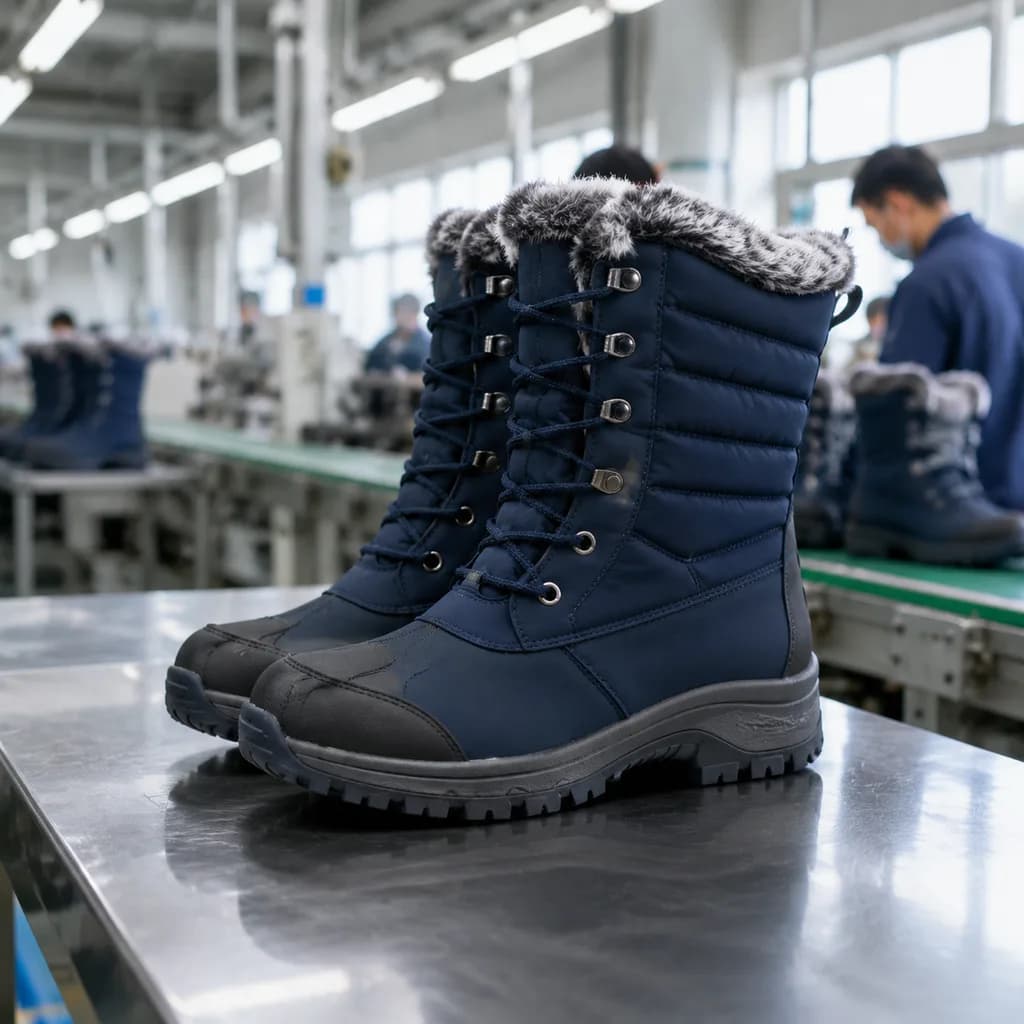
Build a private label snow boot development brief that locks construction, materials, fit reference, and approval standards before sampling or wholesale quotation.
Transactional searches for wholesale snow boots often stall once a sample returns with preference notes instead of a clear pass or fail. The missing control document is usually a private label snow boot development brief: written inputs for construction path, materials direction, sizing system, fit reference, and approval standards. Without that brief, OEM work has nothing stable to score against, and private-label timing slips past the season window.
This guide treats the brief as the decision surface, not the price list. It walks four gates supported by first-party capability and program copy, then helps you choose whether the next ask is development, sampling, or quotation.
Why wholesale snow boot shopping stalls without a development brief
Wholesale shopping works when the SKU is already defined. Private-label and OEM winter boots are different. On the manufacturing capabilities path, custom snow boots are developed to the buyer’s own specification, and construction, materials, and approval standards drive every decision. A price-led inquiry underperforms because the factory still needs those three drivers before a sample can be judged correct rather than merely interesting.
Buyers often reverse the order. They pick a silhouette, request a sample, then discover the upper system, last reference, or acceptance criteria were never written down. Each revision reopens cost and calendar risk. As an editorial recommendation for procurement teams, complete the brief gates first, then open a commercial conversation only for the ask the brief can support.
Gate 1: Lock construction and materials before SKU talk
Style talk without a construction and materials lock produces samples that look close and fail for reasons no one documented. OEM manufacturing treats construction and materials as decision drivers, so the brief should state intended build logic before colorways, pack language, or retail storytelling.
When the program points toward a waterproof textile upper direction, keep materials language inside what the materials library describes. A waterproof textile upper is a woven or laminated synthetic fabric upper, typically nylon or polyester, finished with a durable water-repellent (DWR) coating and often backed by a waterproof membrane or laminate. That direction is positioned as lightweight and flexible for everyday snow boots that need to stay supple in the cold. Use those terms as brief inputs, not as finished-boot waterproof ratings or lab claims the materials page does not state.
Editorial recommendation for buyers locking Gate 1:
- Name the upper family you intend to pursue (for example, coated or laminated synthetic shell with DWR, with or without membrane or laminate backing) and point internal reviewers to the materials detail for shared vocabulary.
- Separate construction notes from styling notes: seams, shaft height intent, closure type, and sole interface belong in the construction block; color and branding graphics belong later.
- Record what you are not deciding yet. Insulation grade, temperature claims, and test methods should stay blank unless you have buyer-owned standards ready to attach. Inventing numbers in the brief creates false precision.
- Only after construction and materials are named should SKU or assortment language appear. Until then, treat style references as direction, not approved engineering.
That sequence keeps Gate 1 from ballooning into a full-boot performance certificate and prevents partial option lists from other pages from being merged into a broader capability claim.
Gate 2: Name the sizing system and fit reference first
Gate 2 prevents a common post-sample complaint: the boot “runs wrong.” For women’s retail and private-label winter collections, product catalog guidance frames fit as a decide-first buyer step: lock the target sizing system and fit reference before deeper product-brief review. That is a brief requirement, not a late aesthetic tweak.
Write the fit block so a sample room can act on it. Name the sizing system the retail channel expects. Identify the fit reference you will treat as truth: a prior season last, a competitor shoe used only as directional reference, or a brand-owned size set. Women’s snow boot platforms are described as fit-led platforms spanning clean urban, quilted, and plush cold-weather directions; state which direction the fit reference must serve so last and volume choices do not fight the upper story.
Private-label programs that skip this gate often approve an upper sample, then reject fit on the next round. Put the sizing system and fit reference on the first page of the brief so sampling starts against a fixed ruler. Review the relevant product family only after that ruler is written.
Gate 3: Define approval standards that decide sample pass or fail
Gate 3 turns sampling from opinion into scoring. OEM manufacturing runs with approval standards as a decision driver alongside construction and materials. The brand owns those standards; manufacturing needs them written so a sample can pass or fail without a new meeting every time.
A useful approval block in a private label snow boot development brief states, in plain language, what “done” means for the next physical sample. Keep the list brand-owned and limited to criteria you can inspect or measure on receipt. The following checklist is an editorial recommendation for buyers drafting snow boot sampling approval standards; it is not a factory-mandated template:
- Construction acceptance: which seams, bonding, and sole attachments must match the construction notes from Gate 1.
- Materials acceptance: which upper direction, hand feel, and visible finish traits must match the materials inputs you locked (for textile uppers, DWR presence and membrane or laminate intent if you specified them).
- Fit acceptance: which sizing system and fit reference from Gate 2 govern try-on, and who signs the fit call.
- Brand execution: logo placement, hangtag or label rules, and color tolerance you will enforce before production release.
- Failure language: what single defect class automatically fails the sample so feedback is not rewritten as soft preference.
If a criterion is not yet decided, mark it open rather than inventing a test method or rating. Vague phrases such as “premium feel” or “more waterproof” force another loop. Written pass or fail language shortens that loop without implying lab results the brief does not attach.
Gate 4: Sequence a private-label path from brand brief to export-ready run
Gate 4 is sequence, not metrics. Case-study program overview language describes one private label waterproof winter boot program as a path in which a brand brief moves from reference samples to an export-ready, branded production run. Stay inside that scope: one program path, no invented volumes, lead times, customer names, or multi-program performance claims.
- Brand brief. Consolidate Gates 1 through 3 into a single document: construction and materials drivers, sizing system and fit reference, and approval standards that will score samples.
- Reference samples. Use the brief to request samples that can be judged against those standards. Reference samples exist to confirm direction and catch mismatches early, not to replace a missing specification.
- Export-ready branded production run. Only after reference samples meet the written approval standards does the program move toward branded production readiness for export. Treat “export-ready” as the case-study end state of that path, not as a logistics playbook beyond what the program overview states.
Review the case studies program overview for that framing, then keep your own brief as the living control document. Expanding one program overview into proof of every winter category or waterproof system would overclaim the source.
Keep development, sampling, and quotation as separate asks
Brief completeness decides the next commercial ask. Mixing development, sampling, and quotation into one email usually recreates the stall: partial specs, unscoreable samples, and quotes that cannot hold because the product is still moving.
| Brief state | Stronger next ask | Why the ask stays distinct |
|---|---|---|
| Construction, materials, fit reference, or approval standards still open | Development conversation against an OEM snow boot specification | Capability language centers custom development to your specification; unfinished drivers belong in development, not a frozen quote |
| Drivers written, physical confirmation needed | Sampling against stated approval standards | Samples exist to pass or fail written criteria, not to invent the brief after the fact |
| Brief and reference direction stable enough for commercial comparison | Quotation discussion for the defined program | Price talk is only as stable as the specification it prices |
Keep inquiry topics honest. You may ask which development, sampling, or quotation options may apply to the project. That invitation is a buyer choice about what to request next; it is not, by itself, a catalog of promised service packages beyond what capability and program pages describe.
For private label winter boot program work, the practical test is simple: if a stranger could sample and reject against your brief without a phone call, the document is ready. If not, stay in development until Gates 1 through 3 are closed. When you are ready to share the current winter footwear definition and select the options that fit the project, use the request a quote path and attach the brief rather than a silhouette name alone.
Wholesale snow boots remain the commercial context. The control document that protects season timing is still the private label snow boot development brief: construction and materials first, sizing system and fit reference next, approval standards that decide pass or fail, then a private-label sequence from brand brief and reference samples toward an export-ready branded run. Finish those gates before you treat catalog price as the main decision.
Evidence layer
Evidence checklist: Private Label Snow Boot Development Brief
OEM, ODM, and private label are not just marketing labels. The practical difference is who owns the starting design, how much the construction changes, and which decisions must be approved before bulk production. Put the decision in writing: reference style, required changes, branding locations, packaging scope, tooling assumptions, and the point at which a sample becomes the production reference. For this guide, map each supplier response to “Why wholesale snow boot shopping stalls without a development brief” so a claim is supported by a written specification, sample reference, controlled document, or a clearly marked open question.
A strong brief also records what is out of scope. That prevents a fast sample discussion from silently becoming a new mold, a new size run, or a new compliance requirement. Use the same approval language in the quote, sample comments, and purchase documentation. Cross-check the response against “Gate 1: Lock construction and materials before SKU talk” and keep every unresolved point visible in the approval record.
- Design ownership and permitted adaptations — scoped to private label snow boot development brief
- Branding, packaging, and tooling boundaries — cross-checked against “Why wholesale snow boot shopping stalls without a development brief”
- Sample approval gates before bulk commitment — with open risks from “Gate 1: Lock construction and materials before SKU talk” recorded
Decision framework
Buyer checklist
- Treat the private label snow boot development brief, not the wholesale price list, as the control document for OEM and private-label programs.
- Lock construction and materials drivers before SKU talk; keep waterproof textile upper language inside the materials description (synthetic shell, DWR, optional membrane or laminate).
- Write sizing system and fit reference as decide-first brief requirements for retail and private-label winter collections.
- Own approval standards that make samples pass or fail in writing, then sequence brand brief to reference samples to an export-ready branded run.
- Choose development, sampling, or quotation as separate asks based on brief completeness, and ask which options apply without treating that invitation as a service promise.
Sources and verification
Evidence used for this guide.
Continue the specification
Move from research to a controlled brief.
Frequently asked questions
Questions buyers ask next
What belongs in a private label snow boot development brief before sampling?
At minimum: construction and materials drivers, the target sizing system and fit reference, and brand-owned approval standards that decide sample pass or fail. Commercial fields can wait until those gates are stable enough to quote.
How should waterproof textile upper language appear in the brief?
Use it as a materials direction: woven or laminated synthetic upper (typically nylon or polyester) with DWR and often a membrane or laminate backing, described as lightweight and flexible for everyday cold use. Do not convert that description into unfinished-boot waterproof ratings or test methods the materials source does not state.
When is quotation the wrong next step?
When construction, materials, fit reference, or approval standards are still open. In that state, a development or sampling ask is more stable than a quote that will move every time the product definition changes.