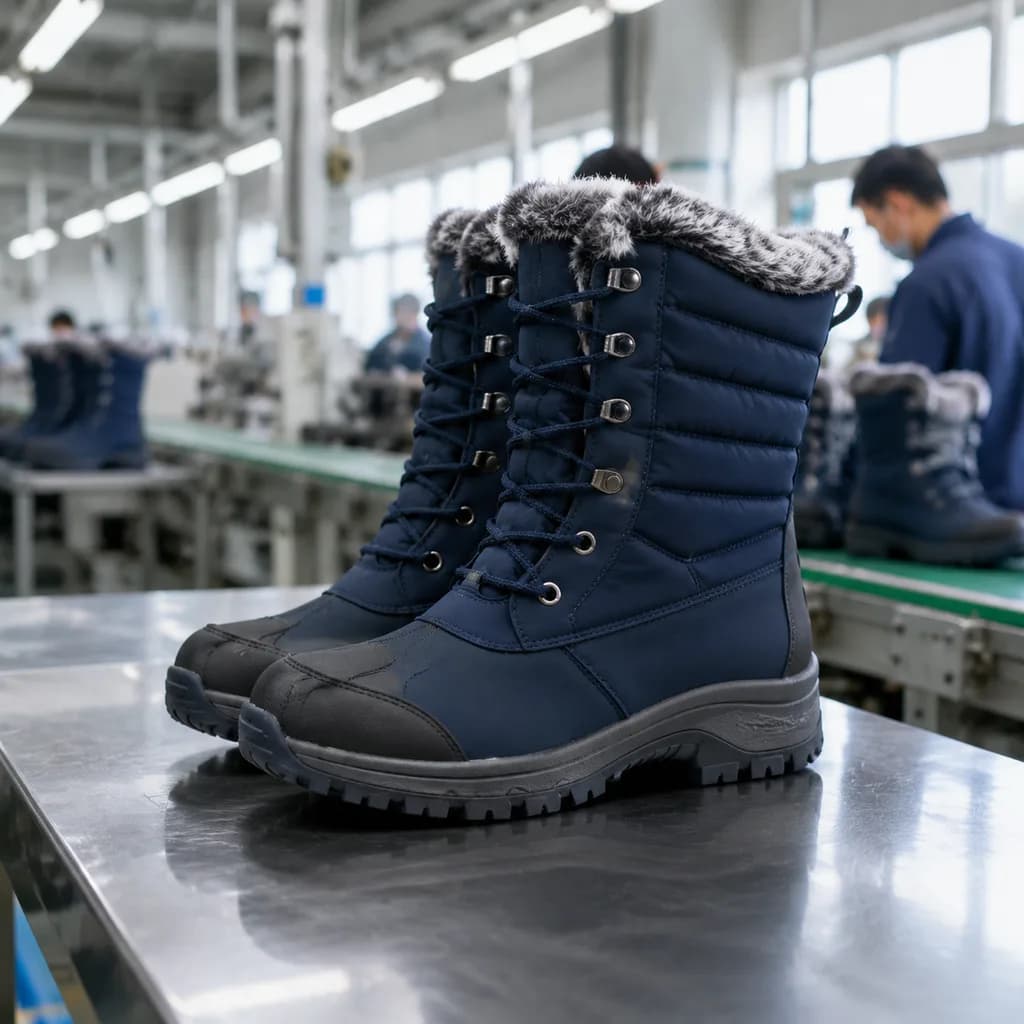
Lock sizing system and fit reference first, then rank clean urban, quilted, or plush for fit-led women's snow boot platforms wholesale.
For fit-led women's snow boot platforms wholesale, the controlling decision is not which photo looks right on a mood board. It is which sizing system and fit reference will govern sample approval when clean urban, quilted, and plush directions compete for the same women's retail or private-label collection. The product catalog states that rule plainly: decide first on target sizing system and fit reference, then review the product brief. Until those two items are written down, platform ranking is taste, not assortment control.
This article treats that catalog instruction as a procurement gate. You lock the fit story, assign fit-led platform directions as commercial range logic, filter them through outdoor-retail priorities, and only then open OEM custom-spec or private-label waterproof framing. No volumes, ratings, or completed orders are implied. Only the decision order buyers can own before asking which development, sampling, or quotation options may apply.
Decide first: sizing system and fit reference
Fashion and fit women's snow boots are presented as fit-led women's winter boot platforms spanning clean urban, quilted, and plush cold-weather directions, with buyer fit described as women's retail and private-label winter collections. The same product path instructs buyers to decide first on target sizing system and fit reference before reviewing the brief. That is a buyer-owned gate, not a claim that lasts, grades, or lab charts have already been measured for your account.
Before shortlisting platforms for women's snow boots sizing system wholesale, fix the gate in writing:
- Target sizing system for the markets you sell into, including how women's sizes will be labeled and communicated to the supplier.
- Fit reference: the house sample, prior-season bestseller, digital brief, or internal standard that defines acceptable entry, instep, and overall stance.
- Program role: women's retail assortment, private-label collection, or both, so platform choices are judged against the right shelf job.
- Technical topics you deliberately leave open (waterproof construction detail, insulation package, outsole compound) so they do not masquerade as fit decisions.
Editorial recommendation for buyers: if two stakeholders cannot name the same sizing system and fit reference in one sentence, stop ranking silhouettes. Closing the gate does not create test data. It keeps later construction and approval questions attached to one fit story.
Why platform ranking fails when the fit gate is open
A platform is commercial range logic that can be graded, sampled, and reordered with a shared fit story. Shaft height, cuff language, or a quilted surface are not platforms by themselves. When a request only ranks looks, buyers and suppliers negotiate surface detail while the controlling variables stay open: which sizing system the account uses, what defines “correct” on foot, and which cold-weather direction the assortment is actually buying.
The failure is specific to fit-led women's work. Clean urban, quilted, and plush cannot be compared fairly if each party assumes a different volume, entry feel, or approval sample. Quotes diverge. Sample comments mix style notes with fit notes. Assortment meetings try to pick a winner without agreeing who the boot is for. None of that requires inventing a technical package to diagnose. It follows from reviewing platforms before the catalog's stated first decision is locked.
Three fit-led platform directions, not a style list
Read clean urban, quilted, and plush as commercial platform directions for retail and private-label collections, not as finished bills of materials and not as a ranked style catalog. The commercial readings below are editorial guidance for buyers mapping shelf job to direction; they are not additional catalog specifications.
| Platform direction | Commercial reading for buyers | What still stays open |
|---|---|---|
| Clean urban | Minimal cold-weather silhouette logic for city and mixed-use retail presentation | Materials stack, waterproof path, insulation, and sole package until specified |
| Quilted | Structured cold-weather surface language where quilted volume often signals warmth on shelf | Quilt pattern ownership, fill type, and weather construction until specified |
| Plush | Softer, more tactile cold-weather direction for comfort-led women's collections | Lining language, cuff treatment, and weather construction until specified |
Style-list shopping asks which image to copy. Fit-led selection asks which direction can carry your locked sizing system and fit reference across the collection. Each direction can later accept different construction choices; none of them substitutes for naming fit first.
Filter platforms through outdoor-retail priorities
After the fit gate and a short platform shortlist, apply a channel lens. On the industries page, outdoor retail brands are framed as winter footwear programs that balance comfort, weather protection, and shelf appeal. That balance is industry framing, not a promise that any single program hits a fixed ratio of the three, and not sell-through data.
Teams building an outdoor retail women's winter footwear program can use the three priorities as filters on platform choice:
- Comfort weighs directions that must feel wearable once your fit reference is fixed; plush often enters as a commercial signal, not as a guaranteed material stack.
- Weather protection forces an honesty check: a waterproof path is a program-framing decision, not something clean urban or quilted automatically implies from the platform name alone.
- Shelf appeal decides how much visual structure (quilted volume, clean lines, plush texture) the channel needs so the assortment reads as intentional rather than accidental variety.
Editorial recommendation: a buyer can prioritize shelf appeal with a quilted direction and still keep weather protection on a separate specification track. The outdoor-retail frame helps decide which platform directions belong in the women's program at all; it does not replace construction, materials, or approval standards when OEM work begins.
When OEM specification and private-label waterproof framing apply
Two first-party paths matter once platforms are no longer only photos. Keep their actors and modalities separate.
On capabilities, OEM manufacturing is described as developing custom snow boots to your own specification, with construction, materials, and approval standards driving every decision. That path applies when your team will own the written spec and the approval standard set, not when you only want a lookalike image reviewed against an unnamed fit reference.
On case studies, a private label waterproof winter boot program is presented as showing how a brand brief moves from reference samples to an export-ready, branded production run. Buyers evaluating private label waterproof women's winter boots should treat that language as program framing: brand brief, reference samples, then export-ready branded production. It is not evidence of a women-only completed order, not a universal outcome list, and not a substitute for the fit gate.
- Confirm the fit gate (sizing system and fit reference) and at least one platform direction for the women's collection.
- Decide whether the project needs OEM develop-to-your-specification, with construction, materials, and approval standards as decision drivers.
- If waterproof private label is in scope, frame the inquiry around brand brief, reference samples, and export-ready branded production run language, without treating the case study as your result.
- Keep outdoor-retail balance (comfort, weather protection, shelf appeal) as the channel filter that explains why those scopes are open, not as a compliance claim.
Turn the fit gate into an inquiry package
When you are ready to ask which development, sampling, or quotation options may apply to the project, send decisions rather than an unsorted image set:
- Women's platform direction under review: clean urban, quilted, plush, or a controlled mix, with one primary direction called out first.
- Target sizing system and the fit reference that will govern sample approval.
- Channel intent: women's retail, private-label winter collection, and any outdoor-retail priorities you are balancing (comfort, weather protection, shelf appeal).
- Scope flags: whether OEM custom specification (construction, materials, approval standards) is requested, and whether private-label waterproof framing (brief to reference samples to export-ready branded production) is in play.
- Open questions you want answered against that package, including which sampling or quotation information applies to this project, without assuming automatic deliverables.
Submit that package through request a quote so the conversation starts from fit-led women's snow boot platforms wholesale logic. Suppliers and internal stakeholders can respond to the same gate, the same platform directions, and the same scope flags. You still own the commercial choices; the catalog and capability pages define the decision order and the program framings available to discuss.
Evidence layer
Evidence checklist: Fit Gate First for Fit-Led Women's Snow Boot Platforms Wholesale
OEM, ODM, and private label are not just marketing labels. The practical difference is who owns the starting design, how much the construction changes, and which decisions must be approved before bulk production. Put the decision in writing: reference style, required changes, branding locations, packaging scope, tooling assumptions, and the point at which a sample becomes the production reference. For this guide, map each supplier response to “Decide first: sizing system and fit reference” so a claim is supported by a written specification, sample reference, controlled document, or a clearly marked open question.
A strong brief also records what is out of scope. That prevents a fast sample discussion from silently becoming a new mold, a new size run, or a new compliance requirement. Use the same approval language in the quote, sample comments, and purchase documentation. Cross-check the response against “Why platform ranking fails when the fit gate is open” and keep every unresolved point visible in the approval record.
- Design ownership and permitted adaptations — scoped to fit-led women's snow boot platforms wholesale
- Branding, packaging, and tooling boundaries — cross-checked against “Decide first: sizing system and fit reference”
- Sample approval gates before bulk commitment — with open risks from “Why platform ranking fails when the fit gate is open” recorded
Decision framework
Buyer checklist
- Lock target sizing system and fit reference before ranking clean urban, quilted, or plush women's platforms.
- Treat the three directions as commercial range logic for retail and private-label collections, not as finished technical packages.
- Use outdoor-retail balance of comfort, weather protection, and shelf appeal as a channel filter, not as a fixed performance guarantee.
- Open OEM only when construction, materials, and approval standards will drive a develop-to-your-specification path; open waterproof private label only as brief, reference samples, and export-ready branded production framing.
- Send an inquiry package built from those gates when asking which development, sampling, or quotation options may apply.
Sources and verification
Evidence used for this guide.
Continue the specification
Move from research to a controlled brief.
Frequently asked questions
Questions buyers ask next
What should be locked before comparing women's snow boot platform photos?
Target sizing system and fit reference should be named first so clean urban, quilted, and plush directions are judged as fit-led commercial platforms for women's retail or private-label collections, not as disconnected style images.
When does OEM framing differ from private-label waterproof framing?
OEM framing applies when custom snow boots are developed to your own specification with construction, materials, and approval standards driving decisions. Private-label waterproof framing, as presented in the program overview, follows a brand brief from reference samples to an export-ready branded production run. Neither path replaces the fit gate.