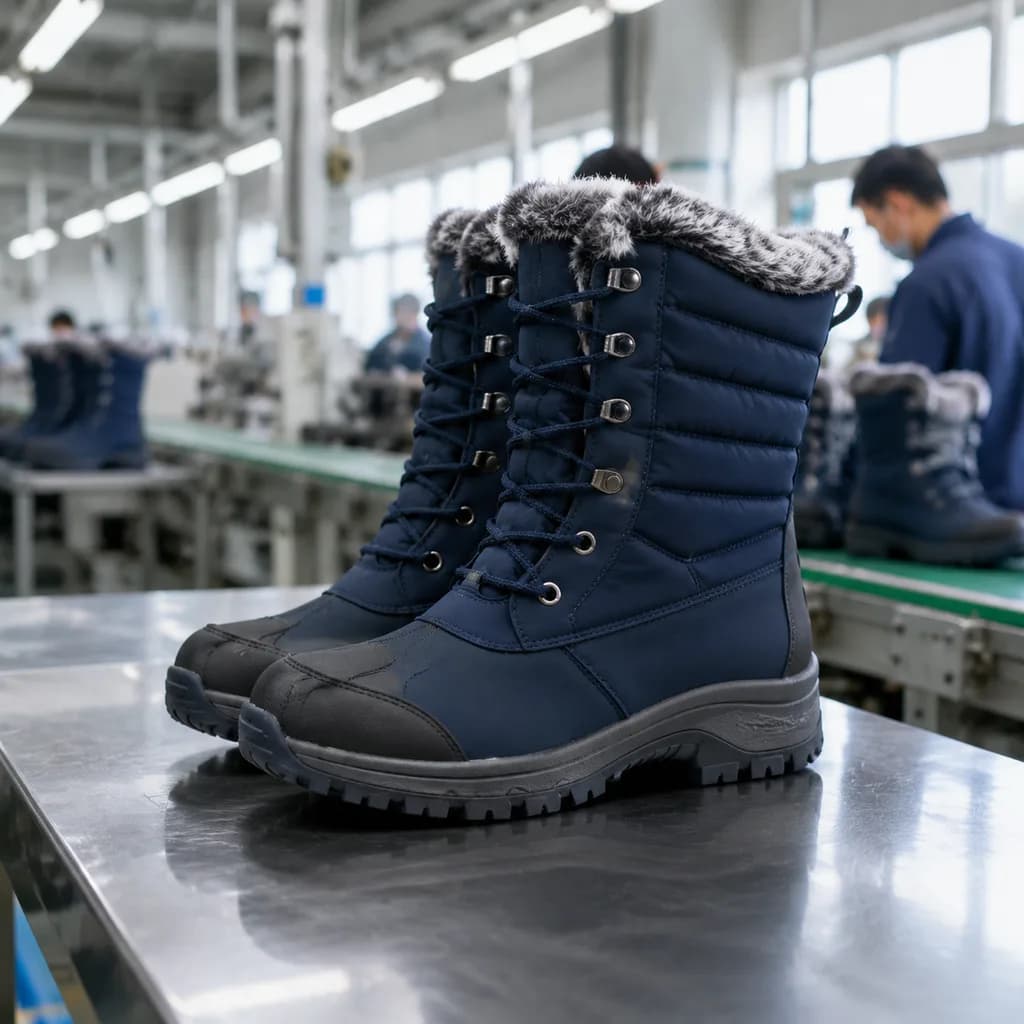
Use a custom winter boot reference sample brief to distinguish source inputs, product decisions, sizing, fit, and unresolved review topics.
For a buyer, the product brief is the place to record what has been decided about a winter boot. A reference item can support that work, yet its purpose needs to be named. A custom winter boot reference sample brief gives each supplied boot, image, or component a defined role and keeps unresolved choices visible in the brief itself.
The working method in this article is editorial guidance for buyers, not a description of a standard SnowBootWorks workflow. It separates buyer-declared source inputs from buyer decisions that still need review. That distinction is useful when a sample is being used to discuss only one part of a product, such as fit or visual direction.
The Brief Holds the Decisions
The SnowBootWorks capabilities page says that custom snow boots are developed to the buyer's own specification. It identifies construction, materials, and approval standards as decision drivers. The statement identifies the topics that drive custom development; it does not identify selections for a particular buyer's boot.
An editorial recommendation is to put each decision into a short register before submitting the inquiry. The register can show what the buyer has selected, what remains open for discussion, and what requires internal confirmation. It should sit alongside the reference material, not inside an assumed interpretation of the reference material.
- Construction
- Record the construction points the buyer has selected. List a separate question for any visible feature being raised for discussion. Name visible features that are outside the request.
- Materials
- Identify material choices that are explicit buyer requirements. Leave appearance-based assumptions out of the selected-requirement field until the buyer records a decision.
- Approval standards
- State the internal criteria the buyer plans to use and identify the person or team able to confirm them.
- Decision status
- Use one status per entry: selected, supplied, open for discussion, or pending internal approval.
This arrangement gives uncertainty a place in the document. A construction question remains a question. A material choice becomes a requirement only when the buyer records it as one. An internal approval topic is visible without suggesting that it has already been resolved.
A Role for Every Reference
A SnowBootWorks case-study excerpt describes a private-label waterproof winter boot program. It says that the program's brand brief moves from reference samples to an export-ready, branded production run. The excerpt mentions reference samples in the account of that brand brief, but it does not assign a general role to samples across SnowBootWorks projects.
For an inquiry, the buyer can assign one declared role to each supplied item. The following register is an editorial template for that task.
Reference-sample scope register
| Source input | Role assigned by the buyer | Record separately in the brief |
|---|---|---|
| Physical reference boot | Fit discussion input | Target sizing system, known reference size, and the fit points to review. |
| Boot photograph or range image | Visual direction | Silhouette, proportion, trim placement, color direction, and excluded details. |
| One feature on a reference item | Construction question | Whether the feature is selected, open for discussion, or included only to explain a question. |
| Existing internal product | Approval comparison | Comparison criteria, decision owner, and the applicable collection context. |
When one boot is relevant to more than one topic, create separate entries for those topics. For example, its shape may be a visual reference while its fit remains outside the request. This approach avoids having a broad instruction such as "match the attached boot" carry decisions that were never stated.
Snow boot reference sample requirements
For each entry, an editorial recommendation is to identify the item or file, its assigned role, the buyer's intended use, and the decision that remains open. An exclusion field is also useful. It can state that a visible detail communicates styling only, belongs to another collection, or is outside the current winter footwear definition. The register then shows what the buyer is asking the recipient to consider without treating the whole item as the governing specification.
Fit and Direction Are Different Inputs
The SnowBootWorks product catalog describes fit-led women's winter boot platforms spanning clean urban, quilted, and plush cold-weather directions. In its buyer-fit content for women's retail and private-label winter collections, the catalog tells buyers to decide the target sizing system and fit reference first, then review the product brief.
Those catalog elements name fit inputs separately from style directions. For the buyer, that is a useful document structure: use a fit field for the target sizing system and designated fit reference, then use a different field for visual direction. Include the size of a supplied reference where it is known, along with the aspects of fit the buyer wants to discuss.
Terms such as clean urban, quilted, and plush cold-weather can describe a direction for a women's winter range. They do not, by themselves, state a sizing system or a fit reference. Keeping those entries apart lets a buyer request discussion of fit without presenting every styling cue as selected, and discuss a visual direction without implying a settled fit position.
Collection Context, Kept in Its Place
The SnowBootWorks industries page describes outdoor retail brand winter footwear programs as balancing comfort, weather protection, and shelf appeal. That is program-level commercial context. It does not name the construction, materials, sizing, or approval standards for an individual boot.
The product catalog's women's snow boot section provides separate direction language for clean urban, quilted, and plush cold-weather platforms. A buyer can use either kind of context to explain where an item belongs in a range. The private label snow boot product brief should still contain its own product decisions, source roles, and unresolved questions. Collection language can orient the inquiry without replacing the definition of the item being discussed.
A Development Inquiry That Can Be Compared
The following is editorial recommended content for a winter footwear development inquiry. It is a buyer-prepared package, not a statement that any particular development, sampling, or quotation outcome will apply.
- A current winter footwear definition that identifies the product category and relevant collection context.
- Each reference file or physical item, with one declared role and any important exclusions.
- The target sizing system and designated fit reference in fields separate from visual direction.
- A decision register covering construction, materials, and approval standards, with a status beside each entry.
- The internal owner for unresolved decisions and approval questions.
- A concise list of open questions that the buyer wants to raise first.
Submit the package through the inquiry page with a clear statement of what needs discussion. Ask which development, sampling, or quotation options may apply to the project. Retaining the same register when reviewing a reply gives the buyer a direct way to check whether the response addresses the known definition, the supplied inputs, and the open questions.
Evidence layer
Evidence checklist: Before Development: A custom winter boot reference sample brief
OEM, ODM, and private label are not just marketing labels. The practical difference is who owns the starting design, how much the construction changes, and which decisions must be approved before bulk production. Put the decision in writing: reference style, required changes, branding locations, packaging scope, tooling assumptions, and the point at which a sample becomes the production reference. For this guide, map each supplier response to “The Brief Holds the Decisions” so a claim is supported by a written specification, sample reference, controlled document, or a clearly marked open question.
A strong brief also records what is out of scope. That prevents a fast sample discussion from silently becoming a new mold, a new size run, or a new compliance requirement. Use the same approval language in the quote, sample comments, and purchase documentation. Cross-check the response against “A Role for Every Reference” and keep every unresolved point visible in the approval record.
- Design ownership and permitted adaptations — scoped to custom winter boot reference sample brief
- Branding, packaging, and tooling boundaries — cross-checked against “The Brief Holds the Decisions”
- Sample approval gates before bulk commitment — with open risks from “A Role for Every Reference” recorded
Decision framework
Buyer checklist
- Buyer recommendation: Assign each reference item a declared role and record exclusions where needed.
- Buyer recommendation: Keep target sizing system and fit reference separate from visual direction.
- Buyer recommendation: Use a decision register to distinguish selected requirements from questions awaiting review.
- Buyer recommendation: Ask which development, sampling, or quotation options may apply to the project.
Sources and verification
Evidence used for this guide.
Continue the specification