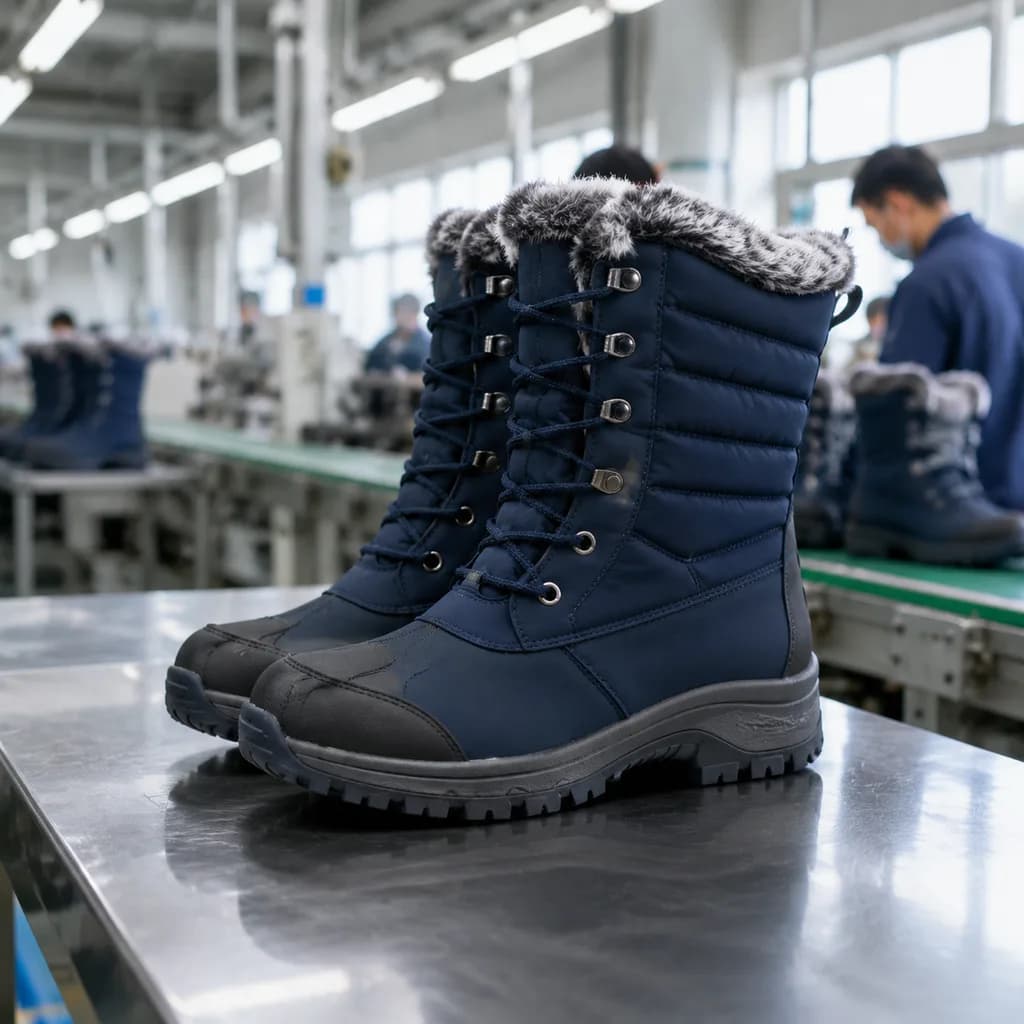
Lock fit reference and specification ownership first for private label winter boots program development, then move from brand brief to an export-ready run.
Private label winter boots program development is a pre-sampling decision sequence. Brand, retail, and import product teams need a locked target sizing system, winter boots fit reference, construction ownership, materials list, and approval standards before any sample round starts. Those fields give OEM and private-label work one product definition. Style boards and cost bands alone leave the same fields empty, so every sample reopens fit, stack-up, and branding questions that belong in the brief.
The path below stays inside published program and capability boundaries. Close fit and specification ownership first. Move from brand brief and reference samples toward an export-ready branded production run. Rank outdoor retail priorities inside that brief. Keep early inquiry topics from replacing decisions that should already be written down.
Close pre-sampling gates before assortment looks
Wholesale and private-label requests still open with assortment looks. Merchants compare clean urban silhouettes, quilted cold-weather styling, or plush directions, then ask for a quote against a price band. Construction ownership, material choices, and approval standards stay unresolved. When those fields remain open, sampling cannot confirm a single product definition.
OEM manufacturing guidance frames custom snow boots as products developed to the buyer’s own specification. Construction, materials, and approval standards drive every decision. That language does not transfer ownership to the factory by default, and it does not turn a partial option list into a guarantee. As an editorial recommendation for the buyer, refuse to treat a mood board plus a landed-cost target as a program brief. Name the owner of construction decisions, the material set under review, and the approval standard that will accept or reject a sample before any sample is requested.
As a further buyer recommendation, close fit and specification ownership early so sample rework does not collide with the seasonal calendar the brand already owns. Teams that start with style often discover mid-cycle that the fit reference does not match the retail size system, or that brand-marking and private-label requirements never entered the brief. Starting with ownership is slower on day one and faster across the program.
Lock the sizing system and winter boots fit reference first
Published product guidance for women’s retail and private-label winter collections sets a clear order of work. Decide the target sizing system and fit reference first. Review the product brief only after those two fields are stable. That order applies to fit-led women’s winter boot platforms spanning clean urban, quilted, and plush cold-weather directions. Do not expand that women’s platform scope into men’s, kids, or universal systems unless your own brief defines those lines separately.
- Record the retail sizing system the brand will sell against for the women’s collection in scope.
- Name the fit reference the sample will be judged against so every later quote and sample request points to the same baseline.
- Only after those two fields are stable, open styling directions such as clean urban, quilted, or plush cold-weather looks against the locked fit base.
- Keep color, trims, and packaging out of the fit decision so they do not masquerade as fit changes during sample review.
Buyers who skip the first two fields often treat a sample rejection as a construction failure when the real issue is an undefined winter boots fit reference. As a buyer recommendation, put the sizing system and fit reference on the first page of the brief, above silhouette sketches. Product developers can then compare platforms on the products catalog without reopening the size story in every meeting.
Assign construction, materials, and approval ownership
Once fit is stable, assign specification ownership. OEM-style custom development, as stated on the capabilities page, is driven by the buyer’s own specification. Construction, materials, and approval standards are the governing inputs, not a catalog swap. The buyer still decides who signs construction, which materials are in scope, and which approval standard closes sampling.
Write those three fields as accountable items rather than adjectives. Construction ownership answers how the boot is built and who can change that stack-up between sample rounds. Materials ownership names the upper, insulation, lining, sole, and membrane or coating choices under review, without inventing ratings the brief does not contain. Approval standards name the person or team that accepts fit, appearance, and brand markings, and the record that will hold the accepted sample state.
Teams that leave these fields vague force suppliers to invent defaults. Defaults create polite samples that do not match retail intent. For an OEM snow boots specification, treat the buyer-owned document as the single source of truth. Link that document in every inquiry so development, sampling, and quotation conversations all point to the same construction and materials decisions. Capability detail for custom programs sits on the capabilities page; use it to align language, not to invent services the brief never requested.
Map the path from brand brief to export-ready branded run
The case studies overview of a waterproof snow boot private label program describes a clear path: a brand brief moves from reference samples to an export-ready, branded production run. Keep this section limited to that sequence. Do not read timelines, MOQs, test results, or waterproof ratings into the overview. The published scope is the movement from brief and reference samples to branded export-ready production, not a full construction textbook.
- Assemble the brand brief with locked sizing system, fit reference, construction ownership, materials list, approval standards, and brand identity requirements.
- Submit reference samples or clearly labeled reference assets that match the fit and construction fields already decided.
- Use private label snow boots sampling to confirm the brief, not to discover the brief. Each round should close named open points rather than invent new ones.
- Accept a sample state against the written approval standard before production language is used.
- Carry brand markings into a branded, export-ready production definition under the same brief.
That path is the published private-label program shape. Buyers still decide which development, sampling, or quotation options apply to a given project. Asking which of those options apply is a valid inquiry move; treating the ask as a pre-scoped service promise is not. Review the program overview on the case studies page when you need the sequence language in one place, then keep your internal checklist stricter than any marketing summary.
Rank outdoor retail priorities inside the brief
Outdoor retail winter footwear programs are described as balancing comfort, weather protection, and shelf appeal. That framing is an assortment priority statement, not proof of finished-boot performance and not a claim of extra services beyond the industries statement. Rank those three priorities inside the brief so merchants and product developers argue about tradeoffs early, while construction and materials ownership still has room to move.
| Priority | What to decide in the brief | What not to invent early |
|---|---|---|
| Comfort | Fit reference and lining feel targets tied to the size system | Temperature or insulation performance claims without your own evidence plan |
| Weather protection | Which construction and material choices must support the brand’s weather story | Lab ratings or finished-boot waterproof outcomes the program has not defined |
| Shelf appeal | Silhouette family, color story, brand markings, and pack presentation for retail | Assortment breadth that reopens fit or construction after samples start |
Force a ranked order of primary, secondary, and tertiary among comfort, weather protection, and shelf appeal before you widen colorways or add companion styles. Outdoor retail teams that keep all three equal often expand the brief every week. Ranking keeps private label winter boots program development inside a controllable width. Industry context for outdoor retail sits on the industries page; use it to name buyer fit, not to claim tested outcomes.
Keep inquiry topics separate from locked program decisions
Early commercial conversations mix open questions with decisions that should already be closed. Separate the two so an inquiry cannot replace a brief.
Lock before you inquire about sampling or quotation detail
- Target sizing system and winter boots fit reference for the women’s private-label or retail collection in scope
- Construction ownership and the construction definition under review
- Materials ownership and the material set allowed for the first sample path
- Approval standards and the named approver for fit, appearance, and brand marks
- Brand brief fields needed for a waterproof private-label path from reference samples toward an export-ready branded run
Reasonable early inquiry topics once those fields exist
- Which development options may apply to the current winter footwear definition
- Which sampling options may apply after the fit reference and construction ownership are written
- Which quotation information may apply once materials and approval standards are named
- How outdoor retail priorities (comfort, weather protection, shelf appeal) should be reflected in the next sample request without widening scope
Do not treat development, sampling, packing, or quotation topics as documented service promises unless your project record and the supplier’s reply say so. The buyer may ask which of those topics apply; the answer is project-specific. Keep the locked fields in one shared document so each reply maps back to the same OEM snow boots specification baseline rather than to a new verbal summary.
Share the winter footwear definition and next options
A workable private-label brief is a decision ledger. Fit and specification ownership come first. Sampling confirms those fields along the published path from brand brief and reference samples to an export-ready branded production run. Outdoor retail priorities stay ranked inside that ledger. Inquiry topics stay subordinate to it.
If you are ready for a commercial conversation, state your current winter footwear definition in plain language: category, gender and market scope you actually own, fit reference status, construction and materials ownership, and approval standard. Then ask which development, sampling, or quotation options may apply to that definition. Use the request a quote path to share that definition and the open options you want reviewed.
Evidence layer
Evidence checklist: Pre-Sampling Private Label Winter Boots Program Development
OEM, ODM, and private label are not just marketing labels. The practical difference is who owns the starting design, how much the construction changes, and which decisions must be approved before bulk production. Put the decision in writing: reference style, required changes, branding locations, packaging scope, tooling assumptions, and the point at which a sample becomes the production reference. For this guide, map each supplier response to “Close pre-sampling gates before assortment looks” so a claim is supported by a written specification, sample reference, controlled document, or a clearly marked open question.
A strong brief also records what is out of scope. That prevents a fast sample discussion from silently becoming a new mold, a new size run, or a new compliance requirement. Use the same approval language in the quote, sample comments, and purchase documentation. Cross-check the response against “Lock the sizing system and winter boots fit reference first” and keep every unresolved point visible in the approval record.
- Design ownership and permitted adaptations — scoped to private label winter boots program development
- Branding, packaging, and tooling boundaries — cross-checked against “Close pre-sampling gates before assortment looks”
- Sample approval gates before bulk commitment — with open risks from “Lock the sizing system and winter boots fit reference first” recorded
Decision framework
Buyer checklist
- Treat private label winter boots program development as a pre-sampling decision sequence: close sizing, fit reference, construction ownership, materials, and approval standards before style review.
- Lock target sizing system and winter boots fit reference before reviewing clean urban, quilted, or plush directions on women’s platforms covered by published product guidance.
- Treat construction, materials, and approval standards as buyer-owned fields that drive OEM snow boots specification decisions rather than catalog defaults.
- Keep the private-label path to the published sequence: brand brief, reference samples, then export-ready branded production run.
- Rank outdoor retail comfort, weather protection, and shelf appeal inside the brief without treating them as finished-boot performance claims.
Sources and verification
Evidence used for this guide.
Continue the specification
Move from research to a controlled brief.
Frequently asked questions
Questions buyers ask next
What should be locked before private label snow boots sampling starts?
Lock the target sizing system and fit reference, construction ownership, materials under review, and the approval standard that will accept or reject samples. Sampling should confirm those fields, not discover them.
How is an OEM snow boots specification different from a style board?
An OEM specification names the buyer's construction, materials, and approval standards as the decisions that drive development. A style board without those fields leaves sample rounds free to reopen the product definition.
What does the published waterproof private-label program path cover?
It shows how a brand brief moves from reference samples to an export-ready, branded production run. It does not by itself document MOQs, lead times, lab ratings, or finished-boot test results.