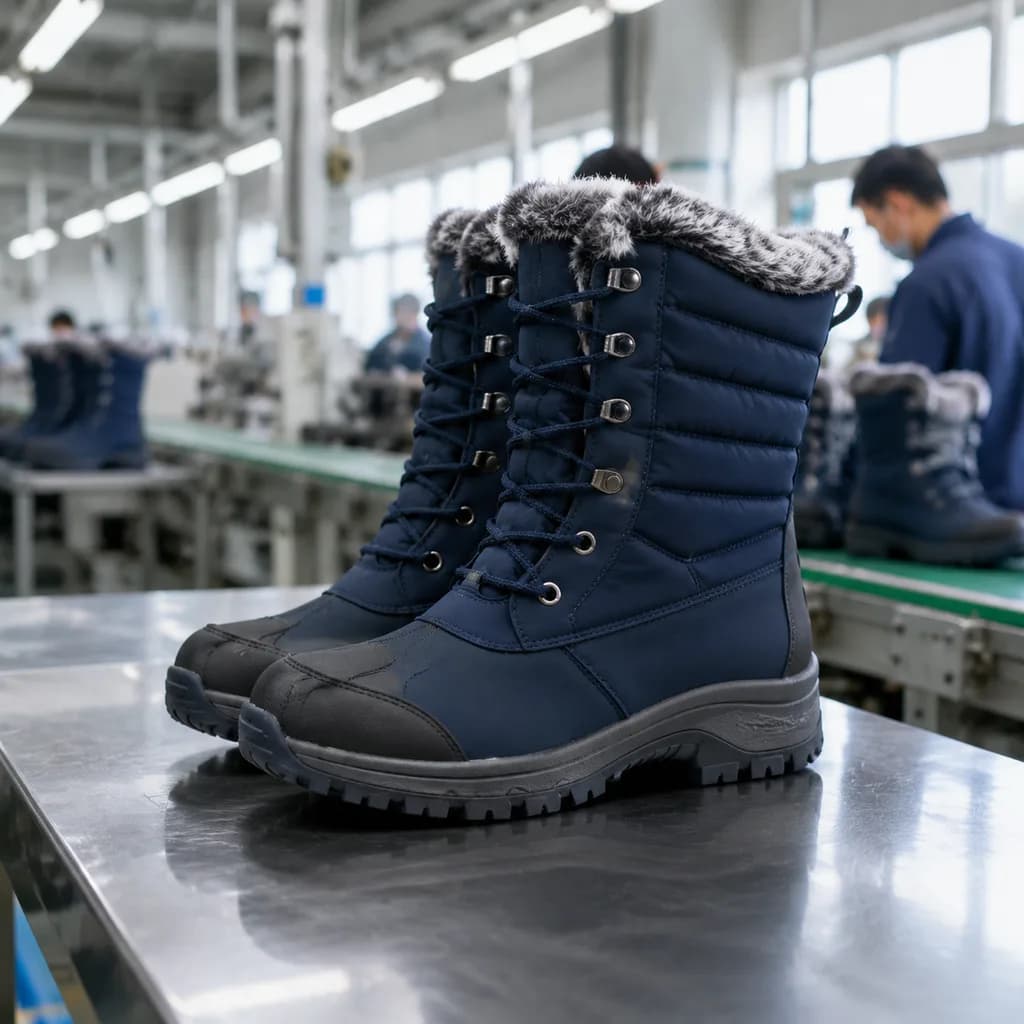
Rank comfort, weather protection, and shelf appeal before locking construction, materials, and approval standards for outdoor retail winter footwear programs.
Merchandising wants the boot to read clearly on a crowded shelf. Product wants wet-cold protection that holds up outside the store. Sourcing wants a build that can be costed and sampled without endless revision. When those three goals land in one custom winter boot RFQ with no ranking, each supplier invents a different winner. Quotes look like different products, and sample reviews turn into preference debates.
That control break is a missing set of outdoor retail winter footwear program priorities. SnowBootWorks describes outdoor retail brand work as winter footwear programs that balance comfort, weather protection, and shelf appeal. Balance is not equal weight. Buyers need one primary and two supporting roles written down before construction and material language freezes. The guidance below is buyer-side briefing practice: force the rank, feed it into manufacturer-facing drivers, then handle women’s platforms, private-label end state, and the inquiry packet only after the stack exists.
Where outdoor retail winter boot briefs lose control first
The brief is usually where control slips. Merchandising treats shelf presence as non-negotiable. Product treats weather claims as non-negotiable. Sourcing treats cost-to-construct as the real governor. Without a written primary priority, every stakeholder can claim top rank. The manufacturer receives that conflict as ambiguity, and ambiguity returns as revision loops.
A common failure pattern: one RFQ line asks for plush handfeel, aggressive water management, and a slim retail silhouette, with no note about which goal wins a conflict. Three suppliers quote three packages. Sample feedback becomes “which feels right” rather than a check against a declared commercial job. The repair is a short rank statement, not a longer feature list.
Build a three-way priority stack before any material list
Editorial recommendation for the buyer: limit the first pass to comfort, weather protection, and shelf appeal. Assign one primary and two supporting roles. Equal top ranking only recreates non-comparable RFQs under cleaner formatting.
- Name the commercial job of the style family in one sentence. Everyday comfort-led winter slot, weather-led outdoor slot, or visual-led retail assortment slot. Write the job before fabrics or bottoms.
- Assign primary, secondary, and tertiary roles. Editorial pattern only (buyer choice, not a factory rule): weather protection primary, comfort secondary, shelf appeal tertiary for a wet-cold utility line; shelf appeal primary, comfort secondary, weather protection tertiary for a fashion-forward women’s capsule.
- State what each rank may overrule. Primary overrules secondary when they conflict. Secondary overrules tertiary. If conflict remains after that rule, the brief is unfinished.
- Freeze the stack before material talk. Upper type, insulation direction, sole construction, and finish language should serve the stack rather than rewrite it.
Use a simple internal disagreement test. If two stakeholders disagree on a sample, can both point to the same primary priority? If not, re-rank before asking a manufacturer to rework construction. Carry the written stack into fit, visual, and weather-related review gates so comments stay on-mission.
Convert each ranked priority into construction, materials, and approval standards
SnowBootWorks presents OEM custom snow boot manufacturing as development to the buyer’s own specification, with construction, materials, and approval standards driving every decision. That decision surface is what the priority stack should feed. For teams evaluating a custom snow boots manufacturer OEM path, rank order is the buyer-side input; construction, materials, and approval standards are the language the manufacturer can act on.
The table below is buyer editorial guidance for translating ranks into those three drivers. It is not a published lab slate, test method list, or pass/fail threshold set.
| If this is primary | Construction focus | Materials focus | Approval-standard focus |
|---|---|---|---|
| Comfort | Last shape, collar and tongue build, flex points, weight distribution of the package | Lining handfeel, cushioning stack, flexibility of upper and midsole choices | Wear comfort against the agreed fit reference and wear-session criteria you define for the program |
| Weather protection | Seam and closure strategy, bottom attachment integrity, coverage height, water-management path | Upper barrier approach, insulation direction, sole compound and tread intent suited to wet or cold use | Weather-related acceptance criteria you own for the brief, including any third-party methods you require |
| Shelf appeal | Silhouette readability, proportion of shaft and sole, hardware and trim placement | Visible surface, color and finish consistency, contrast materials that hold under retail lighting | Visual approval against assortment references, color standards, and photo or shelf criteria you control |
Supporting priorities enter as constraints, not co-primaries. If weather protection is primary and comfort is secondary, insulation and barrier choices may limit how soft the package can become. Record that constraint so later comfort comments do not quietly overturn the primary rank. Approval standards stay program-owned: when your retailer, importer, or brand compliance team requires named methods, put them in the brief as buyer-owned criteria; when they do not, still define what will decide sample acceptance.
Tying rank order to construction, materials, and approval standards makes factory and quote-pack responses scorable against the same program intent. See SnowBootWorks’ OEM manufacturing capabilities for how that decision language is framed on the manufacturer side.
Anchor women’s retail or private-label collections with platform direction and fit reference
Women’s retail and private-label winter collections should add platform direction and fit reference only after priorities are ranked. On the SnowBootWorks products overview, fashion and fit women’s snow boots are presented as fit-led women's winter boot platforms spanning clean urban, quilted, and plush cold-weather directions. Buyer fit for women’s retail and private-label winter collections is framed around deciding first on a target sizing system and fit reference.
Platform talk without rank order becomes style browsing. Platform talk without a sizing system and fit reference produces non-comparable samples. Editorial sequence for the buyer:
- Confirm the ranked stack for the women’s family. Write the primary explicitly rather than assuming a platform name carries it.
- Pick a platform direction as a family, not a finished SKU list. Treat clean urban, quilted, and plush cold-weather as directional families on the product overview, not as a claim that those three exhaust every assortment option.
- Decide the target sizing system before detailed quotation language. State which system merchandising will sell against and how size runs will be communicated.
- Attach a reusable fit reference. A physical reference boot, an approved last direction, or a documented internal fit standard works if the team can reapply it at each sample gate.
- Then discuss platform options against that written base. Sampling and pricing conversations become useful once rank, direction, sizing system, and fit reference are recorded.
When men’s utility and women’s fashion-led winter sets share commercial intent, keep the priority stack shared at program level and allow women’s families to diverge at platform and fit reference. More product-family context sits on the product catalog overview; the buyer still owns rank order and fit-reference discipline.
Use the waterproof private-label path as an end-state definition, not a feature list
When outdoor retail work needs a waterproof private-label path, define commercial “done” early. SnowBootWorks’ case-study overview describes a private label waterproof winter boot program as a brand brief that moves from reference samples to an export-ready, branded production run. That is a program shape, not a waterproof feature menu, volume claim, or performance number.
Editorial guidance: keep feature language subordinate to the ranked priorities and to three buyer-owned definitions:
- Brand brief completeness — ranked priorities, commercial end use, brand or retail identity requirements, and retailer constraints that must survive into branded production.
- Reference sample purpose — which decisions samples must settle (fit, visual, weather-related acceptance criteria you specify) and which decisions remain open.
- Export-ready branded run criteria — packaging, marking, and approval gates your team requires before production is considered ready to export under your brand.
That keeps the case-study language in documented scope: brief to reference samples to export-ready branded production, without adding logistics process claims, volumes, customers, or test results the overview does not state. Program context is summarized on the case studies page. Channel differences (branded vs private label) change packaging and brand-control details; they do not remove the need for a written comfort / weather / shelf-appeal stack before construction and materials freeze.
What to share when you request development, sampling, or quotation options
Once the stack, platform direction (if needed), and end state are clear enough to discuss next steps, assemble a short packet. Share the current winter footwear definition and ask which development, sampling, or quotation options may apply to the project. Treat those as topics to discuss, not as a fixed service menu with commercial terms in this article.
- Current winter footwear definition — category, gender or unisex intent, end use, retail channel, and whether the work is OEM custom or private label.
- Ranked outdoor retail winter footwear program priorities — one primary and two supporting roles among comfort, weather protection, and shelf appeal, plus what each rank may overrule.
- Construction, materials, and approval-standard notes tied to that stack — enough detail for a manufacturer to see decision drivers, without treating unpublished lab methods as already agreed.
- Platform direction and fit reference when women’s retail or private-label collections are in scope — target sizing system, fit reference, and directional family (clean urban, quilted, or plush cold-weather) where relevant.
- Private-label end state if waterproof branded production is the goal — brand brief status, what reference samples must settle, and what “export-ready branded run” means for your team.
- Open gaps labeled as open gaps — missing retailer constraints, undecided colorways, or unresolved weather-acceptance methods should not hide inside vague adjectives.
Hypothetical packet for internal assembly only: a mid-tier outdoor retailer ranks weather protection primary for a women’s wet-cold capsule, chooses a quilted cold-weather direction after the stack, attaches a target sizing system and a fit reference boot, and asks which sampling and quotation options apply to that definition. Commercial quantities, MOQs, prices, and lead times are outside the evidence used here and should be requested as project-specific information.
Industry context for outdoor retail brand programs is outlined on the industries page. When the packet is ready, use the request a quote form to share the current winter footwear definition and ask which development, sampling, or quotation options may apply to the project.
Evidence layer
Evidence checklist: Outdoor Retail Winter Footwear Program Priorities
OEM, ODM, and private label are not just marketing labels. The practical difference is who owns the starting design, how much the construction changes, and which decisions must be approved before bulk production. Put the decision in writing: reference style, required changes, branding locations, packaging scope, tooling assumptions, and the point at which a sample becomes the production reference. For this guide, map each supplier response to “Where outdoor retail winter boot briefs lose control first” so a claim is supported by a written specification, sample reference, controlled document, or a clearly marked open question.
A strong brief also records what is out of scope. That prevents a fast sample discussion from silently becoming a new mold, a new size run, or a new compliance requirement. Use the same approval language in the quote, sample comments, and purchase documentation. Cross-check the response against “Build a three-way priority stack before any material list” and keep every unresolved point visible in the approval record.
- Design ownership and permitted adaptations — scoped to outdoor retail winter footwear program priorities
- Branding, packaging, and tooling boundaries — cross-checked against “Where outdoor retail winter boot briefs lose control first”
- Sample approval gates before bulk commitment — with open risks from “Build a three-way priority stack before any material list” recorded
Decision framework
Buyer checklist
- Force one primary and two supporting roles among comfort, weather protection, and shelf appeal before any material list.
- Translate each rank into construction focus, materials focus, and approval-standard focus the manufacturer can act on.
- For women’s retail or private-label collections, choose platform direction only after the stack, then lock sizing system and fit reference.
- Treat a private label waterproof winter boot program as brief to reference samples to export-ready branded run, not as an unbounded feature menu.
- Submit ranked priorities, open gaps, and the current winter footwear definition when asking which development, sampling, or quotation options may apply.
Sources and verification
Evidence used for this guide.
Continue the specification
Move from research to a controlled brief.
Frequently asked questions
Questions buyers ask next
Why rank outdoor retail winter footwear program priorities before sending a material list?
Unranked comfort, weather protection, and shelf appeal goals produce non-comparable RFQs and sample feedback. A written primary-plus-supporting stack gives construction, materials, and approval standards a decision rule before suppliers quote different interpretations of the same brief.
What should women’s outdoor retail collections lock after the priority stack?
After ranking, set platform direction and decide first on a target sizing system and fit reference. Fit-led women’s winter boot platforms may include clean urban, quilted, and plush cold-weather directions as directional families; those directions are not a substitute for ranking or fit reference.
How should buyers frame a waterproof private-label end state?
Define the commercial end state as a brand brief that can move through reference samples to an export-ready, branded production run under buyer-owned approval standards. Keep feature detail subordinate to ranked priorities and that end-state definition.