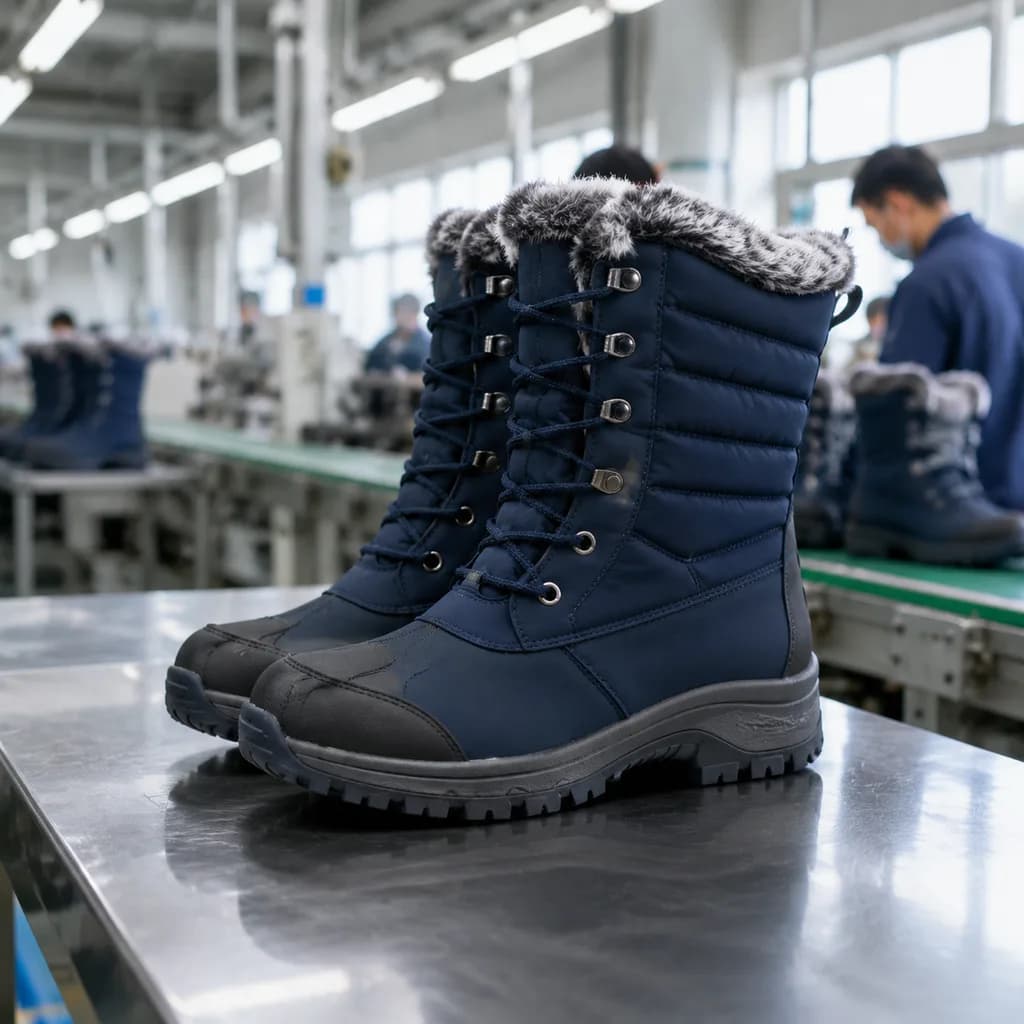
Use private label women's winter boots sizing and a shared fit reference as the gate before urban, quilted, or plush platforms, samples, and OEM approval.
Wholesale and private-label teams often place two women's winter silhouettes on one size run and discover, only at sample review, that insulation mass and lining pile shifted free volume. Private label women's winter boots sizing is the gate that prevents that mismatch: name the commercial size scale and a concrete fit reference before urban, quilted, or plush platform work begins, then hand that same basis to construction and approval.
The product catalog for women's retail and private-label winter collections puts the order in plain terms. Decide the target sizing system and fit reference first, then review platform direction. That sequence keeps multi-style lines comparable and keeps OEM decisions from reverse-engineering volume out of a styled prototype.
Keep printed sizes honest across a multi-style women's line
When a catalog or private-label program carries more than one cold-weather silhouette, buyers need a single answer to "what does this size mean?" Without that answer, reviewers compare photographs and pile height instead of a shared baseline. Feedback becomes subjective ("snug with a thermal sock," "roomy for dress wear") and reorders diverge from the first season.
A written fit reference turns those comments into gaps against one baseline. Style mood boards and weather claims still matter for outdoor retail, but they do not replace the commercial scale on the label or the physical or documented reference that defines true-to-size for the collection. For the buyer, treat multi-platform size-run honesty as a procurement stage, not a late sample fix.
Name the sizing system and fit reference before any platform
A sizing system is the commercial scale the brand will sell against, for example US women's whole and half sizes, or another market scale the retail channel already uses. A fit reference is the concrete basis used to interpret that scale: a retained sample the team trusts, a graded last family already approved in a prior season, or a documented volume profile the brand will hold across styles. The products catalog asks buyers to decide both first for women's retail and private-label winter collections. It does not prescribe a mandatory last geometry or a market-wide standard.
The following buyer-side questions make later construction and approval workable. They are not a catalog field list:
- Which commercial size scale will appear on packaging and product data for the collection?
- What physical or documented reference defines "true to size" for that scale (sample pair, last code, or graded volume note)?
- How much sock-room allowance is expected for cold-weather use, and is that allowance part of the reference or an intentional oversize?
- Which entry method (pull-on, zip, lace) the fit reference assumes, so collar and shaft volume are not judged in isolation?
- Which size is the development base, and which nearby sizes will be checked before production approval?
If any of those answers is still open, platform styling is premature. Freeze the answers in writing before requesting styled samples that already carry branding intent.
How urban, quilted, and plush directions depend on fit volume
Once the sizing system and fit reference are fixed, platform directions become comparable rather than competing mood boards. The women's product range is framed as fit-led winter boot platforms spanning clean urban, quilted, and plush cold-weather directions. Each direction consumes volume differently, so the same foot reference can support more than one shelf story only when that reference is stable.
| Platform direction | Fit-volume dependency | Outdoor retail balance to watch |
|---|---|---|
| Clean urban | Often prefers a closer shaft and a neater toe profile that still clears a midweight sock under the named fit reference | Shelf appeal can push a slim silhouette; weather protection and comfort still need room defined by the reference, not by the photo crop |
| Quilted | Padding and channeling add bulk; collar and vamp volume must still match the same size scale as cleaner styles in the line | Comfort and weather coverage improve with insulation mass, but grade expectations must keep the printed size honest against the fit reference |
| Plush cold-weather | Pile linings and higher shaft builds reduce free volume; entry and sock room need explicit checks against the same reference used for urban SKUs | Comfort and cold-weather cues are strong on shelf; they do not replace a buyer-defined weather and fit specification |
Outdoor retail winter footwear programs are described as a balance of comfort, weather protection, and shelf appeal. That balance is a program goal, not a ranking of styles. A clean urban boot and a plush cold-weather boot can share one women's size run only if both are judged against the same fit reference. Without that lock, wholesale teams often discover that "same size" labels hide different internal volumes across the line.
When comparing directions, keep the women's winter boots fit reference constant and change only the platform variables you intend to sell. That is the practical meaning of fit-led platforms: style follows volume rules already accepted by the brand.
Construction, materials, and approval standards after the fit basis
OEM manufacturing is described as developing custom snow boots to the buyer's own specification, with construction, materials, and approval standards driving every decision. That wording puts the specification in the buyer's seat. The fit reference is part of that specification. When teams skip it, construction debates become proxy fights over fit: a thicker lining is rejected as "too tight," or a stiffer waterproof build is blamed for a narrow entry that the last never intended to open.
A cleaner split of work keeps those debates in the right order. First, name the size scale and fit reference. Second, choose materials and construction methods that can meet weather and durability goals inside that volume. Third, write approval standards that measure both performance claims and fit against the same base sample. For wholesale women's snow boots sizing across a multi-style line, that means urban, quilted, and plush SKUs share grade expectations even when their materials differ.
Do not reverse-engineer the fit reference from a single styled prototype. If the prototype is the only evidence of intended volume, convert it into an explicit reference (retained sample, measured notes, or both) before expanding materials or branding. OEM language in the capabilities overview supports specification-led decisions. It does not replace the buyer's duty to state what "approved fit" means for the collection.
Private-label sample-to-export work once fit is stable
A private-label waterproof winter boot program is presented as the path from a brand brief and reference samples to an export-ready, branded production run. That path only stays controlled when the fit reference is stable enough that construction and branding decisions can be interpreted against it. If the reference changes after upper patterns or outsole tooling are already in motion, sample rounds multiply for reasons unrelated to weather claims.
The program overview does not document a fixed factory control checklist. After a stable fit reference, private-label teams commonly sequence work this way on the buyer side:
- Confirm the commercial size scale and the physical or documented fit reference before requesting styled samples.
- Approve a base-size sample against that reference for entry, sock room, and shaft behavior, not only for appearance.
- Freeze construction choices that affect volume (lining pile, insulation mass, collar height, closure type) against the approved fit sample.
- Apply brand marks and packaging language only after the fit sample is accepted, so artwork is not rebuilt around a revised last or collar.
- Carry the same reference into production approval so size runs remain consistent with the samples the brand signed.
Buyers can still ask which development, sampling, or quotation options may apply to a given project once the fit basis and platform direction are clear enough to discuss. The overview does not list commercial quantities, lead times, or pricing.
Fit-first checklist before development or quotation
Before opening development or asking which sampling or quotation path may apply, share a short fit-and-platform package rather than a full product encyclopedia. Keep it distinct from longer quote-ready field inventories and focus on the decisions that unlock women's winter boot platform fit work:
- Markets and commercial size scale the women's line will sell against
- Named fit reference and the base size that development will hold
- Cold-weather sock-room and entry rules under that reference
- One or more platform directions (clean urban, quilted, plush cold-weather) chosen only after volume is fixed
- Weather and comfort priorities construction must meet without abandoning the fit basis
- Program stage: private-label waterproof with branding through to an export-ready run, or still exploratory sampling
- How the brand will accept or reject construction and materials against the fit sample
If one hypothetical example helps: a catalog team wants a quilted women's winter boot beside a cleaner urban silhouette under one size run. The useful first message is not fabric swatches alone. It is the shared size scale, the fit reference both styles must pass, and the sock-room rule that keeps quilt bulk from shifting printed sizes. Platform materials can follow that lock.
When those points are ready, review the women's product directions, the OEM specification approach, the private-label waterproof program overview, and how outdoor retail programs balance comfort, weather protection, and shelf appeal. Then share the current winter footwear definition for the project and ask which development, sampling, or quotation options may apply through request a quote.
Evidence layer
Evidence checklist: Lock Fit First for Private Label Women's Winter Boots Sizing
OEM, ODM, and private label are not just marketing labels. The practical difference is who owns the starting design, how much the construction changes, and which decisions must be approved before bulk production. Put the decision in writing: reference style, required changes, branding locations, packaging scope, tooling assumptions, and the point at which a sample becomes the production reference. For this guide, map each supplier response to “Keep printed sizes honest across a multi-style women's line” so a claim is supported by a written specification, sample reference, controlled document, or a clearly marked open question.
A strong brief also records what is out of scope. That prevents a fast sample discussion from silently becoming a new mold, a new size run, or a new compliance requirement. Use the same approval language in the quote, sample comments, and purchase documentation. Cross-check the response against “Name the sizing system and fit reference before any platform” and keep every unresolved point visible in the approval record.
- Design ownership and permitted adaptations — scoped to private label women's winter boots sizing
- Branding, packaging, and tooling boundaries — cross-checked against “Keep printed sizes honest across a multi-style women's line”
- Sample approval gates before bulk commitment — with open risks from “Name the sizing system and fit reference before any platform” recorded
Decision framework
Buyer checklist
- Name the commercial size scale and a concrete fit reference before choosing urban, quilted, or plush women's winter platforms.
- Judge multi-style lines against one women's winter boots fit reference so printed sizes stay honest across insulation and lining builds.
- Hand a stable fit sample into construction freezes and private-label branding toward export-ready production.
- Use construction, materials, and approval standards to serve a buyer-written specification rather than reverse-engineering fit from a styled prototype.
- Share a short fit-and-platform package when asking which development, sampling, or quotation options may apply.
Sources and verification
Evidence used for this guide.
Continue the specification
Move from research to a controlled brief.
Frequently asked questions
Questions buyers ask next
What should a women's private-label fit reference include before platform styling?
As a buyer-side package, state the commercial size scale, the physical or documented reference that defines true-to-size, sock-room and entry expectations for cold-weather use, the development base size, and how nearby sizes will be checked. Platform direction should wait until those points are written.
Can urban, quilted, and plush women's winter boots share one wholesale size run?
They can share a size run when all styles are judged against the same fit reference and grade expectations. Different insulation mass and lining pile change free volume, so each platform still needs explicit checks against that shared reference rather than visual comparison alone.