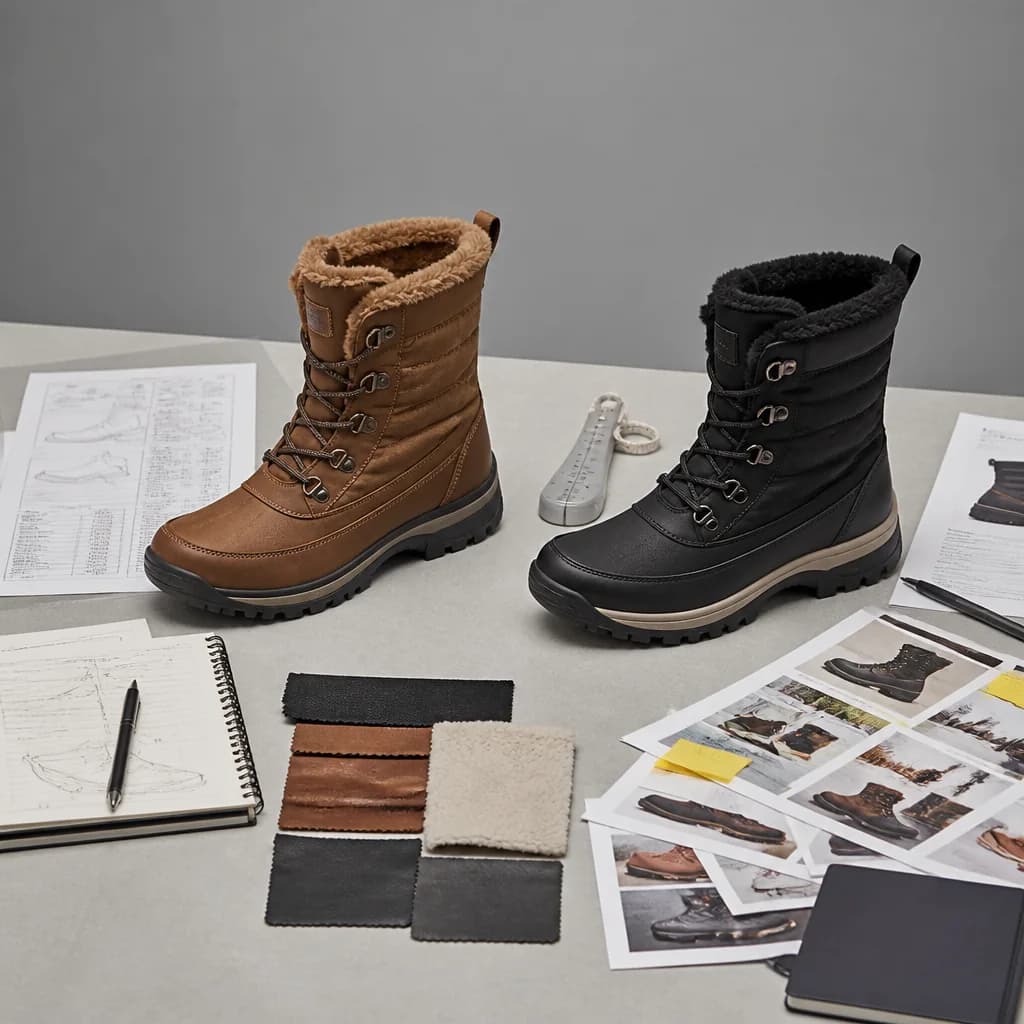
Prepare a specification-led or brief-and-reference inquiry for women's winter boots while keeping fit, retail goals and open questions visible.
When a sourcing team discusses OEM vs private label women's winter boots, the route name should follow the material ready to submit. SnowBootWorks documents custom OEM development against a buyer's own specification. A separate case study describes one private-label program that began with a brand brief and reference samples. These sources support two starting points, but they do not define universal service packages.
The recommendations below are editorial preparation steps for buyers, not a description of a standard SnowBootWorks workflow. Buyers with an established specification can present that document as the basis of the inquiry. Buyers working from a brand brief and reference samples can describe those materials and ask whether the path shown in the documented private-label program is relevant to their project.
Build the project packet before choosing a label
A route name cannot replace the product information behind it. This guide recommends reviewing every item in the project packet and assigning it one of four roles. Doing that first makes it easier to show what the buyer has decided and what still requires discussion.
- Requirement
A condition the buyer currently considers necessary. Identify its source and keep it distinct from preferences or visual references.
- Preference
A direction the buyer would like to retain but has not designated as mandatory.
- Reference
A sample, image or document included to communicate a particular feature. State which feature matters instead of allowing the entire reference to stand for the intended product.
- Open decision
A question for which the buyer is seeking project-specific information. Keep it visibly unresolved rather than inserting an assumed answer.
This classification is useful for either starting point. A detailed specification may still contain preferences and open decisions. A brand brief may contain firm requirements as well as visual direction. The organizing document determines how the inquiry is presented; it does not make every entry final.
The specification-led OEM path
The SnowBootWorks capabilities page states that custom snow boots can be developed to the buyer's own specification, with construction, materials and approval standards driving decisions. That is the documented boundary for a specification-led OEM inquiry.
The source does not identify accepted file formats, available components, approval procedures or the range of specifications that can be accommodated. The buyer's packet should therefore present proposed requirements for review rather than presume feasibility.
For a clearer submission, this guide recommends identifying the specification as the controlling document and marking the status of its entries. Construction and material requirements can be separated from preferences. Proposed approval standards can have their own section, apart from any testing, certification or supporting material the buyer already holds. Unresolved entries should remain marked as questions.
References may still accompany the specification, but their role should be explicit. A reference might communicate a preferred upper treatment, visual direction or other selected feature without replacing the buyer's written requirements. This keeps the women's winter boot development inquiry centered on the specification.
What can a brief and reference set show?
The SnowBootWorks case study describes one private-label program in which a brand brief moved from reference samples to an export-ready, branded production run. It documents that program's starting materials and stated endpoint. It does not establish a standard sequence, a standard private-label package or the availability of catalog selection or branding-only arrangements.
For buyers whose current material is a brief and reference set, the safer approach is to describe exactly what is available. They can then ask whether the path shown by that program is relevant to the proposed private label women's snow boots project.
- Brand brief
Summarize the intended customer, use context, retail position and visual objective. Mark comfort or weather-protection statements as objectives unless the buyer has already defined the corresponding requirements.
- Reference set
Explain the purpose of each sample or image. Identify the feature being referenced and whether it is required, preferred, unsuitable or included only for comparison.
- Brand direction
State the desired brand presentation while listing implementation details that still need to be discussed.
This packet does not need to imitate a complete technical specification. Its purpose is to show what the brief establishes, what the references communicate and where product definition is still open.
Fit belongs in both project packets
The SnowBootWorks women's product catalog presents fit-led women's winter boot platforms across clean urban, quilted and plush cold-weather directions. It also instructs buyers to decide the target sizing system and fit reference first.
This guide recommends carrying those two fit inputs with either an OEM specification or a brief-and-reference inquiry:
- Target sizing system: Name the system the project is intended to use, or mark it as unresolved.
- Fit reference: Identify the reference and explain the role it should play in the project discussion.
- Product direction: Note a relevant clean urban, quilted or plush direction only when it helps communicate the brief.
Keep the fit basis separate from visual direction. A quilted or plush reference can communicate an appearance without defining the sizing system or the intended use of a fit reference. Separating those fields prevents a style image from silently becoming the authority for unrelated decisions.
Route comparison at submission
| Submission point | Specification-led OEM inquiry | Brief-and-reference inquiry |
|---|---|---|
| Documented starting point | Buyer's own specification. | One cited private-label program began with a brand brief and reference samples. |
| Organizing material | Use the specification to distinguish requirements, preferences and open decisions. | Use the brief to state project intent and explain the role of each reference. |
| Fit information | Include the target sizing system and fit reference with the specification. | Include the target sizing system and fit reference with the brief and references. |
| Route-specific question | Ask which development, sampling or quotation information may be available for the submitted definition. | Ask whether the path shown in the cited program is relevant and which options, if any, may apply. |
| Items to preserve as open | Any specification entries that have not been confirmed internally or discussed with the supplier. | Any product decisions that the brief and references do not settle. |
The table compares submission strategies, not confirmed service menus. A packet may contain both technical requirements and brand references. The buyer should still identify which document is intended to organize the initial discussion.
Retail intent and product definition
SnowBootWorks describes winter footwear programs for outdoor retail brands as balancing comfort, weather protection and shelf appeal. Those considerations can be carried into the project packet without presenting them as measured product results.
- Comfort objective
Describe the intended wearing context and the fit objective the buyer wants to discuss.
- Weather-protection objective
State the intended requirement or claim and ask what project-specific substantiation information, if any, may be available or required.
- Shelf-appeal objective
Connect the visual direction to the intended assortment and retail position.
Keeping these objectives in separate fields helps preserve the commercial purpose of the product while showing which technical and evidence questions remain open.
Questions not answered by the source record
The supplied excerpts do not establish quantities, prices, schedules, sample stages, test methods, certifications or general export arrangements. They also do not address Canada-specific compliance, labeling, customs or delivery requirements. Buyers should retain these as inquiry questions rather than assigning assumed values or procedures.
- Commercial information: Is project-specific MOQ, pricing, packing or quotation information available after the current definition is reviewed?
- Development and sampling: Which options, if any, may apply to the submitted project, and what buyer inputs would be needed for further discussion?
- Evidence: What testing documents, certifications or other substantiation would be relevant to the intended product claims and destination?
- Scheduling: What timing information, if any, can be discussed once the product definition and proposed quantity have been reviewed?
- Destination requirements: Which labeling, customs, delivery or Canada-specific matters must the buyer confirm with the responsible parties?
- Export arrangements: What arrangements, if any, would apply to this project rather than to the program described in the case study?
The final project handoff
A concise handoff should make the starting point visible without presenting unresolved work as complete. This guide recommends including the following fields:
- Starting point: Identify the buyer-owned specification or describe the brand brief and reference set.
- Definition status: Separate requirements, preferences, references and open decisions.
- Fit basis: Name the target sizing system and fit reference, or mark either one as unresolved.
- Product direction: Include a relevant clean urban, quilted or plush direction when it contributes to the brief.
- Retail objectives: Record comfort, weather-protection and shelf-appeal objectives as separate considerations.
- Inquiry questions: List the commercial, development, sampling, evidence, timing, destination and export topics that still need an answer.
Share the current definition through the project inquiry. State which document organizes the submission and ask which development, sampling or quotation options may apply to the project.
Evidence layer
Evidence checklist: What to Submit for OEM vs private label women's winter boots
OEM, ODM, and private label are not just marketing labels. The practical difference is who owns the starting design, how much the construction changes, and which decisions must be approved before bulk production. Put the decision in writing: reference style, required changes, branding locations, packaging scope, tooling assumptions, and the point at which a sample becomes the production reference. For this guide, map each supplier response to “Build the project packet before choosing a label” so a claim is supported by a written specification, sample reference, controlled document, or a clearly marked open question.
A strong brief also records what is out of scope. That prevents a fast sample discussion from silently becoming a new mold, a new size run, or a new compliance requirement. Use the same approval language in the quote, sample comments, and purchase documentation. Cross-check the response against “The specification-led OEM path” and keep every unresolved point visible in the approval record.
- Design ownership and permitted adaptations — scoped to OEM vs private label women's winter boots
- Branding, packaging, and tooling boundaries — cross-checked against “Build the project packet before choosing a label”
- Sample approval gates before bulk commitment — with open risks from “The specification-led OEM path” recorded
Decision framework
Buyer checklist
- Let the available project material determine how the inquiry is organized.
- Use a buyer-owned specification as the controlling document for a specification-led OEM inquiry.
- Describe a brand brief and reference samples without treating one documented program as a universal private-label model.
- Carry the target sizing system, fit reference and unresolved project questions into either submission.
Sources and verification
Evidence used for this guide.
Continue the specification