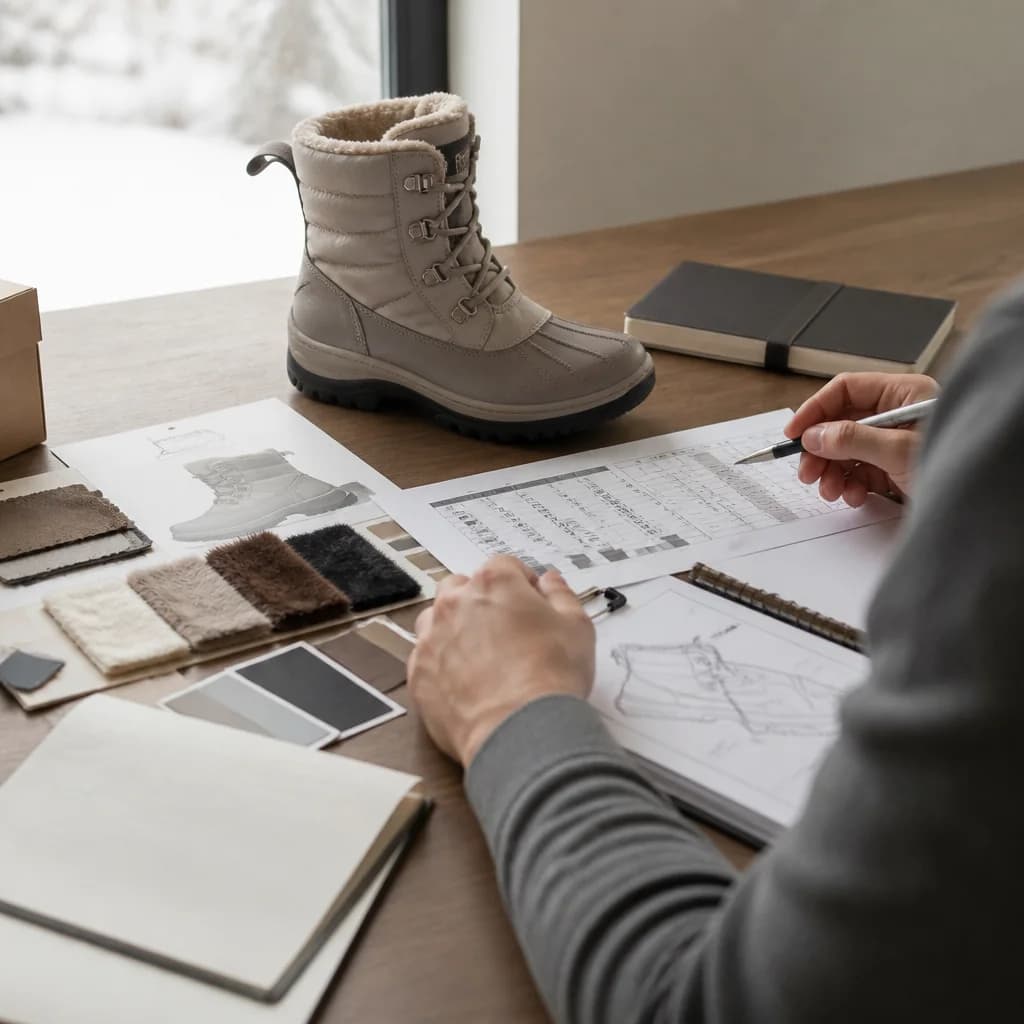
Record fit, sizing, construction, materials and open questions in a private label snow boot sample brief for a clear sampling inquiry.
A team can hold a clear winter footwear direction and still send an under-specified inquiry.
The missing piece is often a shared record of settled choices. A private label snow boot sample brief supplies that record. It names the sizing system and fit reference, states the product direction, and flags construction, material, and approval points that remain open. That record reshapes a snow boot sampling inquiry for private label winter boot development. The buyer lists known inputs and marks every unresolved item instead of leaving a partner to reverse-engineer intent from photos. Development, sampling, or quotation options can then be discussed against a visible definition.
The habit simply makes intent reviewable before the first conversation.
Why a winter direction rarely equals a usable brief
SnowBootWorks describes its OEM custom snow boot work as development to a buyer's own specification, with construction, materials, and approval standards driving decisions. That boundary is useful for brief preparation. The custom snow boot capabilities page is the source for that OEM description.
A silhouette, color story, and retail position can sit in place while those three areas stay blank. Soft phrases such as "true to size" or "comfortable fit" usually conceal an open sizing choice rather than resolve it.
Write what the team already intends to review. Identify the fit anchor. Flag every preference that has not hardened into a requirement. You do not need every field closed before inquiry. The document must simply show which statements are fixed and which are questions. This single habit keeps design, merchandising, technical development, and buying from talking past one another in the first project conversation.
Which two fit fields come first?
In the SnowBootWorks catalog context for women's retail and private-label winter collections, the site directs relevant buyers to decide the target sizing system and fit reference first. The same catalog describes fit-led women's winter boot platforms across clean urban, quilted, and plush cold-weather directions. Use that guidance only inside the stated women's catalog context, not as a universal rule for every footwear program. Review the relevant winter boot product context when that catalog is your reference.
The buyer's practical task is larger than listing a size run. Name the sizing convention the brief will follow. Name the physical or documented reference that defines the intended fit.
Without those two anchors, a measurement table, a reference pair, and an internal product request can each assume a different system.
- Target sizing system
- State the market or internal sizing convention. Do not leave it to be inferred from a product image alone.
- Fit reference
- Identify the reference boot, last, specification, or approved internal benchmark, plus the reference size and why it is used.
- Wear condition
- As an editorial recommendation for the buyer, note the intended use context that affects fit review, such as sock condition or whether the desired feel is close, regular, or roomier.
- Fit decision owner
- As an editorial recommendation for the buyer, name the person or team on the buyer side who can resolve a fit question so a pending choice does not harden into an assumption.
These fields do not prove a finished product outcome. They make the desired fit reviewable. If fit is still open, say so and list the alternatives under consideration. An honest open point beats a confident label with no reference behind it.
Upper direction at the right level of specificity
On its materials page, SnowBootWorks describes a waterproof textile upper as a woven or laminated synthetic fabric, typically nylon or polyester, with a durable water-repellent coating and often a waterproof membrane or laminate behind it. The page presents that material direction as lightweight and flexible for everyday snow boots intended to remain supple in cold conditions. See the snow boot materials page for the full material context.
That excerpt describes an upper-material direction and its component configuration. It does not state a finished-boot performance result.
In a custom snow boot specification, record the desired upper direction at that same level of specificity.
- Useful brief language
- Note the preferred textile character, whether the visible look should read as woven or laminated, and whether nylon or polyester is the current direction.
- Topics to keep open
- State whether a durable water-repellent finish, membrane, or laminate needs discussion, unless the buyer has already decided those points.
- Reference evidence
- Attach close product views or material swatches where available, and label what each item is meant to show: surface appearance, color, hand feel, or construction direction.
Precision here keeps the brief honest. It also shows whether a later issue belongs to the upper direction, the broader construction, or the approval standard the team will use when reviewing work.
Settled buyer inputs versus open project questions
Construction, materials, and approval standards are the decision drivers named for OEM custom snow boot development. Use that trio to split the brief into two columns: what the buyer can state now, and what may stay open for a development, sampling, or quotation conversation. The split is buyer guidance. It is not a documented factory submission form.
| Buyer can state in the brief | Buyer can leave open for discussion |
|---|---|
| Target sizing system, named fit reference, intended wearer, and the product direction under review. | Fit points that still need clarification once the reference is compared to the stated sizing system. |
| Construction priorities already decided, plus any construction point that must not be assumed from a photo. | Construction alternatives the team wants to compare before treating them as approved. |
| Material direction, visible finish preferences, and material features the buyer wants examined. | Material options or combinations that may fit the stated direction. |
| Approval standards, decision owners, and the evidence the buyer will use when reviewing work. | How unresolved criteria should be written for this specific project conversation. |
When stakeholders own different parts of the program, the two-column layout keeps certainty levels honest. Design can add preference language without forcing technical teams to treat every line as locked. The recipient sees which lines need a reply and which lines are already fixed.
How a labeled reference sample improves reviewability
One SnowBootWorks case-study entry concerns a private-label waterproof winter boot program. It describes a brand brief moving from reference samples to an export-ready, branded production run. That wording applies to the identified program. It is not a process claim or outcome claim for every inquiry. The source is under winter boot programs.
When a reference sample is available, give it a stated job. Mark whether the item is meant to communicate silhouette, fit feel, upper appearance, height, trim placement, or another visible cue. Mark what it does not settle.
A reference boot can support proportion while leaving the target sizing system open. It can support a material direction while construction and approval criteria remain undecided. A labeled role makes the brief easier to review and stops an inherited product from being read as a complete instruction set.
Pre-inquiry checklist the buyer owns
Before you send a request, assemble a short record that design, development, sourcing, and commercial stakeholders can read the same way. The list below is a way to prepare an inquiry. It is not a SnowBootWorks requirement, and it does not indicate which options will apply to a project.
- Target sizing system and fit reference, including the reference size.
- Product direction and intended wearer or collection context.
- Construction decisions already made, plus construction points that need discussion.
- Upper and material direction, with references that show the desired visible attributes.
- Approval standards, review criteria, and buyer-side decision owners.
- Reference samples or images, each labeled with the purpose it serves.
- Unresolved questions written as questions, not as hidden assumptions.
- Current brief status, so recipients can separate fixed inputs from working preferences.
Keep the record short enough for a live conversation. Keep it specific enough that each open point maps back to fit, construction, materials, or approval. When a requirement changes, update the record. Do not let a side email redefine the brief by accident. The checklist remains pure buyer-owned preparation for private label winter boot development discussions.
Share the definition and ask which options apply
Once the sizing system, fit reference, known decisions, and open questions sit in one place, share the current winter footwear definition through the project inquiry page. Ask which development, sampling, or quotation options may apply to the project. Those are questions for the conversation, not details this article can fill in.
A strong inquiry does not invent missing answers. It shows the current product definition, names who owns the fit decision on the buyer side, and makes the unresolved choices easy to address. That gives the next discussion a defined starting point while leaving room to evaluate which options are relevant.
Evidence layer
Evidence checklist: How to Prepare a Private Label Snow Boot Sample Brief
OEM, ODM, and private label are not just marketing labels. The practical difference is who owns the starting design, how much the construction changes, and which decisions must be approved before bulk production. Put the decision in writing: reference style, required changes, branding locations, packaging scope, tooling assumptions, and the point at which a sample becomes the production reference. For this guide, map each supplier response to “Why a winter direction rarely equals a usable brief” so a claim is supported by a written specification, sample reference, controlled document, or a clearly marked open question.
A strong brief also records what is out of scope. That prevents a fast sample discussion from silently becoming a new mold, a new size run, or a new compliance requirement. Use the same approval language in the quote, sample comments, and purchase documentation. Cross-check the response against “Which two fit fields come first?” and keep every unresolved point visible in the approval record.
- Design ownership and permitted adaptations — scoped to private label snow boot sample brief
- Branding, packaging, and tooling boundaries — cross-checked against “Why a winter direction rarely equals a usable brief”
- Sample approval gates before bulk commitment — with open risks from “Which two fit fields come first?” recorded
Decision framework
Buyer checklist
- Treat the private label snow boot sample brief as a buyer decision record, not as a visual direction alone.
- Name the target sizing system and fit reference before locking construction or material language.
- Separate fixed inputs from open development, sampling, or quotation questions, and label each reference sample's role.
Sources and verification
Evidence used for this guide.
Continue the specification