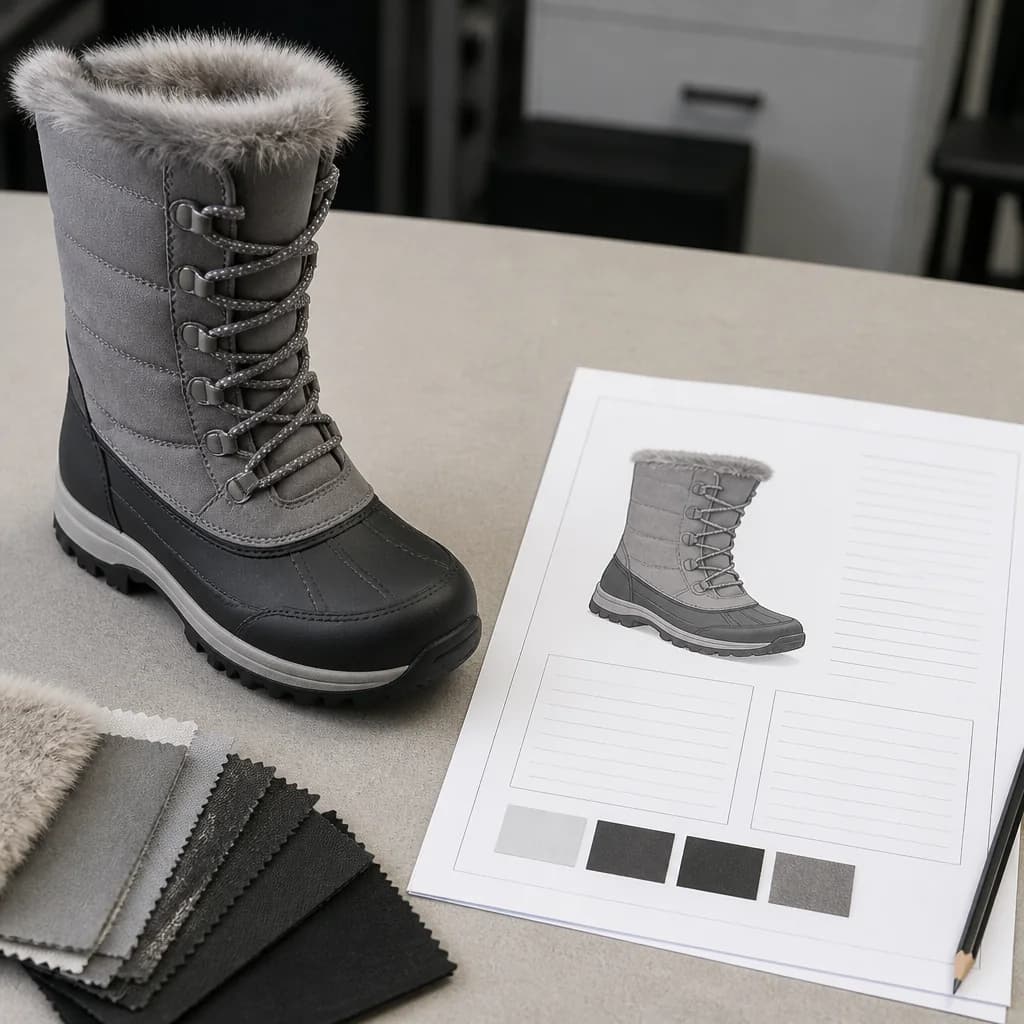
Before a women's winter-boot inquiry, document the target sizing system and fit reference, keep other fields separate, and mark grading or sampling gaps as open questions.
Product developers often reach the product-brief stage for women's retail or private-label winter boots without naming which sizing system the collection will use or what the team means by its fit reference. In its women's snow boot catalog guidance, SnowBootWorks tells buyers preparing those collections to decide those two inputs first. A custom women's snow boot sizing specification only helps when both entries sit at the top of the inquiry with an explicit decision state, and when unsupported technical detail is left out of the record.
The immediate task is not to invent a complete size chart. It is to state the system the project is intended to use and to identify the fit reference the team will rely on. If either choice is still pending, leave that field visibly unresolved. A named gap is more useful during scoping than a provisional answer that reads like an approved requirement.
Neither entry establishes size conversions, grading rules, width choices, lasts, tolerances, or fit-validation methods. The supplied catalog evidence does not document those details. They stay in the inquiry as questions unless the buyer already controls the relevant requirements.
Why the two fit inputs come first
The target sizing system and the fit reference answer different questions in the buyer's document. The sizing-system field records the framework the collection is intended to use. The fit-reference field identifies the buyer's chosen point of comparison. Completing one field does not resolve the other.
A private label winter boot product brief can therefore carry both fields with independent decision states. If the sizing system is already selected while the fit reference remains under internal review, show that difference. If neither has been fixed, say so before introducing construction or material requirements.
Keeping the pair explicit also stops other parts of the specification from silently becoming fit instructions. A product image, material direction, or construction note should not be treated as a sizing decision unless the buyer has expressly defined it that way in the project record.
How to state the target sizing system
The snow boot target sizing system field should name the system intended for the project, or state that the selection has not been made. As an editorial recommendation for the buyer, keep this entry free of improvised conversions, assumed regional equivalents, or charts assembled from information the team has not approved.
- Field label: Target sizing system
- Project entry: Use the exact designation already adopted in the buyer's product records, or write that no designation has been selected.
- Decision state: Note whether the entry is fixed in buyer records, still under internal review, or deferred until project scoping.
- Buyer-controlled source: If the entry comes from an existing buyer document, identify that document and its current revision in the buyer's own records.
For document control, a buyer can apply four editorial checks:
- Use the same sizing-system wording in the product brief, the inquiry, and related internal records.
- Separate an approved buyer requirement from a suggested alternative or unresolved question.
- Reference a buyer-owned chart only when that chart is intended to govern the project definition.
- Do not add conversions, grading increments, widths, or tolerances merely to make the field look complete.
SnowBootWorks' catalog guidance supports deciding the sizing system first, but the excerpt does not provide a size chart or describe conversion and grading rules. Those omissions should remain visible rather than being filled with assumptions.
How to name the fit reference
A practical women's snow boot fit reference entry needs an identity and a decision state. The identity tells the reader what the buyer is referring to. The decision state explains how much authority that reference has within the buyer's current definition.
The supplied evidence does not define what form of fit reference SnowBootWorks accepts or how one would be assessed. The inquiry should therefore explain what the buyer means by the term and ask whether that reference is suitable for the project. It should not presume that the reference will be translated into a last, graded, tested, or approved through a particular method.
- Assign a unique name or code that remains consistent throughout the inquiry.
- Describe the reference in neutral terms sufficient to distinguish it from other project materials.
- State whether the buyer treats it as controlled, provisional, superseded, or still unassigned.
- Clarify whether it is directional information or a controlled basis for the buyer's own review.
- Record where the reference is held and whether the buyer is prepared to share it for scoping.
Keep this entry factual. Do not state that a reference controls grading, last development, sample assessment, or production approval unless those responsibilities and methods have been separately established for the project.
Fit fields versus the rest of the product brief
SnowBootWorks' capabilities page frames its OEM manufacturing scope as developing custom snow boots to the buyer's own specification. Within that statement, construction, materials, and approval standards are identified as decision drivers. For the buyer's document, those subjects should remain distinct from the two initial fit inputs.
The comparison below is an editorial recommendation for structuring buyer information. It shows how fit entries can stay separate from construction, materials, and approval standards without treating every field as one undifferentiated block.
| Document area | Record in the current definition | Keep separate unless independently defined |
|---|---|---|
| Target sizing system | The named system and its decision state | Conversions, grading rules, width choices, and tolerances |
| Fit reference | Its identifier, description, decision state, and buyer-defined authority | Last requirements, fit-review methods, and approval procedures |
| Construction | Buyer requirements already fixed and construction questions still open | Assumptions derived only from the fit reference |
| Materials | Buyer material requirements and unresolved material decisions | Performance statements that have not been specified and supported |
| Approval standards | Standards the buyer has actually named, plus any open approval questions | Unnamed methods, tolerances, or expected outcomes |
This structure does not describe a documented SnowBootWorks validation sequence. Development availability and the treatment of each requirement still need to be scoped against the individual project.
Keep the sizing document narrow enough to review quickly. Broader program questions can sit in a separate project record, with the OEM snow boots guide used as an additional reading path rather than as a replacement for project-specific definitions.
Questions that stay open until scoped
The available evidence establishes the need to decide the two fit inputs and identifies construction, materials, and approval standards as wider decision areas. It does not establish what grading, width, last, fit-review, sampling, tolerance, or commercial options are available for a particular inquiry. Treat those subjects as scoped questions.
Use the table below to classify each topic as either a known buyer input or a question that should stay visibly unresolved in the inquiry. An unresolved classification is neutral: it does not mean an option is available or unavailable. It means the supplied evidence is insufficient to write that item as a confirmed part of the project definition.
| Topic | Current classification | Suitable buyer wording |
|---|---|---|
| Target sizing system | Required buyer decision for this women's collection scope | State the selected system, or note that the selection has not been made. |
| Fit reference | Required buyer decision for this women's collection scope | Name the reference and its decision state, or note that it is still unassigned. |
| Grading and size conversion | Inquiry topic unless controlled by the buyer | Ask which grading or conversion information, if any, is needed to scope the project. |
| Width choices | Inquiry topic unless controlled by the buyer | Ask what width information the buyer should provide and whether any options apply. |
| Last, fit review, and tolerances | Separate inquiry topics | Ask which last-related inputs, fit-review information, or tolerance documents are needed, if any. |
| Sampling and commercial information | Project-specific inquiry topics | Ask which sampling, MOQ, packing, and quotation information may apply. |
When an answer is received, revise the relevant field instead of leaving the decision buried in correspondence. Procurement can then distinguish the original buyer requirement, a later clarification, and any point that remains unresolved.
Hand the current definition to the inquiry
The final inquiry should be an honest snapshot of the current definition, not a document made to look complete. As an editorial recommendation for the buyer, a compact handoff can contain:
- The women's retail or private-label winter collection the inquiry covers.
- The target sizing system, with its present decision state.
- The fit reference, including its identifier, description, and decision state.
- Any construction, material, and approval-standard fields the buyer has already fixed.
- A separate register of grading, width, last, fit-review, tolerance, and sampling questions.
- The buyer-controlled documents that support the entries, identified by their current internal revisions.
Share that current winter footwear definition through the project inquiry page. Ask which development or sampling options, and which MOQ, packing, or quotation information, may apply to the project. Availability, timing, pricing, and the applicable process should remain open until they are addressed for that specific inquiry.
This handoff gives the discussion a precise starting point: the two fit inputs are either named or visibly unresolved, the wider specification retains its own fields, and unanswered questions remain questions rather than undocumented commitments.
Evidence layer
Evidence checklist: Set Fit Inputs for a Custom Women's Snow Boot Sizing Specification
OEM, ODM, and private label are not just marketing labels. The practical difference is who owns the starting design, how much the construction changes, and which decisions must be approved before bulk production. Put the decision in writing: reference style, required changes, branding locations, packaging scope, tooling assumptions, and the point at which a sample becomes the production reference. For this guide, map each supplier response to “Why the two fit inputs come first” so a claim is supported by a written specification, sample reference, controlled document, or a clearly marked open question.
A strong brief also records what is out of scope. That prevents a fast sample discussion from silently becoming a new mold, a new size run, or a new compliance requirement. Use the same approval language in the quote, sample comments, and purchase documentation. Cross-check the response against “How to state the target sizing system” and keep every unresolved point visible in the approval record.
- Design ownership and permitted adaptations — scoped to custom women's snow boot sizing specification
- Branding, packaging, and tooling boundaries — cross-checked against “Why the two fit inputs come first”
- Sample approval gates before bulk commitment — with open risks from “How to state the target sizing system” recorded
Decision framework
Buyer checklist
- For women's retail and private-label winter collections, name the target sizing system and fit reference before expanding the inquiry.
- Give each fit input its own decision state instead of filling open fields with assumed charts, conversions, or technical rules.
- Keep sizing and fit entries separate from construction, materials, and approval standards in the wider product definition.
- Present grading, widths, lasts, fit review, tolerances, sampling, MOQ, packing, and quotation details as questions when they are not already controlled by the buyer.
Sources and verification
Evidence used for this guide.
Continue the specification