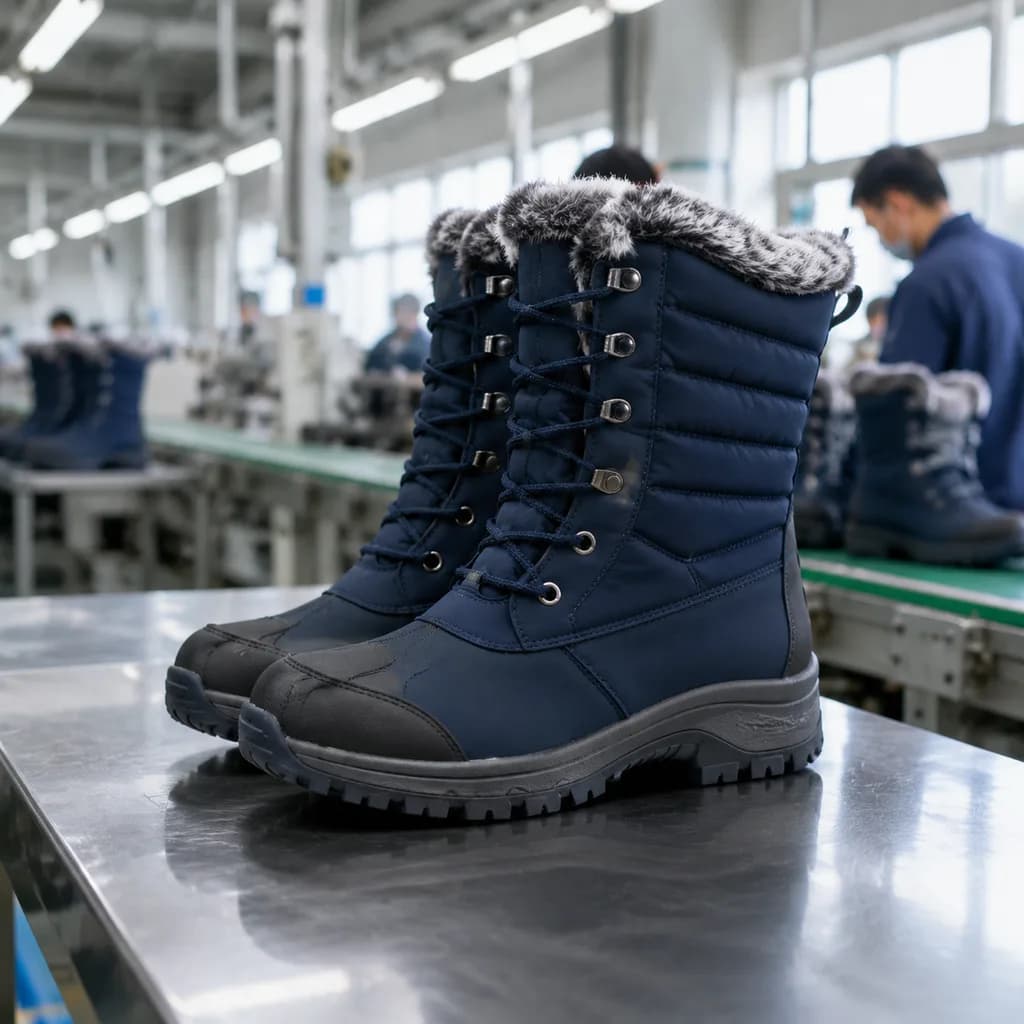
Use custom winter boot assortment planning to assign roles to women's cold-weather directions and keep unresolved product decisions visible before inquiry.
On the editorial range board below, clean urban, quilted, and plush occupy separate planning rows. Target sizing system and fit reference sit in a different record. SnowBootWorks' women's product page names fit-led women's winter boot platforms spanning those cold-weather directions. It gives the buyer context as women's retail and private-label winter collections, and it tells buyers to decide the target sizing system and fit reference first. In this article, custom winter boot assortment planning means assigning each proposed direction a buyer-written role while preserving those two inputs as separate decisions.
The capabilities page addresses a different part of the definition. It describes custom snow boots developed to a buyer's own specification. It identifies construction, materials, and approval standards as decision drivers. The worksheet below does not present these statements as a company-defined development process. Its role rationales, overlap decisions, internal owners, unresolved questions, and range statuses are editorial fields recommended for the buyer.
Which Rows Earn a Place in the Range?
A cold-weather direction label gives the buyer a starting point for organizing the range. The editorial recommendation is to require a written role before keeping any direction in the plan. That role should explain why the buyer wants the row, what purpose it has in the intended collection, and whether another row has already been assigned the same purpose.
Editorial buyer role map
| Cold-weather direction | Role rationale | Overlap decision | Internal owner | Unresolved question | Range status |
|---|---|---|---|---|---|
| Clean urban | Write the buyer's intended commercial role for this row. | Name any row with a similar role and state whether the overlap is deliberate. | Identify who owns the buyer's next internal decision. | Record the information still needed to decide. | Keep, review, or remove. |
| Quilted | State the reason this direction belongs in the proposed range. | Compare its role with the other proposed rows. | Identify the internal decision owner. | Record the question preventing a decision. | Keep, review, or remove. |
| Plush | Define the buyer's intended purpose for this direction. | Note whether another row already covers that purpose. | Identify the internal decision owner. | Record what remains unresolved. | Keep, review, or remove. |
Use the role-rationale column for the buyer's collection logic. If two rows receive the same rationale, the buyer should decide whether that overlap is intentional or whether one row should remain under review. This is an editorial planning decision, not a documented SnowBootWorks sales rule.
Keep technical assumptions out of these cells. As documented on the women's product page, clean urban, quilted, and plush are cold-weather direction labels. The available wording does not assign a particular material, insulation package, waterproof construction, outsole design, fit characteristic, or performance level to any of them. A buyer who needs one of those attributes should record it in the appropriate field or leave it as an open question.
Sizing and Fit at Range Level
The women's product page places target sizing system and fit reference first. For the range board, the editorial recommendation is to give each input its own row beside the direction map. Do not embed either answer in a direction label.
- Target sizing system: Enter the buyer's current decision or mark the field open.
- Fit reference: Enter the buyer's current reference or state that the selection remains unresolved.
- Scope: Mark the input as range-wide, direction-specific, or undecided. These are buyer-created worksheet labels.
- Internal status: Use wording that identifies the actor, such as buyer decided, under buyer review, or open for project discussion.
A buyer-decided status records the buyer's present position. It should not be read as supplier acceptance or project approval. For a women's private label winter boot range, this arrangement makes it possible to see whether sizing and fit decisions apply across the planned assortment or still require separate consideration for a particular row.
Keep the sizing-system entry distinct from the fit-reference entry. A shared scope label may apply to both, but one answer should not be used as shorthand for the other. If the buyer has not selected an input, leaving the field open is more accurate than inferring an answer from clean urban, quilted, or plush.
A Separate Technical Record
The capabilities page identifies construction, materials, and approval standards as decision drivers for custom snow boots developed to a buyer's own specification. For this editorial planning method, each driver receives its own entry outside the range-role table.
- Construction
- Record a requirement already decided by the buyer. If none has been selected, write the construction question that needs project-specific discussion.
- Materials
- Record the buyer's known material requirement or leave the field open. Do not infer a material package from a cold-weather direction label.
- Approval standards
- Record any standard the buyer has already identified or the question that remains. Keep this field separate from routine internal comments and range-review status.
Status wording should remain precise. “Buyer decided” describes the buyer's input. “Under buyer review” identifies an internal decision that is still moving. “Open for discussion” preserves a question for the inquiry. None of those worksheet labels documents a SnowBootWorks approval practice or commitment.
The buyer can keep internal sign-off notes in an adjacent section, but those notes should retain a clear buyer label. The term approval standards comes from the capabilities page and should not be silently replaced with an internal owner, review date, or keep-review-remove decision.
How Much Role Overlap Is Deliberate?
For this winter boot product line planning method, the overlap column leads to a range decision rather than an automatic rule. The buyer reviews the role rationales and decides whether similar purposes are intentional, unresolved, or a reason to remove a row.
- If a direction were removed, which buyer-defined role would no longer appear in the plan?
- If two rows have the same rationale, has the buyer chosen that overlap deliberately?
- What unresolved information could change the keep, review, or remove decision?
- Who owns the next internal decision, and what question should that person answer?
These prompts do not predict sales, pricing, or product performance. Their purpose is to make the buyer's current assortment reasoning legible. A row may remain under review when its direction is known but its commercial role or required information is not.
Outdoor-Retail Collection Intent
SnowBootWorks' industries page describes winter footwear programs for outdoor retail brands as balancing comfort, weather protection, and shelf appeal. That wording applies to the outdoor-retail brand context stated on the page.
When that context matches the planned range, the buyer can use the three terms as collection-level prompts. Record comfort as an intended priority or an unresolved question. Record weather protection as a buyer requirement or discussion point. Record shelf appeal in the buyer's commercial language.
These entries remain statements of collection intent. They do not verify an achieved attribute for a proposed boot, and the industries-page wording does not attach them to clean urban, quilted, or plush. Buyers working outside the stated outdoor-retail brand context should not assume that this list defines their program.
Preparing a Snow Boot Development Inquiry
The inquiry should show the present state of the range rather than conceal unfinished decisions. Under this editorial method, the buyer shares separate records so the recipient can distinguish source language, buyer decisions, and open questions.
- Range-role record: List the applicable cold-weather directions, the buyer-written rationale for each row, the overlap decision, the internal owner, and the keep-review-remove status.
- Sizing and fit record: State the target sizing system and fit reference, or mark either product-page input as unresolved.
- Technical record: State any buyer-decided construction requirement, material requirement, or approval-standard requirement. Keep unanswered points visible as questions.
- Outdoor-retail note: Include the buyer's intended balance of comfort, weather protection, and shelf appeal only when the cited outdoor-retail brand context is relevant.
- Open-question record: Identify what the buyer still needs to determine without assigning the unanswered work to a direction label.
Share the current winter footwear definition through the request-a-quote page and ask which development, sampling, or quotation options may apply to the project. That wording leaves availability, sequence, timing, pricing, and commercial terms open for a project-specific response.
Project-Specific Unknowns
Under this editorial method, an incomplete field remains a question. The supplied company language does not establish the following matters for a buyer's proposed assortment:
- Finished-boot performance, temperature ratings, waterproof ratings, traction results, or other test outcomes.
- Certification, compliance, or testing status.
- A sample route, development sequence, or confirmed approval process.
- Quote terms, minimum quantities, pricing, timing, packing, shipping, or export commitments.
- Current catalog availability or confirmation that a proposed direction can be developed for the project.
Do not fill these gaps from the direction names. Mark them open, attach the buyer's current decision records, and use the inquiry to ask what options may apply. The resulting range map keeps the commercial purpose of each proposed direction visible without allowing that purpose to stand in for the missing product definition.
Evidence layer
Evidence checklist: Custom Winter Boot Assortment Planning by Range Role
OEM, ODM, and private label are not just marketing labels. The practical difference is who owns the starting design, how much the construction changes, and which decisions must be approved before bulk production. Put the decision in writing: reference style, required changes, branding locations, packaging scope, tooling assumptions, and the point at which a sample becomes the production reference. For this guide, map each supplier response to “Which Rows Earn a Place in the Range?” so a claim is supported by a written specification, sample reference, controlled document, or a clearly marked open question.
A strong brief also records what is out of scope. That prevents a fast sample discussion from silently becoming a new mold, a new size run, or a new compliance requirement. Use the same approval language in the quote, sample comments, and purchase documentation. Cross-check the response against “Sizing and Fit at Range Level” and keep every unresolved point visible in the approval record.
- Design ownership and permitted adaptations — scoped to custom winter boot assortment planning
- Branding, packaging, and tooling boundaries — cross-checked against “Which Rows Earn a Place in the Range?”
- Sample approval gates before bulk commitment — with open risks from “Sizing and Fit at Range Level” recorded
Decision framework
Buyer checklist
- Editorial recommendation: assign each proposed cold-weather direction a buyer-written range role and an explicit keep, review, or remove status.
- Keep the product-page sizing and fit inputs in their own record, separate from the technical decision drivers identified on the capabilities page.
- Share the current winter footwear definition and ask which development, sampling, or quotation options may apply.
Sources and verification
Evidence used for this guide.
Continue the specification