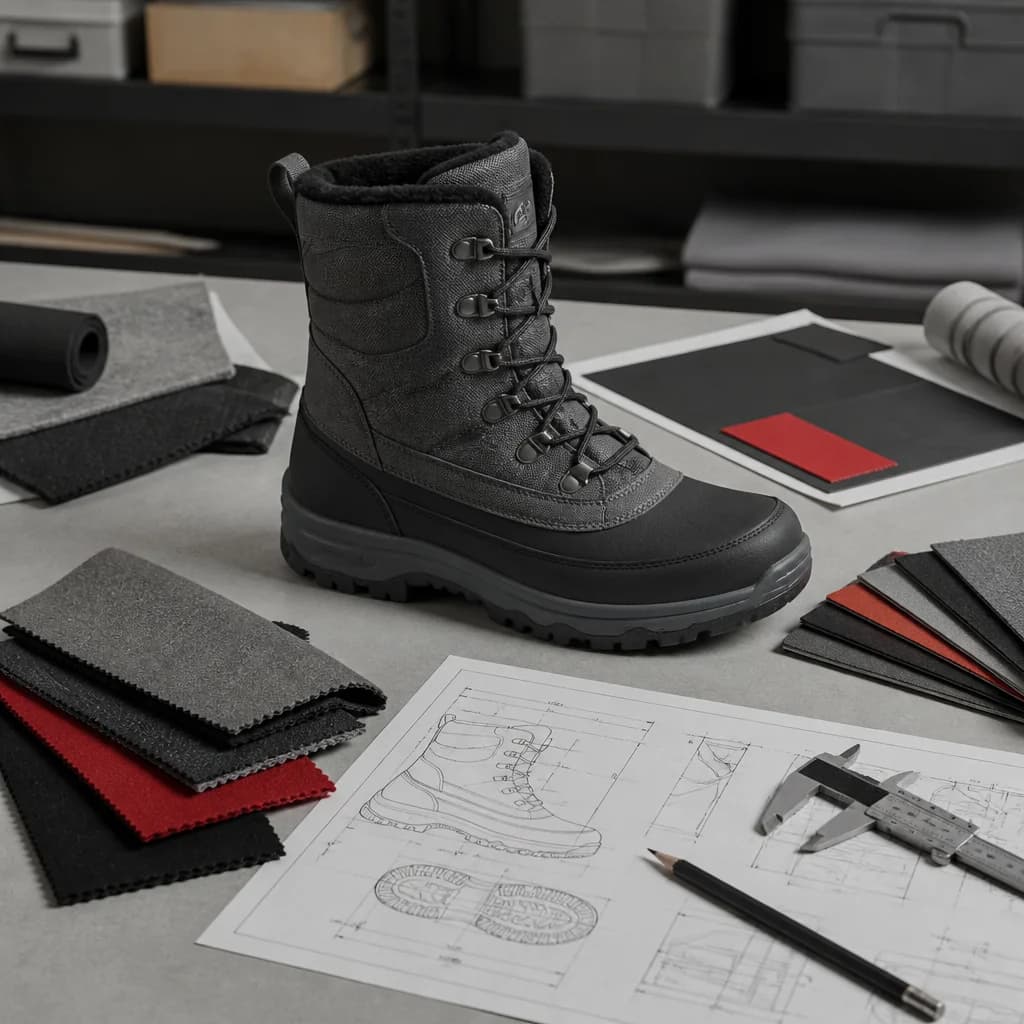
Define waterproof scope, construction, material roles, reference limits, open questions, and buyer approvals for comparable winter boot quotations.
A hypothetical review could place two quotations side by side and find that both answer a request for waterproof boots while covering different parts of the product. One response might leave a construction point open; the other might treat it as fixed. A buyer preparing a custom waterproof winter boots specification should make those boundaries visible before comparing scope, commercial fields, or later approval needs.
SnowBootWorks' capabilities page says that, when developing custom snow boots to a buyer's own specification, construction, materials, and approval standards drive every decision.
The framework below is buyer-side editorial guidance. Treat testing methods, ratings, sample formats, quantities, packing terms, schedules, prices, and logistics as open questions until the relevant details are confirmed for the project.
What can the buyer confirm today?
Begin with the information available now rather than filling every field with a preferred final answer. The initial definition can distinguish four types of input:
- Intended use
Record the wearer, sales channel, product position, and relevant conditions in the buyer's own terms. Keep desired positioning separate from a verified product claim.
- Waterproof boundary
Name the areas, openings, interfaces, or components covered by the request. If the boundary is undecided, identify the point that requires discussion.
- Fixed decisions
List the design, architecture, material, branding, or other requirements that a proposed direction is expected to retain.
- Open points
Mark the technical, commercial, and buyer-side decisions that do not yet have an approved answer.
SnowBootWorks separately describes outdoor retail winter footwear programs as balancing comfort, weather protection, and shelf appeal. For a product in that sector, the buyer should decide whether the current brief addresses those priorities separately instead of allowing the waterproof request to stand for the entire product definition.
The requirement-and-question matrix
The recommended comparison tool is a matrix that keeps confirmed requirements apart from questions. Each row should show what the buyer has fixed, where an alternative may be considered, what requires a manufacturer response, who owns the buyer decision, and when supporting information should be discussed.
Buyer requirement-and-question matrix
| Topic | Confirmed requirement | Acceptable alternative | Manufacturer confirmation needed | Buyer approval responsibility | Evidence stage |
|---|---|---|---|---|---|
| Waterproof boundary | State the intended context and the named product areas covered by the request. | Indicate whether a revised boundary may be proposed for discussion. | Ask which construction and material assumptions are used in the response and which boundary points need more detail. | Accept or reject changes to the stated boundary and resulting product definition. | Ask when the boundary and any supporting evidence should be discussed. |
| Construction | List fixed architecture, openings, interfaces, and design constraints. | Identify the elements for which another direction may be considered. | Ask what construction direction the response assumes and what remains unresolved. | Review any proposed change against the intended use and fixed requirements. | Ask what could be reviewed during any applicable development or sampling stage. |
| Materials | Name mandatory and preferred materials separately and state the intended role of each. | List the categories or substitutions the buyer is willing to discuss. | Ask what information is needed to discuss the material direction and whether a substitution is being proposed. | Approve or reject the material direction and any associated specification revision. | Ask what documentation or evidence, if any, could be considered and when. |
| Reference items | Identify the attributes each reference is intended to communicate and the attributes it does not define. | State whether another reference or interpretation may be discussed. | Ask how each supplied reference would be interpreted in the proposed direction. | Correct any interpretation that extends beyond the reference's written role. | Review the reference at the initial discussion and at any later stage where it is used. |
| Approval criteria | Record buyer-selected criteria already in place and name the decision owner. | Identify criteria that remain open for discussion. | Ask what evidence may apply, what it would cover, and at what stage it could be considered. | Decide whether the available information supports the next buyer approval. | Keep the stage open until it is confirmed for the project. |
| Commercial response | List the fields needed to compare responses against the same product definition. | Identify fields that may remain open or be answered with stated assumptions. | Ask which sampling, MOQ, packing, timing, and quotation details may apply. | Check that each commercial response refers to the same stated scope. | Address these fields during quotation discussion and retain unresolved items as open. |
The matrix should not turn a blank field into implied agreement. Keep an unanswered item visible, assign its next action, and avoid comparing commercial responses as though they cover the same definition when their assumptions differ.
Three records, three decisions
The distinction between construction, materials, and approval standards can be carried into the buyer's brief as three separate records:
- Construction record: Define the physical boundary, fixed architecture, relevant interfaces, and areas where another direction may be discussed. Do not present an unconfirmed method as the required solution for every waterproof winter boot.
- Material record: State the intended role of each named material and label it mandatory, preferred, or referential. Do not use one material name as shorthand for the complete boot construction.
- Approval record: Identify what the buyer intends to review, who owns the decision, and what information is expected for that decision. Keep a planned review criterion separate from a claim about finished-product performance.
As a document-control recommendation, flag related records whenever one of them changes. A proposed material substitution, for example, should remain a proposal until the buyer has considered whether the construction description or approval record also needs revision.
How much authority does a reference carry?
SnowBootWorks documents one private-label waterproof winter boot program in which a brand brief moved from reference samples to an export-ready, branded production run. The published excerpt does not identify which attributes the samples established, so it cannot define the role of a reference in a new inquiry.
For buyers considering private label waterproof winter boots, the editorial recommendation is to give every reference a written scope:
- Signal
Name the exact attributes the recipient should study, such as proportions, appearance, material direction, or closure layout.
- Authority
Classify the item as a fixed benchmark, a directional reference, or one option that remains open for discussion.
- Exclusions
List the attributes the item does not approve or define, including construction, materials, fit, or performance where those points have not been specified separately.
This written scope prevents the reference from silently acquiring authority over decisions the buyer has not made.
Complete form or honest open point?
In a winter boot specification for quotation, completeness should mean that each field has a clear status. It should not mean that every technical or commercial point already has an answer. The buyer can use four status labels:
- Confirmed
The requirement is part of the current brief and should be addressed in the response.
- Preferred
The direction is favored, but an alternative may be proposed and explained.
- Open
The point requires a manufacturer response, a buyer decision, or further discussion.
- Not applicable
The field is outside the current product definition or quotation request.
Where no method, rating, sample type, quantity, packing requirement, price basis, schedule, or logistics arrangement has been selected, mark the field open and ask what may apply. A factual-looking placeholder can be mistaken for a confirmed requirement when the buyer only intended it as a reminder.
Document control before the inquiry
A short document-control pass can remove ambiguity that is separate from the product definition itself. The buyer should:
- Add a date or version so recipients can identify the current brief.
- Use reference names in the specification that match the supplied files or physical items.
- Name the buyer-side owner for approvals that will occur later.
- Specify how alternatives and unresolved points should be identified in the response.
- Keep omitted information visibly open instead of deleting the field or filling it by assumption.
The project handoff
Send the current waterproof boundary, construction record, material roles, reference limits, approval responsibilities, and unresolved questions through the project inquiry. Ask which development, sampling, or quotation options may apply to that definition.
Keep feasibility, performance, pricing, timing, and production acceptance open until they are addressed for the project. The immediate purpose of the inquiry is narrower: give both parties a shared record of what the buyer has confirmed, what may change, and what still needs an answer.
Evidence layer
Evidence checklist: A custom waterproof winter boots specification for quotes
OEM, ODM, and private label are not just marketing labels. The practical difference is who owns the starting design, how much the construction changes, and which decisions must be approved before bulk production. Put the decision in writing: reference style, required changes, branding locations, packaging scope, tooling assumptions, and the point at which a sample becomes the production reference. For this guide, map each supplier response to “What can the buyer confirm today?” so a claim is supported by a written specification, sample reference, controlled document, or a clearly marked open question.
A strong brief also records what is out of scope. That prevents a fast sample discussion from silently becoming a new mold, a new size run, or a new compliance requirement. Use the same approval language in the quote, sample comments, and purchase documentation. Cross-check the response against “The requirement-and-question matrix” and keep every unresolved point visible in the approval record.
- Design ownership and permitted adaptations — scoped to custom waterproof winter boots specification
- Branding, packaging, and tooling boundaries — cross-checked against “What can the buyer confirm today?”
- Sample approval gates before bulk commitment — with open risks from “The requirement-and-question matrix” recorded
Decision framework
Buyer checklist
- Buyer recommendation: define the intended waterproof boundary and keep unresolved parts visible.
- Buyer recommendation: record construction, material roles, and approval responsibilities separately.
- Buyer recommendation: give each reference item a written signal, level of authority, and set of exclusions.
- Buyer recommendation: mark testing, ratings, sampling, quantities, packing, timing, pricing, and logistics as open until confirmed for the project.
Sources and verification
Evidence used for this guide.
Continue the specification