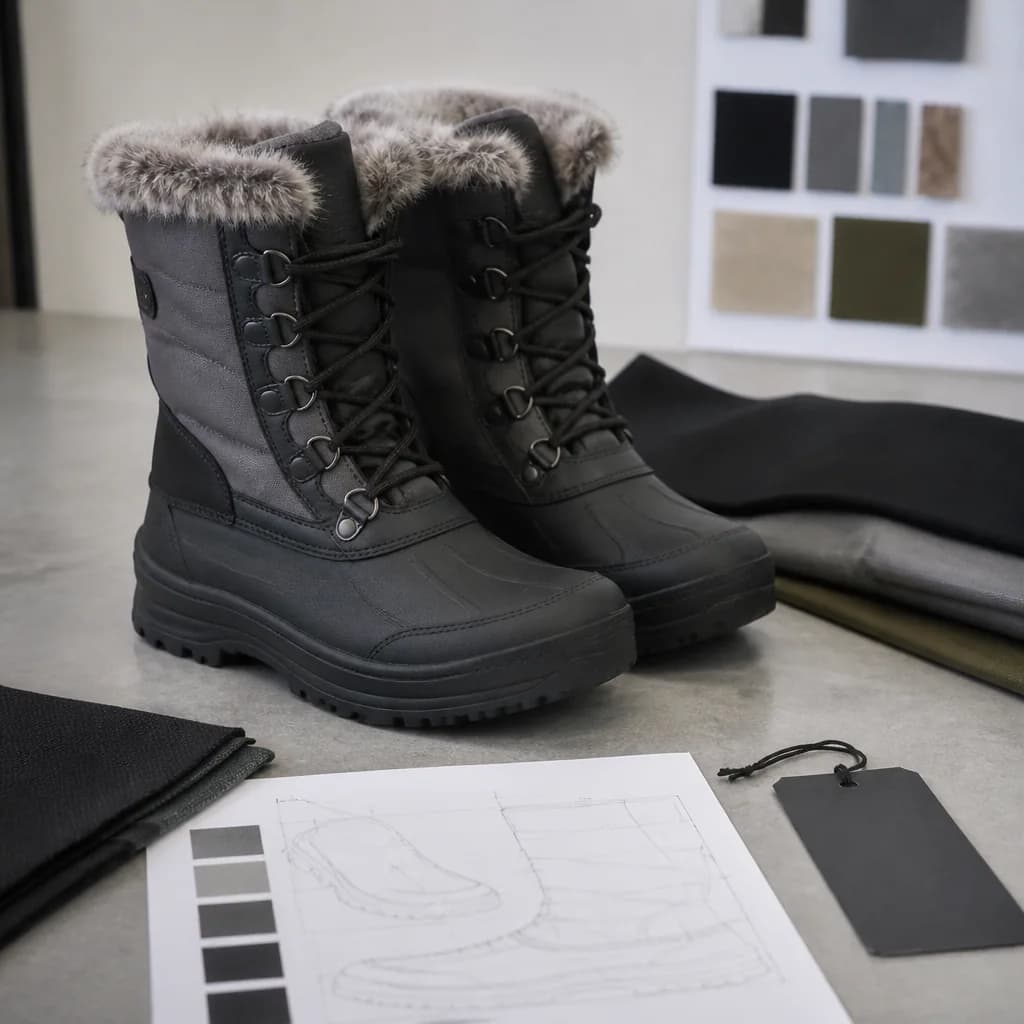
Follow a brief-to-export path for private label wholesale snow boots: own program, lock construction with materials, approve samples, then quote export readiness.
Private label wholesale snow boots hold up when construction, materials, and approval standards govern the path from brief to export. When buyers reverse that order and shop unit cost before anyone owns the product definition, sampling loops, weak export readiness, and unclear development ownership usually follow. Treat the work as a controlled sequence: lock the definition first, then quote against it.
Why private label wholesale snow boot programs stall at the quote stage
Unit-cost shopping before product ownership turns every later choice into a renegotiation. Construction method, insulation stack, upper system, branding placement, and acceptance criteria all change cost and process path, yet none of them live cleanly on a generic wholesale list.
The practical failure mode is familiar. A catalog team asks for pricing on a silhouette seen elsewhere, then learns during sampling that fit reference, waterproof approach, and labeling rules were never assigned. Development ownership drifts between brand and factory. Samples cycle without a written standard. Carton marks and packing questions arrive at the end, when they should have shaped the brief.
An OEM snow boot specification framing puts construction, materials, and approval standards in the lead from the first working document. That does not remove commercial pressure. It makes the quotation meaningful because both sides know what is being priced.
Assign program ownership before any SKU conversation
Private label and fully custom OEM routes share one non-negotiable: someone on the brand side must own the brief. Before any SKU talk, decide who defines fit reference, sizing system, branding, and acceptance criteria, and whether the program starts from a platform adaptation or a full custom specification.
- Name the fit reference and target sizing system the brand will hold.
- List branding elements, placements, and art ownership.
- Write acceptance criteria for samples and production release.
- State whether the path is private label platform work or full custom-to-spec OEM.
On the product catalog, fit-led women's winter boot platforms for retail and private-label winter collections ask buyers to decide first on target sizing system and fit reference. As an editorial recommendation for any private label winter boot program, that same sequence is sound practice beyond a single gender line: fit ownership should precede style conversation.
Factory execution follows the brief. Brand teams still hold market claims, destination labeling legality, and consumer-facing performance language unless a written agreement assigns those duties elsewhere. For capability context, review how OEM manufacturing is framed around buyer specification and how product platforms present fit-first decisions.
Lock construction and materials as one dual decision
Treat construction method and material stack as a single decision, not sequential afterthoughts. Sole attachment, membrane placement, insulation type, and upper fabric interact. Approval standards only govern sampling and production readiness when they describe a coherent build.
Use a dual-lock checklist before you invite quotation:
- Construction method and sole attachment approach
- Upper system (textile, leather, or hybrid) and any membrane or laminate
- Insulation type and the cold-weather use framing you will defend commercially
- Lining, tongue, and collar materials that affect fit and finish
- Branding substrates that survive the chosen construction process
- Written approval standards that reference the locked stack
SnowBootWorks describes OEM manufacturing as developing custom snow boots to the buyer's own specification, with construction, materials, and approval standards driving every decision. Carry that same order into your wholesale snow boot development brief even when you adapt a private label platform rather than invent a full custom last. See the capabilities overview for that sequence in source language.
When a waterproof textile upper fits the everyday private label direction
Not every program needs the same upper. When the brand direction is lightweight, flexible everyday snow boots that should stay supple in cold conditions, a waterproof textile upper is a documented material direction worth evaluating early in the dual lock.
The materials library describes a waterproof textile upper as a woven or laminated synthetic fabric upper, typically nylon or polyester, finished with a durable water-repellent (DWR) coating and often backed by a waterproof membrane or laminate. Related naming includes coated nylon upper, water-resistant fabric upper, and technical textile shell. The same source positions that stack as the lightweight, flexible direction for everyday snow boots.
Keep the boundary clear: that text is a material definition, not a finished-boot lab rating. As an editorial recommendation, buyers still set acceptance tests, any membrane brand preferences, seam sealing expectations, and wear-trial rules. State whether a waterproof textile upper is in or out of scope before sampling starts so quotation and approval work against one stack. Detail lives on the materials page.
Treat reference samples as approval instruments, not catalog shortcuts
A program overview on the case studies page presents a private label waterproof winter boot program as showing how a brand brief moves from reference samples to an export-ready, branded production run. Treat that framing as a process map. Reference samples are tools for locking approval, not a shortcut around a written program brief.
- Write the brand brief with construction, materials, fit reference, branding, and acceptance criteria.
- Use reference samples only to communicate shape, hand-feel, or construction details that words under-specify.
- Record sample comments against the written standards, not against free-form preference notes.
- Release production only after branded sample approval matches the dual-locked stack.
- Carry the same standards into carton marks, packing, and export documentation topics.
If a sample looks right but fails a written water-entry, stitch, or branding rule, the sample fails. Catalog appearance does not override the brief. Process context is summarized under case study program overviews.
What “export-ready” should mean in the buyer brief
Export-ready is easy to leave vague. For private label wholesale snow boots, translate the phrase into checkpoints the brand controls, then ask which topics a manufacturing partner can support for the project. The table below separates buyer-owned definitions from inquiry topics. Inquiry topics are questions you may raise; they are not documented service promises unless a written commercial agreement says so.
| Buyer checkpoint | Define in the brief | Inquiry topic for the project |
|---|---|---|
| Brand identity on the boot | Logo, tongue label, heel mark, hangtag rules | Branding application method and sample proof |
| Production release gate | Which sample stage releases bulk | Sample stages available for this build |
| Carton and packing | Assortment logic, polybag rules, carton mark language | Packing options for the destination market |
| Document handoff | Invoice fields and packing list detail you require | Export documentation topics for the lane |
| Quality hold points | Defect definitions and hold rules you own | How nonconformances are reported in production |
The case framing uses an export-ready, branded production run as the end state of a brief-to-sample path. It does not publish logistics SLAs, commercial quantities, or test protocols. Keep those as open RFQ questions rather than assumptions.
Development, sampling, and quotation options to request next
Once ownership, dual lock, material direction, and sample discipline are clear, the commercial conversation can stay specific. Share your current winter footwear definition and ask which development, sampling, or quotation options may apply to the project.
- State whether the work is private label platform adaptation or full OEM custom-to-spec.
- Attach or describe fit reference and sizing system.
- Record construction and material stack, including whether a waterproof textile upper is in scope.
- List approval standards and destination-market labeling constraints you already know.
- Ask which sample stages are appropriate before branded production release.
- Request quotation only against the locked brief, not against an undefined silhouette.
- Ask which packing and export documentation topics can be addressed for the intended lane.
SnowBootWorks positions OEM work around buyer specification and presents a private label program overview as a brief-to-export process map. Buyers still set commercial quantities, compliance evidence requirements, and performance claims. For the next step, share the definition you already own and indicate which development, sampling, or quotation options need clarification for your private label wholesale snow boots program.
Evidence layer
Evidence checklist: Brief-to-Export Path for Private Label Wholesale Snow Boots
OEM, ODM, and private label are not just marketing labels. The practical difference is who owns the starting design, how much the construction changes, and which decisions must be approved before bulk production. Put the decision in writing: reference style, required changes, branding locations, packaging scope, tooling assumptions, and the point at which a sample becomes the production reference. For this guide, map each supplier response to “Why private label wholesale snow boot programs stall at the quote stage” so a claim is supported by a written specification, sample reference, controlled document, or a clearly marked open question.
A strong brief also records what is out of scope. That prevents a fast sample discussion from silently becoming a new mold, a new size run, or a new compliance requirement. Use the same approval language in the quote, sample comments, and purchase documentation. Cross-check the response against “Assign program ownership before any SKU conversation” and keep every unresolved point visible in the approval record.
- Design ownership and permitted adaptations — scoped to private label wholesale snow boots
- Branding, packaging, and tooling boundaries — cross-checked against “Why private label wholesale snow boot programs stall at the quote stage”
- Sample approval gates before bulk commitment — with open risks from “Assign program ownership before any SKU conversation” recorded
Decision framework
Buyer checklist
- Quote private label wholesale snow boots only after construction, materials, fit reference, branding, and approval standards are owned in a written brief.
- Lock construction method and material stack together so sampling and production release share one coherent build.
- Use reference samples as approval instruments against written standards, not as a substitute for program ownership.
- Translate export-ready into buyer-controlled checkpoints, then ask which development, sampling, packing, and quotation topics apply to the project.
Sources and verification
Evidence used for this guide.
Continue the specification
Move from research to a controlled brief.
Frequently asked questions
Questions buyers ask next
What should be locked before requesting a quote on private label wholesale snow boots?
Own fit reference and sizing system, construction method, material stack, branding rules, and written approval standards first. Quote against that brief rather than against an undefined silhouette.
How should reference samples be used in a private label winter boot program?
Use them to communicate shape, hand-feel, or construction details that words under-specify, then score them against the written brief. They are approval instruments on a path toward branded production, not a replacement for program ownership.
When is a waterproof textile upper a useful material direction?
When the brand direction is lightweight, flexible everyday snow boots that should stay supple in cold conditions. Treat the material definition as a stack choice to lock with construction, and set your own finished-boot acceptance rules separately.