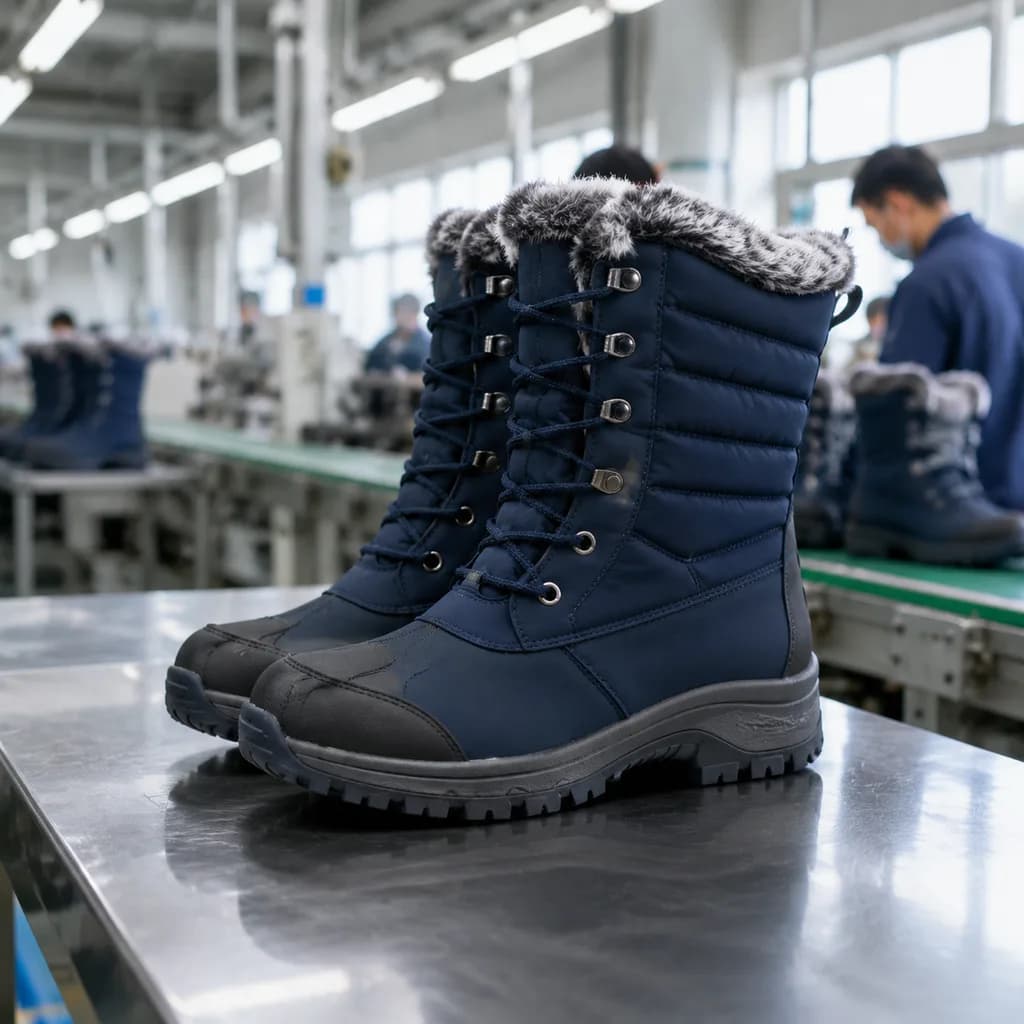
Private label snow boot sampling works when construction, materials, approval standards, and fit are owned before upper direction or branded production.
Wholesale teams often treat private label snow boot sampling as a quick look-check: pull a silhouette, request a pair, then reverse-engineer a tech pack from whatever arrives. That habit leaves construction, materials, and approval standards unowned, so the sample cannot govern later bulk decisions. Brands, importers, and product developers who need private-label winter footwear get more value when sampling tests a written OEM snow boot specification instead of inventing one under showroom pressure.
Ownership comes first; samples come second. Construction, materials, and snow boot approval standards should share equal decision rights in the brief. Sizing system and fit reference should be fixed before waterproof textile upper choices. Only after those gates does a private label winter boot program path stay controlled: brand brief, reference samples, then an export-ready branded run, rather than a late visual review.
Style-first briefs leave sampling without governing power
Merchandising meetings favor silhouettes, color stories, and retail lookalikes because those cues are easy to share. Factories, however, need drivers that control custom development: how the platform is built, which materials rank above substitutions, and which criteria will accept or reject bulk goods. A sample that only matches a photo can still leave sole construction, upper stack, lining direction, and pass/fail language unresolved.
When style leads, procurement usually inherits the same damage in different forms. Fit arguments start only after a try-on pair exists, so last and volume choices reopen on every revision. Material swaps arrive late because no ranked hierarchy separates shell, coating, optional membrane directions, insulation approach, and bottom materials. Approval language stays informal, often no stronger than “like the sample,” until a production dispute forces standards to be written under deadline pressure.
Editorial recommendation for buyers: treat early samples as instruments that test a brief, not as substitutes for one. If the brief cannot yet name construction family, material direction, and approval standards, postpone sample requests until those decision rights are assigned on paper and owned by named internal stakeholders.
Equal decision rights for construction, materials, and approval standards
SnowBootWorks describes its OEM manufacturing scope as developing custom snow boots to the buyer’s own specification, with construction, materials, and approval standards driving every decision. That boundary is useful because it is narrow. It does not claim open-ended category control. It places three co-equal drivers at the center of custom work.
Assign those rights in one shared brief section before anyone places a sample order:
- Construction. As buyer-side brief questions, not as a factory menu, state the platform family you intend to produce. Ask yourselves what midsole and outsole relationship you expect, which shaft height band fits the channel, which closure system the end user needs, and whether the upper should behave as a soft everyday shell or a more structured cold-weather build. Those answers constrain tooling, last selection, and how textile waterproof components can integrate later.
- Materials. Rank shell textiles, coatings, optional membrane or laminate directions, linings, insulation approach, and bottom materials in an order your program can defend commercially. An unranked materials list is still a shopping list, not a specification.
- Approval standards. Define what will pass or fail at sample and bulk stages: dimensional tolerances you care about, visual quality gates, packing presentation rules, and any brand-side lab or wear protocol you will apply. If a standard cannot be written, it cannot govern production.
Link design, merchandising, and sourcing owners to each right so no single function overrides the others by default. Route the brief into OEM capability discussions only after those owners have signed the same draft.
Sizing system and fit reference before any fit-critical sample
For fit-led women’s winter boot platforms aimed at women’s retail and private-label winter collections, SnowBootWorks product guidance tells buyers to decide first the target sizing system and fit reference. That is a program gate, not a styling footnote.
Lock the following before requesting samples that anyone will treat as fit-critical:
- Target sizing system: the regional size scale your retail channel will print on the label and size chart.
- Fit reference: a named last, an approved competitor reference, or an internal gold sample your team already trusts.
- Width or volume expectations for the primary customer when those expectations differ from a default medium last.
- A sample-size review plan so comments map back to the agreed system rather than to one reviewer’s foot.
Without that gate, private label snow boot sampling collapses into ad-hoc try-ons. Reviewers argue about snugness, instep height, and shaft circumference while the factory still lacks a single fit reference. Later upper work and branded packaging then sit on an unstable foundation.
Keep the scope honest. The catalog cue cited here covers women’s fit-led platforms for retail and private-label winter collections. Do not stretch it into men’s, kids, or work programs without separate evidence. If your assortment spans multiple gender or channel lines, write a separate sizing and fit block for each line rather than assuming one women’s reference travels everywhere. Related product framing appears on the wholesale product catalog when you need the women’s platform language in context.
Waterproof textile upper stays a materials direction
After construction, approval standards, and fit reference are stable, upper direction can be chosen without turning material language into unearned performance claims. SnowBootWorks materials copy describes a waterproof textile upper as a coated nylon upper, water-resistant fabric upper, or technical textile shell: a woven or laminated synthetic fabric upper, typically nylon or polyester, finished with a durable water-repellent (DWR) coating and often backed by a waterproof membrane or laminate. The same excerpt frames that stack as the lightweight, flexible direction for everyday snow boots that need to stay supple in the cold.
Use that language as a materials direction, not as a finished-boot warranty. In the brief, separate three layers of decision:
- Shell fabric family: nylon or polyester technical textile, woven or laminated.
- Surface finish: DWR coating as the water-repellent face treatment described on the materials page.
- Optional membrane or laminate backing when the program needs that stack, without inventing brand names, hydrostatic ratings, or lab methods the excerpt does not provide.
Buyer-side editorial recommendation: write acceptance criteria you will actually enforce (seam handling rules, lining interface, care claims you are willing to print) instead of pasting marketing adjectives into a tech pack. If your compliance team requires specific test methods, those methods belong in your approval standards block and remain your responsibility unless a factory document independently states them. For material vocabulary only, cross-check the materials page rather than treating a sample’s hand-feel as proof of waterproof performance.
Documented path shape: brief, reference samples, branded run
SnowBootWorks case-study framing for a waterproof snow boot private label program shows how a brand brief moves from reference samples to an export-ready, branded production run. Read that as a documented path shape, not as a multi-client portfolio or a guarantee of export outcomes.
Decision ownership should tighten at each stage rather than reopen earlier locks:
- Brand brief
- Construction family, materials hierarchy, approval standards, sizing system, and fit reference must already be locked. The stage allows clarification questions only, not structural redesign.
- Reference samples
- The same brief remains in force, plus a sample size plan and named review owners. Changes are limited to documented deviations with written impact on bulk standards.
- Export-ready branded production run
- Approved reference outcomes, brand marks, and packing presentation rules are locked. No open redesign; only controlled production adjustments under the same standards.
In a hypothetical sequence, a brand might freeze a women’s fit reference and a coated nylon upper direction in the brief, request reference samples only against those locks, then move brand marks onto an export-ready run after sample sign-off. That sequence is a planning sketch for decision order. It is not a customer case, quantity plan, or timeline promise.
Keep each stage’s artifact distinct. The brief owns decisions. The reference sample tests those decisions. The branded production run executes under the approved package. When teams skip the brief locks, sampling becomes a design workshop funded by production risk. When teams treat the case-study path as automatic export success, they confuse a program overview with an outcome guarantee. Path language on the case studies page frames brief to reference samples to branded run in the same order.
What remains open after program scope is locked
Locked program scope should include construction family, materials hierarchy, snow boot approval standards, sizing system, fit reference, and any upper direction you are prepared to defend. Open inquiry topics are the questions still needed before commercial documents can be final. They are not, by themselves, documented service menus or MOQ promises.
A practical buyer checklist:
- Write your current winter footwear definition in one paragraph: end use, channel, climate band, and who owns fit and quality sign-off.
- Confirm that construction, materials, and approval standards appear as co-equal drivers in the OEM snow boot specification, consistent with the custom-development boundary on the capabilities page.
- Confirm that women’s retail or private-label lines, if applicable, have a named sizing system and fit reference before samples judged on fit.
- Confirm that waterproof textile upper language stays at materials-direction level unless your own standards add test methods.
- Map your private label winter boot program to brief → reference samples → export-ready branded run without inventing quantities, lead times, or compliance certificates the public pages do not state.
- Ask which development, sampling, or quotation options may apply to the project after those internal locks are clear.
If the locks are incomplete, pause sample requests. If they are complete, share the winter footwear definition and remaining questions with a manufacturing partner so sampling can test the brief instead of rewriting it. Teams ready to move can start from a structured inquiry on the request a quote page after internal decision rights are assigned.
Private label snow boot sampling is a governance tool. Used early against equal rights for construction, materials, and approval standards, and after sizing and fit reference are locked, it protects later branded production. Used late as a style checkpoint, it mostly records disagreements a clearer brief would have prevented.
Evidence layer
Evidence checklist: Assign Spec Rights Before Private Label Snow Boot Sampling
OEM, ODM, and private label are not just marketing labels. The practical difference is who owns the starting design, how much the construction changes, and which decisions must be approved before bulk production. Put the decision in writing: reference style, required changes, branding locations, packaging scope, tooling assumptions, and the point at which a sample becomes the production reference. For this guide, map each supplier response to “Style-first briefs leave sampling without governing power” so a claim is supported by a written specification, sample reference, controlled document, or a clearly marked open question.
A strong brief also records what is out of scope. That prevents a fast sample discussion from silently becoming a new mold, a new size run, or a new compliance requirement. Use the same approval language in the quote, sample comments, and purchase documentation. Cross-check the response against “Equal decision rights for construction, materials, and approval standards” and keep every unresolved point visible in the approval record.
- Design ownership and permitted adaptations — scoped to private label snow boot sampling
- Branding, packaging, and tooling boundaries — cross-checked against “Style-first briefs leave sampling without governing power”
- Sample approval gates before bulk commitment — with open risks from “Equal decision rights for construction, materials, and approval standards” recorded
Decision framework
Buyer checklist
- Private label snow boot sampling should test a written brief, not invent construction, materials, or approval standards after a style sample exists.
- Give construction, materials, and approval standards equal decision rights in the OEM snow boot specification before ordering samples.
- For women's retail and private-label winter collections, lock sizing system and fit reference before fit-critical samples.
- Treat waterproof textile upper language as a materials direction (coated nylon or technical textile, DWR, optional membrane or laminate), not as a finished-boot performance claim.
- Read the private label path as brand brief to reference samples to export-ready branded production, then separate open inquiry topics from locked program scope.
Sources and verification
Evidence used for this guide.
Continue the specification
Move from research to a controlled brief.
Frequently asked questions
Questions buyers ask next
What should be locked before private label snow boot sampling begins?
Lock construction family, materials hierarchy, and approval standards as co-equal drivers, then lock sizing system and fit reference before fit-critical samples. Upper direction and brand marks follow those gates rather than leading them.
How should a private label winter boot program sequence brief, samples, and production?
Use the documented path shape of brand brief, then reference samples, then an export-ready branded production run. Keep each stage from redesigning what the previous stage already locked, and treat the path as a process overview rather than a guaranteed export outcome.
What can a buyer still ask after the brief is locked?
A buyer may share the current winter footwear definition and ask which development, sampling, or quotation options may apply to the project. Those questions do not themselves document MOQs, lead times, or compliance services unless separate evidence states them.