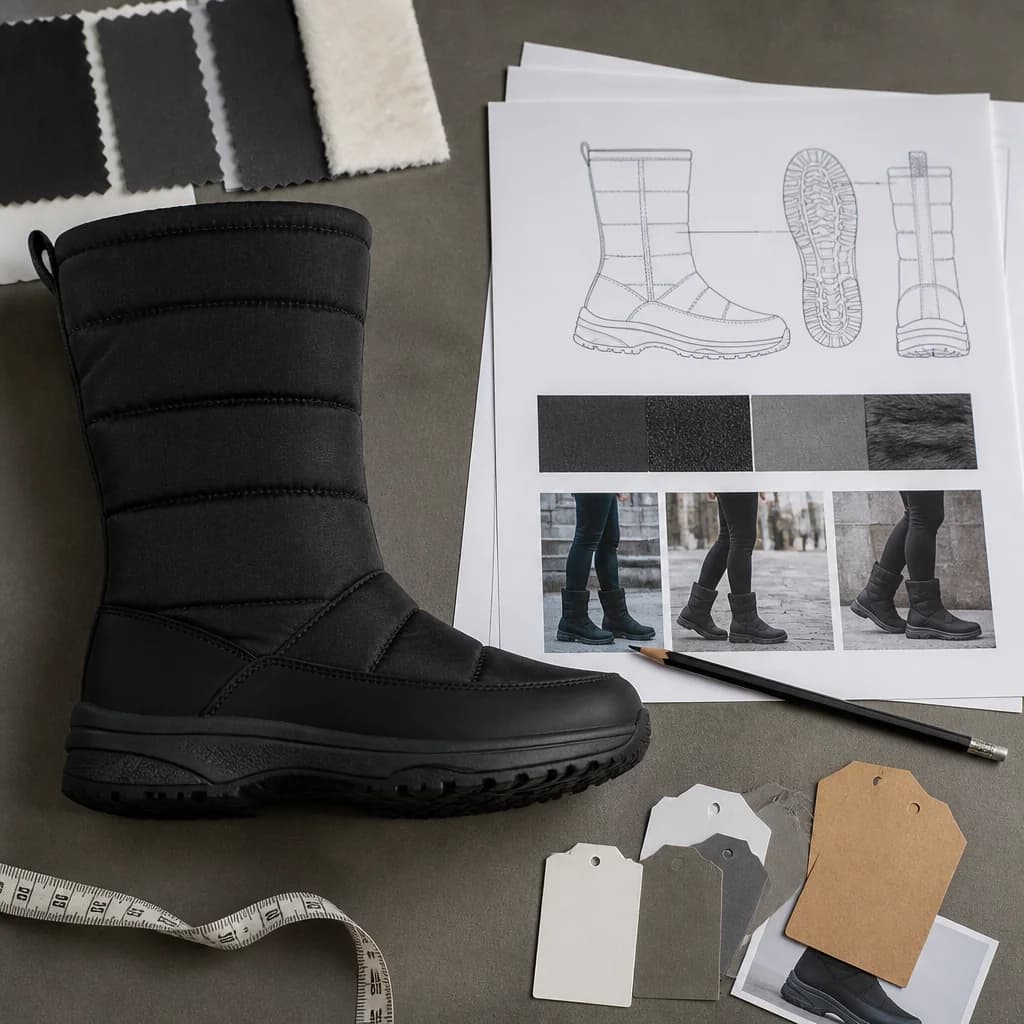
Prepare a buyer-owned snow-boot record that states the target sizing system, fit reference, scope, and open decisions.
The buyer-side problem starts at handoff. A named reference may reach another reviewer without a recorded scope, target sizing system, owner, or list of open decisions. This editorial recommendation uses a wholesale winter boots fit reference brief as a buyer-owned record that makes those points explicit before the project is raised for development, sampling, or quotation discussion.
The record gives the buying team one place to identify the reference, state what it is intended to guide, and show what still requires a decision. The fields and checks below are editorial buyer guidance. They do not describe a SnowBootWorks workflow, approval method, or fit result.
The Handoff Failure
For women's retail and private-label winter collections, the SnowBootWorks product catalog directs the buyer to decide the target sizing system and fit reference first, then review the product brief. The catalog also describes fit-led women's winter boot platforms spanning clean urban, quilted, and plush cold-weather directions. Those are catalog directions. The decision prompt identifies the target sizing system and fit reference as early inputs for the stated collection context.
For the buyer, a useful handoff keeps those inputs beside the current product brief. Collection direction can remain visible as context. The target sizing system can be recorded as the named project input. The fit reference can be identified as a separate buyer-controlled source. Open decisions can remain visible instead of being embedded in a product image, a styling label, or an email thread.
The Buyer-Owned Fit Record
Use one buyer-controlled record for the current project definition. The following eight fields are an editorial recommendation for organizing that record. They are deliberately limited to decisions and references the buyer can identify before asking which project options may apply.
- Product identifier
- Record the buyer's product name, internal reference, or collection label and connect it to the current product brief.
- Target sizing system
- Write the target sizing system selected for the project. Mark it as confirmed or open. Do not infer it from a photograph, sales channel, or previous item.
- Fit reference
- Name the reference clearly enough for the buyer's reviewers to identify the same item, document, or buyer-held source.
- Reference boundary
- State the part of the discussion the reference is intended to guide. Keep construction, material, and approval questions in their own fields.
- Current construction direction
- Record only the construction direction already included in the buyer's current product definition.
- Current material direction
- Record the material direction currently selected by the buyer and identify material questions that remain open.
- Approval expectations
- State the buyer's current approval expectations and identify the internal reviewer or reviewer group.
- Owner and unresolved status
- Give each open point a buyer-side owner and a clear status, such as awaiting review or awaiting confirmation.
This structure can be useful in a private label snow boot product brief. A buyer may already have a collection direction while the target sizing system or fit reference still needs internal confirmation. Recording that status directly keeps the brief readable as the current definition of the project.
What Can a Fit Reference Decide?
A named winter boot fit reference should be given a stated scope. This article recommends a short scope line that answers one question: what is the buyer asking the reference to guide? A buyer may, for example, limit the reference to the fit discussion and retain all other decisions in their own fields.
That boundary prevents the reference from carrying unrecorded meaning. A fit reference does not need to silently settle the target sizing system, construction direction, material direction, brand requirements, or approval expectations. The record should show any connection the buyer has already decided and preserve the remaining items as open decisions.
- Can a reviewer identify the reference without guessing?
- Is the target sizing system written separately from the reference?
- Does the scope line show what the reference is intended to guide?
- Are unmade decisions assigned to an owner and status?
Construction, Materials, and Approval Standards
SnowBootWorks states on its capabilities page that it develops custom snow boots to the buyer's own specification. The page says construction, materials, and approval standards drive every decision. Those three terms provide useful headings for a buyer-side record because they keep the current fit reference connected to the wider product definition without treating it as the whole specification.
The table below is an editorial framework for the buyer's own record. It separates what can be stated now from what still needs a buyer decision.
| Brief heading | Record now | Keep visible as open |
|---|---|---|
| Construction | The construction direction already stated in the current buyer brief. | Construction choices awaiting buyer review and the owner of that review. |
| Materials | The material direction already recorded by the buyer. | Material decisions awaiting selection, confirmation, or buyer review. |
| Approval standards | The buyer's current approval expectations and reviewer. | Approval expectations still being drafted, confirmed, or assigned. |
Use a separate line whenever the buyer wants to connect a fit reference to one of these headings. That makes the connection explicit. It also preserves the status of the construction, material, or approval decision for the next buyer review.
Fit Direction Versus Product Specification
Fit direction and product specification have different roles in the handoff record. The catalog's clean urban, quilted, and plush descriptions provide context for fit-led women's winter boot platforms. A target sizing system names the sizing input for the project. A fit reference identifies the buyer's chosen comparison point. The product brief carries the buyer's current construction direction, material direction, and approval expectations.
This editorial classification gives each item a clear job. It also helps a buyer avoid treating a familiar styling direction as a substitute for a documented input. Within a snow boot sizing system for buyers, the central question is whether the target sizing system is recorded for the current brief, not whether another party can infer it from context.
Read the record once from the perspective of a reviewer seeing it for the first time. Every statement should be identifiable as a buyer decision, a named reference, or an unresolved item. Move any ambiguous statement into one of those categories and attach a status before the inquiry is sent.
The Inquiry Decision Gate
Use this final check immediately before requesting information. Its limited job is to identify the content that can be shared as the current winter-footwear definition and the content that remains open within the buyer's team.
- Does the product identifier link to the current product brief?
- Is the target sizing system written as a project input?
- Is the fit reference named and given a clear scope?
- Are the current construction and material directions recorded separately?
- Are approval expectations visible, including the buyer-side reviewer?
- Does every unresolved point have an owner and status?
When the record answers those questions, share the current winter-footwear definition through the project inquiry page and ask which development, sampling, or quotation options may apply to the project. Include the open items with the confirmed inputs so the inquiry reflects the buyer's current decision state.
Evidence layer
Evidence checklist: Preparing a wholesale winter boots fit reference brief
A product category page is a starting point, not an assortment plan. Decide which customer, climate, price band, and selling channel each direction serves. Then compare shaft height, warmth, waterproofing, outsole behavior, color architecture, size coverage, and packaging as a group. A range with fewer clearly differentiated roles is easier to brief, sample, and explain than a long list of near-duplicates. For this guide, map each supplier response to “The Handoff Failure” so a claim is supported by a written specification, sample reference, controlled document, or a clearly marked open question.
Document the role of every style in the seasonal plan: traffic builder, core repeat, premium option, kids or family extension, or workwear solution. This makes later decisions about size ratios, colorways, and replenishment more explicit. Cross-check the response against “The Buyer-Owned Fit Record” and keep every unresolved point visible in the approval record.
- One clear role for each style — scoped to wholesale winter boots fit reference brief
- Size, color, and channel assumptions — cross-checked against “The Handoff Failure”
- Range gaps and avoidable duplication — with open risks from “The Buyer-Owned Fit Record” recorded
Decision framework
Buyer checklist
- Use a buyer-owned record to connect the target sizing system, fit reference, scope, and current product brief.
- Give the fit reference a stated boundary and keep open construction, material, and approval decisions visible.
- Record construction direction, material direction, and approval expectations as separate buyer-side fields.
- Share the current winter-footwear definition and ask which development, sampling, or quotation options may apply.
Sources and verification
Evidence used for this guide.
Continue the specification