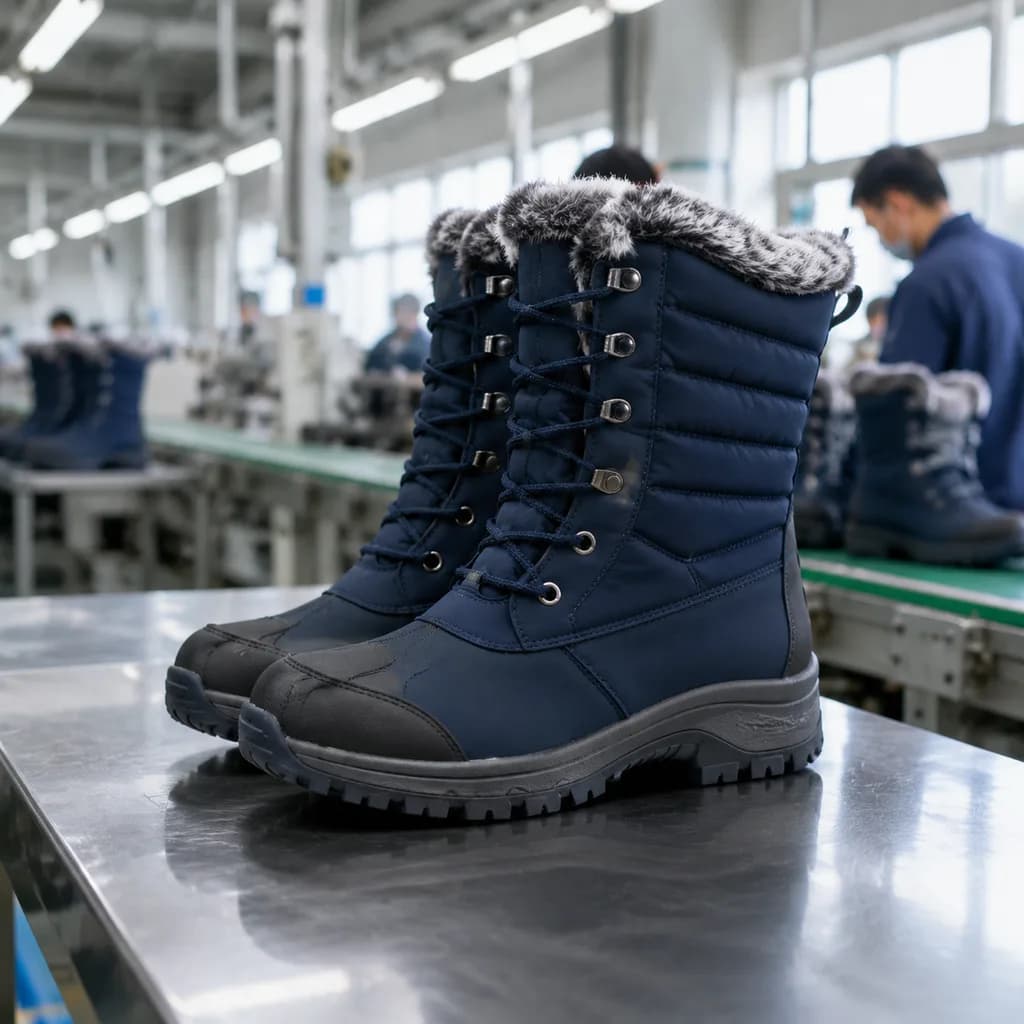
Build a consistent wholesale snow boot RFQ by defining construction, materials, sizing, fit, branding and approval standards before comparing quotes.
A wholesale snow boot RFQ can produce responses based on different product definitions when the brief leaves key decisions open. A textile upper may be described broadly, women's sizing may lack a named sizing system, and a reference boot may not show which features the buyer intends to retain. Before comparing prices, the buyer needs a consistent basis for reading each response.
SnowBootWorks states that its custom snow boots are developed to the buyer's specification, with construction, materials and approval standards driving decisions. These documented inputs support a practical starting point for the RFQ. The matrix and review method below are editorial recommendations for buyers; they are not a complete list of quotation variables or a statement that every discussed option is available for every project.
Build the definition-gap matrix
Instead of presenting every line as a settled specification, divide the brief into three statuses. This makes unresolved decisions visible and distinguishes buyer requirements from questions that require a project-specific response.
- Confirmed requirement
- A product direction the buyer has selected and wants quotation respondents to interpret consistently.
- Decision still open
- A choice that remains under buyer review and should not be settled by an unrecorded supplier assumption.
- Question for the supplier
- A request for information about the project. Its inclusion does not document a service, deliverable or commitment from SnowBootWorks.
| Definition field | Confirmed requirement | Decision still open | Question for the supplier |
|---|---|---|---|
| Construction | Record the selected construction direction. | Identify construction choices awaiting buyer approval. | Ask how the supplied direction would be interpreted for the project. |
| Upper material | Name the required base material, finish and backing separately. | List alternative material directions without merging them. | Ask which description applies to the proposed definition. |
| Sizing system | State the target system. | Mark the system open when the buyer has not selected it. | Ask what sizing information is needed to assess the brief. |
| Fit reference | Identify the reference and what it is intended to communicate. | List fit points that remain subject to buyer review. | Ask how the reference would be read for the inquiry. |
| Reference sample | Identify each sample supplied with the brief. | Separate directional features from undecided details. | Ask what supporting information should accompany the reference. |
| Branding | Record the branding included in the requested definition. | Flag unresolved placement or execution choices. | Ask which branding details require confirmation. |
| Approval standards | Name the buyer's governing approval basis. | Show criteria or ownership that remain unresolved. | Ask how open approval points should be represented in the response. |
Buyers should complete only the cells supported by the current brief. An open status is preferable to language that lets each respondent make a different silent assumption.
Fix the fit basis before adding style direction
The SnowBootWorks women's snow boot catalog section describes fit-led women's winter boot platforms in clean urban, quilted and plush cold-weather directions. For those cited platforms, the page directs buyers to decide the target sizing system and fit reference first.
For an RFQ based on one of those directions, the buyer can use the following order:
- Name the sizing system. Replace broad wording such as “women's sizing” with the actual system selected for the project.
- Identify the fit reference. State which approved reference respondents should use when reading the brief.
- Limit the reference's role. Record the characteristics it is intended to communicate and mark other fit decisions as open.
- Add style direction separately. Clean urban, quilted and plush are directions named in the cited product excerpt; they do not determine the sizing system or fit reference.
Keeping those fields separate allows the buyer to trace a quotation difference to a stated fit assumption rather than to an undefined style label. The excerpt supports this direction for the cited women's platforms, not a general claim about fit development or size grading.
Write the upper as separate material fields
The SnowBootWorks materials page places coated nylon upper, water-resistant fabric upper and technical textile shell under its “Waterproof Textile Upper” heading. The same excerpt also describes a woven or laminated synthetic fabric upper, typically nylon or polyester. It says the fabric is finished with a durable water-repellent coating and is often backed by a waterproof membrane or laminate.
For clarity, buyers should avoid collapsing those terms into a single requirement. A base textile, a finish and a backing occupy different places in the product definition. The RFQ can record them as follows:
- Base upper: state the selected fabric or textile direction.
- Finish: mark DWR as required, under consideration or outside the current definition.
- Backing: record any membrane or laminate direction separately.
- Open relationship: ask how the named material fields would relate to the proposed construction.
The cited description concerns upper materials. It does not provide a finished-boot waterproof rating or other finished-product result. Buyers requiring finished-product evidence should state their own approval requirement and ask what information may apply to the project.
Define the approval basis
SnowBootWorks identifies approval standards as one of the inputs driving decisions for custom snow boots made to a buyer's specification. The cited capability statement does not name particular certifications, laboratory methods or inspection systems.
As an editorial procurement practice, buyers should make the approval basis traceable in the RFQ:
- Identify the buyer document, internal standard or approved reference governing the relevant decision.
- Mark an unselected criterion as open.
- Separate product-definition approval from the buyer's commercial authorization to proceed.
- Ask which project-specific information may be available for review.
During comparison, an assumed approval basis should be recorded as a deviation from a confirmed buyer requirement. The quotations can then be reviewed again after that difference has been clarified.
Annotate the reference sample
SnowBootWorks describes a private-label waterproof winter boot program in which a brand brief moves from reference samples to an export-ready, branded production run. The excerpt supports that program description only. It provides no quantities, timing or detailed sequence that can be applied to another inquiry.
For the buyer's RFQ, a reference sample should be accompanied by written boundaries. Record which features are requirements, which are directional and which should not carry into the proposed product. Branding should have its own entry rather than being inferred from the sample.
If the written brief and reference appear to conflict, the matrix gives the respondent a defined place to raise the question. The buyer can then resolve the conflict without allowing the sample to replace the specification.
Review interpretations before prices
When responses arrive, buyers should map each quotation back to the same definition fields. The review should check whether each respondent used the same interpretation of:
- the requested construction direction;
- the upper material terms included in the brief;
- the target sizing system;
- the fit reference and its stated role;
- the purpose of each reference sample;
- the requested branding scope; and
- the buyer's approval basis.
Record a substitution, assumption or unresolved question beside the field it affects. Until those differences are reconciled, the responses do not represent the same custom snow boot specification and should not be treated as a direct price comparison.
Prepare the RFQ handoff
The final handoff should preserve the matrix statuses. Buyers should provide the current winter footwear definition, identify the relevant references and show which entries are confirmed, open or directed to the supplier.
To discuss a project with SnowBootWorks, review its stated capabilities and share the current definition through the quotation request. Ask which development, sampling or quotation options may apply to the brief. Any applicable options remain subject to confirmation for that inquiry.
Evidence layer
Evidence checklist: Wholesale Snow Boot RFQ: Define Before You Compare
A supplier comparison becomes useful when each candidate answers the same questions in the same format. Record the closest existing construction, what must change for your brief, which sample revisions are included, and how the approved reference will be carried into production. Keep commercial promises separate from evidence: a polished catalog image is not proof of repeatability, and a low opening price is not proof of landed cost. For this guide, map each supplier response to “Build the definition-gap matrix” so a claim is supported by a written specification, sample reference, controlled document, or a clearly marked open question.
Ask for a written development summary, a sample revision log, the proposed inspection checkpoints, and the export documents your importer will need. If an answer is conditional, write down the condition rather than converting it into a guarantee. Cross-check the response against “Fix the fit basis before adding style direction” and keep every unresolved point visible in the approval record.
- Program fit and closest base style — scoped to wholesale snow boot RFQ
- Sample notes, measurements, and revision ownership — cross-checked against “Build the definition-gap matrix”
- Production, inspection, and corrective-action evidence — with open risks from “Fix the fit basis before adding style direction” recorded
Decision framework
Buyer checklist
- Buyers should use a definition-gap matrix to separate confirmed requirements, unresolved decisions and supplier questions.
- For the cited fit-led women's platforms, buyers should settle the target sizing system and fit reference before relying on style language.
- Buyers should record the base upper, finish and backing as separate fields rather than merging distinct material directions.
- Before comparing prices, buyers should reconcile how each response interprets construction, materials, sizing, fit, reference samples, branding and approval standards.
Sources and verification
Evidence used for this guide.
Continue the specification