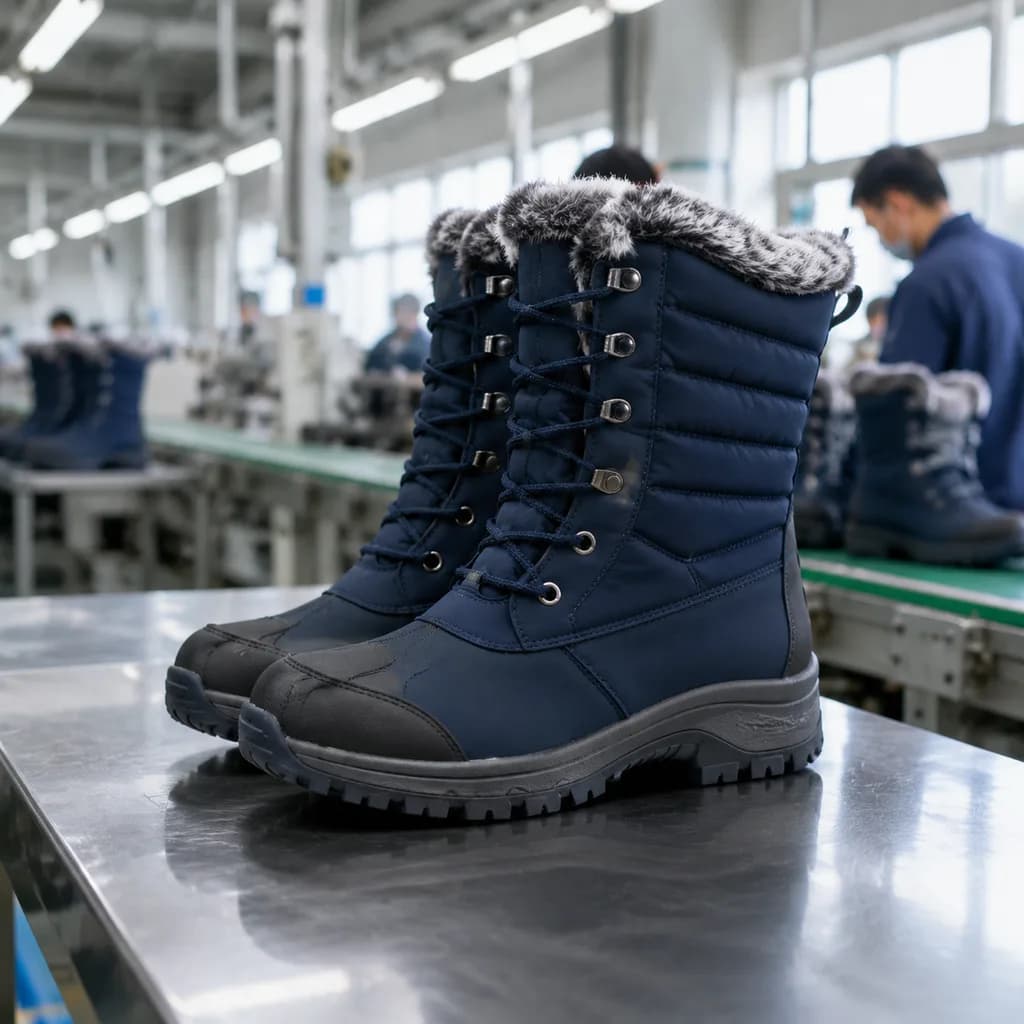
Stop price-first RFQs that stall branded runs. Build a private label wholesale winter boots brief covering path, fit, retail goals, and sample gates.
A unit price only compares products that already exist. Winter footwear brands and outdoor retailers still open private label wholesale winter boots talks with a price-list request, then find construction, materials, fit, and approval ownership unfinished. Sampling becomes product invention. Quotation rounds compare unlike builds.
A branded program is not a frozen catalog SKU. Treat the work as a controlled brief-to-production sequence: choose the program path, lock sizing and fit reference where the public guidance applies, convert outdoor-retail goals into fields developers can challenge, and gate samples with the criteria that belong to the path you chose. Share that definition before you ask which development, sampling, or quotation options may apply.
Why do price-list requests stall branded winter boot programs?
Wholesale pricing assumes a known product. A private-label winter boot program does not start known. On the case-studies page, SnowBootWorks frames a waterproof private-label program as a brand brief that moves from reference samples to an export-ready, branded production run. That is program work, not shopping a finished SKU list for unit cost alone.
When the brief is thin, teams argue colorways while construction is still open. Fit complaints surface after style boards are approved. Later quotes look comparable only because materials and approval ownership never settled.
As an editorial recommendation for buyers: treat an early price without a written program definition as non-comparable. If you still need platform language after the brief fields are filled, review the product catalog then, not first.
Private-label path or OEM winter boot specification?
Buyers often collapse private label and OEM into one vague custom line. The public pages keep them separate, and the RFQ should too. Use the comparison below as a path choice, not a merged service claim.
| Decision dimension | Private-label program framing | OEM winter boot specification framing |
|---|---|---|
| Starting point | Brand brief plus reference samples toward a branded production run (waterproof winter boot program example on the case-studies page) | Buyer-owned specification for custom snow boots |
| What the source says drives decisions | Movement from brief and references to an export-ready branded production run | Construction, materials, and approval standards |
| Buyer emphasis | Brand direction, references, and branded-line outcomes | Owning the specification content that construction and materials must meet |
| When this path fits (editorial guidance) | You are building a branded line from a defined brief rather than buying a stock wholesale style as-is | You already control construction, materials, and the standards that must gate decisions |
A private label snow boot program, in the case-study excerpt, is the waterproof path from brand brief and reference samples to an export-ready branded run. Do not stretch that excerpt into non-waterproof or multi-category coverage.
Separately, OEM manufacturing is described as developing custom snow boots to the buyer’s own specification, with construction, materials, and approval standards driving every decision. Pick one primary path in the brief header. Dual-path labels force factories to guess who owns the specification and what done means. Keep OEM manufacturing capabilities and the private-label program overview as distinct references.
Fit ownership before style boards
Style boards are easy first artifacts. Fit is the harder gate. For women’s retail and private-label winter collections, product guidance on the catalog page is fit-led: decide the target sizing system and fit reference first, then review the product brief against women’s winter boot platforms that span clean urban, quilted, and plush cold-weather directions.
- Name the sizing system. State the size scale the brand will sell against so last and grading talk share one language.
- Name the fit reference. Identify what the team will use for women’s private-label or retail fit judgment before platform or upper direction locks.
- Shortlist platforms only after that ownership is clear. Urban, quilted, or plush cold-weather looks still matter. They should follow fit, not lead it.
That fit-first order is scoped to women’s retail and private-label winter collections on the source page. It is not documented there as a rule for men’s, kids’, or unisex lines. For other categories, as an editorial recommendation, treat sizing system and fit reference as the same buyer priority even when those lines are not named in the fit-led block.
Turning outdoor-retail goals into brief fields
Outdoor retail winter footwear programs, as described on the industries page, balance comfort, weather protection, and shelf appeal. Those three phrases help only after you turn them into fields product developers can challenge.
The table below is buyer structure for a brief. It is not a set of performance ratings or merchandising KPIs the source does not publish.
| Outdoor-retail goal | Brief field to complete | What to write without inventing proof |
|---|---|---|
| Comfort | Wear context and fit priority | Who wears the boot, for what use pattern, and which fit reference will judge comfort for the collection |
| Weather protection | Protection intent in plain language | What weather the assortment must address at the program level. Leave temperature ratings, insulation grams, and waterproof test methods out unless you bring independent standards |
| Shelf appeal | Assortment role and visual direction | Which platform direction supports the shelf story after sizing and fit reference are locked for women’s collections that use the fit-led order |
Keep waterproof private-label intent on the case-study path when that is your program type. Do not fold it into the outdoor-retail balance claim. Context for outdoor retail brands sits on the industries page.
What should gate sampling on each path?
Samples should test a written brief, not invent the product. The public pages assign different decision drivers to each path. Keep those drivers separate in the RFQ.
OEM winter boot specification path. OEM manufacturing language puts construction, materials, and approval standards in the driver’s seat for custom snow boots built to the buyer’s own specification. Before you request samples or quotes on this path, write those three items so a sample can pass or fail against them.
- Construction: What build the buyer-owned specification requires.
- Materials: Which material choices the specification locks or leaves open.
- Approval standards: Which standards and which role can accept or reject a sample.
Private label snow boot program path. The waterproof private-label case study describes a brand brief that moves from reference samples to an export-ready, branded production run. Before sampling on this path, write those elements only. Do not import OEM construction, materials, or approval-standards language onto this path from the capabilities page.
- Brand brief: Program direction and branded-line intent stated in writing.
- Reference samples: Physical or photo references that define close enough before new rounds start.
- Export-ready branded production run intent: Note that the program aims at a branded production run, using the case-study wording rather than expanded packaging or labeling claims the excerpt does not make.
As an editorial recommendation for buyers on either path: name who can accept or reject a sample, and refuse ballpark quotes that skip the path-specific definition above. A quote that pretends the build is fixed while those fields are blank recycles sample cost into argument rather than into a production decision.
Hand-off checklist for a wholesale winter boot development brief
Use this list as a gate before you ask for options. Documented-scope lines reflect what the cited pages describe. Open-inquiry lines are questions you may raise for a project. They are not guaranteed service packages.
- Documented scope: Primary path selected. Waterproof private-label brand-brief path or OEM custom specification path, kept distinct.
- Documented scope: For women’s retail or private-label winter collections, target sizing system and fit reference decided before platform styling.
- Documented scope: Outdoor-retail goals written as comfort, weather protection, and shelf-appeal fields without invented ratings.
- Documented scope (OEM path): Construction, materials, and approval standards written so they can drive custom-spec decisions.
- Documented scope (private-label path): Brand brief plus reference samples defined for movement toward an export-ready, branded production run.
- Open inquiry: Which development, sampling, or quotation options may apply once this brief is shared.
- Open inquiry: Logistics, packing, MOQ, compliance filings, or retail sell-through support you may need from partners. Treat those as project questions, not as documented manufacturer services in the excerpts.
When the list is complete enough for internal sign-off, share your current winter footwear definition with the team that will answer development questions. Ask which development, sampling, or quotation options may apply rather than demanding a unit price against an empty specification. Start at request a quote with the wholesale winter boot development brief attached.
Private label wholesale winter boots fail when wholesale language hides unfinished product decisions. They move when path, fit, outdoor-retail goals, and path-specific sample gates are explicit enough that a sample can pass or fail for documented reasons. Write the brief first. Price second.
Evidence layer
Evidence checklist: Private Label Wholesale Winter Boots Brief
OEM, ODM, and private label are not just marketing labels. The practical difference is who owns the starting design, how much the construction changes, and which decisions must be approved before bulk production. Put the decision in writing: reference style, required changes, branding locations, packaging scope, tooling assumptions, and the point at which a sample becomes the production reference. For this guide, map each supplier response to “Why do price-list requests stall branded winter boot programs?” so a claim is supported by a written specification, sample reference, controlled document, or a clearly marked open question.
A strong brief also records what is out of scope. That prevents a fast sample discussion from silently becoming a new mold, a new size run, or a new compliance requirement. Use the same approval language in the quote, sample comments, and purchase documentation. Cross-check the response against “Private-label path or OEM winter boot specification?” and keep every unresolved point visible in the approval record.
- Design ownership and permitted adaptations — scoped to private label wholesale winter boots
- Branding, packaging, and tooling boundaries — cross-checked against “Why do price-list requests stall branded winter boot programs?”
- Sample approval gates before bulk commitment — with open risks from “Private-label path or OEM winter boot specification?” recorded
Decision framework
Buyer checklist
- Treat private label wholesale winter boots as a brief-to-production sequence, not a finished catalog SKU purchase.
- Choose a private label snow boot program path or an OEM winter boot specification path explicitly; do not merge them in one vague RFQ line.
- For women’s retail and private-label winter collections, lock sizing system and fit reference before platform or style direction.
- Convert outdoor-retail comfort, weather protection, and shelf appeal into brief fields without inventing performance ratings.
- Gate sampling with path-specific criteria: OEM uses construction, materials, and approval standards; private label uses brand brief, reference samples, and export-ready branded production run intent.
Sources and verification
Evidence used for this guide.
Continue the specification
Move from research to a controlled brief.
Frequently asked questions
Questions buyers ask next
Why do wholesale price requests stall private-label winter boot programs?
A unit price assumes a known build. Private-label work still needs a brand brief, reference samples, fit decisions, and a clear path to an export-ready branded production run before price is comparable, so price-first inquiries compare unlike products.
How should buyers separate private label from OEM on a winter boot RFQ?
Use private label when the program starts from a brand brief and reference samples toward a branded production run. Use OEM when the buyer owns the specification and construction, materials, and approval standards drive every decision. State one primary path in the brief header.
What should be locked before style assortment for women’s private-label winter boots?
Target sizing system and fit reference should be decided first for women’s retail and private-label winter collections, then platform or style direction can be reviewed against that fit decision.