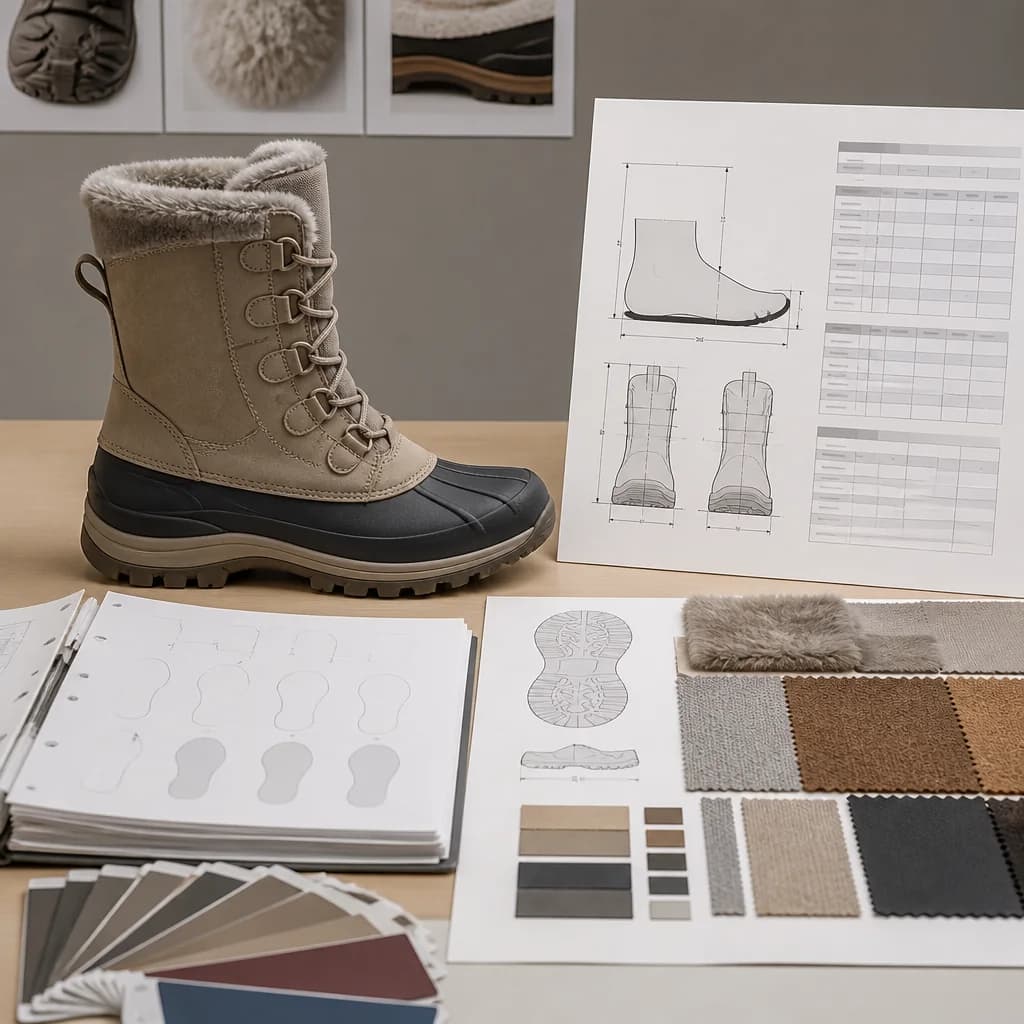
Build a custom women's snow boots fit specification with sizing system, fit reference, platform direction, and open construction or approval fields.
A women's style platform can set merchandising direction and still leave fit unresolved. Buyers who need a custom women's snow boots fit specification should treat the target sizing system and the fit reference as the first two fields to lock. SnowBootWorks presents fit-led women's snow boot platforms and tells buyers to decide those two inputs first.
Platform aesthetics, construction notes, material direction, and approval standards can sit beside those anchors. They do not replace them. Without the two fit fields, the project stays too broad for a focused discussion of which development, sampling, or quotation options may apply.
Style platforms do not answer sizing or fit reference
The SnowBootWorks product catalog lists women's snow boot platforms across clean urban, quilted, and plush cold-weather directions. Those labels locate a style family for women's retail and private-label winter collections.
They do not state how a platform fits, which sizing convention it follows, or which reference a buyer should use. As an editorial recommendation for the buyer, treat platform direction as an aesthetic field only: useful for visual language and collection position, never as a substitute for dimensional requirements.
A practical first pass of a custom winter footwear fit brief only needs three buckets—buyer decisions already made, product or material directions supported by source material, and topics still open for the inquiry.
Two fit anchors the brief must name
SnowBootWorks names the target sizing system and the fit reference as the decisions to make first. The catalog page does not publish size ranges, measurements, grading rules, last dimensions, or tolerances. If the buyer does not already control those details, leave them open and ask about them later rather than inventing numbers for the worksheet.
| Fit field | What the buyer should record | What remains open |
|---|---|---|
| Target sizing system | Name the commercial sizing convention intended for the collection and the market or internal document that governs that choice. If the organization uses a particular version or reference file, record that file rather than a loose regional label. | Size coverage, conversion treatment, grading basis, and any project-specific measurement requirements remain inquiry topics. The catalog does not assign those decisions to SnowBootWorks or document particular options. |
| Fit reference | Identify the exact reference the buyer wants as the comparison point for fit discussion. Record enough detail for the project team to distinguish that reference from a mood-board image, styling cue, or material sample. | Ask what reference format is useful for the project and how it would relate to development or sample review. An unnamed reference does not establish measurements, tolerances, or grading instructions on its own. |
Keep the two fields distinct. Naming a market does not, by itself, document the project's sizing convention. A sizing label does not describe the volume, shape, or fit expectations represented by a reference.
As an editorial control step, assign an owner and revision status to each field so design, merchandising, sourcing, and quality teams do not work from different references under one project name.
Platform labels versus independent fit fields
Within the catalog's stated scope, clean urban, quilted, and plush cold-weather are separate women's platform directions. None of those labels should expand into an assumed fit profile.
| Documented direction | Useful role in the brief | Do not infer |
|---|---|---|
| Clean urban | Records one of the catalog's stated women's platform directions. | A particular width, volume, last shape, or sizing behavior. |
| Quilted | Records one of the catalog's stated women's platform directions. | A fit allowance, grading method, or validated retail fit. |
| Plush cold-weather | Records one of the catalog's stated women's platform directions. | A universal fit or a defined relationship between interior materials and sizing. |
| Buyer-selected fit reference | Records the intended fit comparison point. | Construction, material composition, approval criteria, or finished-product performance. |
When several internal teams write one request, this split matters. Design can state the platform direction. The fit owner can name the governing reference. Sourcing can flag missing information as an inquiry topic instead of inventing meaning from the style name.
Construction and upper direction stay adjacent to fit
The SnowBootWorks capability page describes custom snow boot development to the buyer's own specification. Construction, materials, and approval standards drive decisions in that description. Those topics belong in the same project definition as fit, but they should not collapse into the fit fields.
- Buyer specification
Identify the documents or requirements the buyer expects to govern the project. Where several files exist, state each file's purpose and revision status so a styling document is not treated as a fit authority.
- Construction direction
Record the intended direction in the buyer's terminology. Mark unconfirmed architecture or execution points as open and ask what may apply for the project.
- Material direction
Name the required upper category. Separate known component attributes from any desired finished-boot performance so material selection is not used as shorthand for an unverified product outcome.
For one documented material direction, the SnowBootWorks materials page describes a waterproof textile upper as woven or laminated synthetic fabric, typically nylon or polyester, finished with a durable water-repellent coating. It says this upper is often backed by a waterproof membrane or laminate.
The word “often” matters: not every upper in the category is described as membrane-backed. Those component details can populate the material field. They should not be rewritten as a finished-boot performance claim.
If the project needs a particular waterproof result, test method, or acceptance threshold, record that requirement separately or mark it open. A DWR finish, coated textile, membrane, or laminate is a component-level description, not a complete approval record for the boot.
Name the approval field, then leave unsupported detail open
Approval standards appear with construction and materials in the capability description. The page does not name certifications, test methods, pass criteria, testing parties, or verification formats. Keep a dedicated approval field on the fit-definition sheet and leave unsupported detail out of it.
When the buyer already holds a standard, name the governing document, intended market, required criteria, and internal decision owner. When the requirement is unsettled, label it open. Useful inquiry questions include which project information is needed, who would own any required evaluation, and what evidence would have to be reviewed before approval.
Keep fit discussion and performance discussion from collapsing into one sign-off. A fit reference may guide fit talk; it does not establish waterproof performance, cold-weather suitability, traction, durability, or regulatory status. A material or performance requirement does not resolve the target sizing system or fit reference.
Compact record for the first commercial conversation
Before a commercial discussion, consolidate the current information into one short record. The goal is not to erase unknowns. It is to separate confirmed buyer inputs, documented product directions, and questions that still need a response.
- Women's platform direction: Record clean urban, quilted, plush cold-weather, or another buyer-defined style direction, and keep it separate from fit assumptions.
- Target sizing system: Name the intended commercial convention and the buyer document or market requirement behind it. This is the women's snow boot sizing system field.
- Fit reference: Identify the exact winter boot fit reference intended to anchor the fit discussion and clarify that reference's role.
- Buyer specification: List the governing documents and distinguish fit, styling, construction, material, and approval information.
- Construction direction: State what is known and mark undecided architecture or execution points as inquiry topics.
- Material direction: Describe the intended material category. If a waterproof textile upper is under consideration, keep its documented textile, DWR, and possible backing attributes separate from finished-product requirements.
- Applicable approval standards: Name buyer-controlled requirements where available and identify missing methods, criteria, responsibilities, or evidence as open questions.
A concise inquiry can then state the platform direction, target sizing system, fit reference, and current specification status before presenting unresolved items. That sequence shows which decisions the buyer has already made and which information is being requested.
Project definition: women's platform direction identified; target sizing system specified; fit reference identified; construction, material, and approval fields attached or marked open. Please advise which development, sampling, or quotation information may apply to this definition and what additional inputs are needed for discussion.
Share the current fit definition through the request page. Ask which development, sampling, or quotation options may apply to the project. Do not treat every open topic as an established service or commitment.
Evidence layer
Evidence checklist: Custom women's snow boots fit specification before first inquiry
A supplier comparison becomes useful when each candidate answers the same questions in the same format. Record the closest existing construction, what must change for your brief, which sample revisions are included, and how the approved reference will be carried into production. Keep commercial promises separate from evidence: a polished catalog image is not proof of repeatability, and a low opening price is not proof of landed cost. For this guide, map each supplier response to “Style platforms do not answer sizing or fit reference” so a claim is supported by a written specification, sample reference, controlled document, or a clearly marked open question.
Ask for a written development summary, a sample revision log, the proposed inspection checkpoints, and the export documents your importer will need. If an answer is conditional, write down the condition rather than converting it into a guarantee. Cross-check the response against “Two fit anchors the brief must name” and keep every unresolved point visible in the approval record.
- Program fit and closest base style — scoped to custom women's snow boots fit specification
- Sample notes, measurements, and revision ownership — cross-checked against “Style platforms do not answer sizing or fit reference”
- Production, inspection, and corrective-action evidence — with open risks from “Two fit anchors the brief must name” recorded
Decision framework
Buyer checklist
- Record the target sizing system and fit reference as separate buyer decisions before treating the fit brief as inquiry-ready.
- Use clean urban, quilted, and plush cold-weather labels only as platform directions, not as dimensional fit requirements.
- Keep construction, material direction, and approval standards alongside the fit fields but separate from them.
- Present unresolved measurements, grading, testing, and evidence requirements as inquiry questions rather than assumed capabilities.
Sources and verification
Evidence used for this guide.
Continue the specification