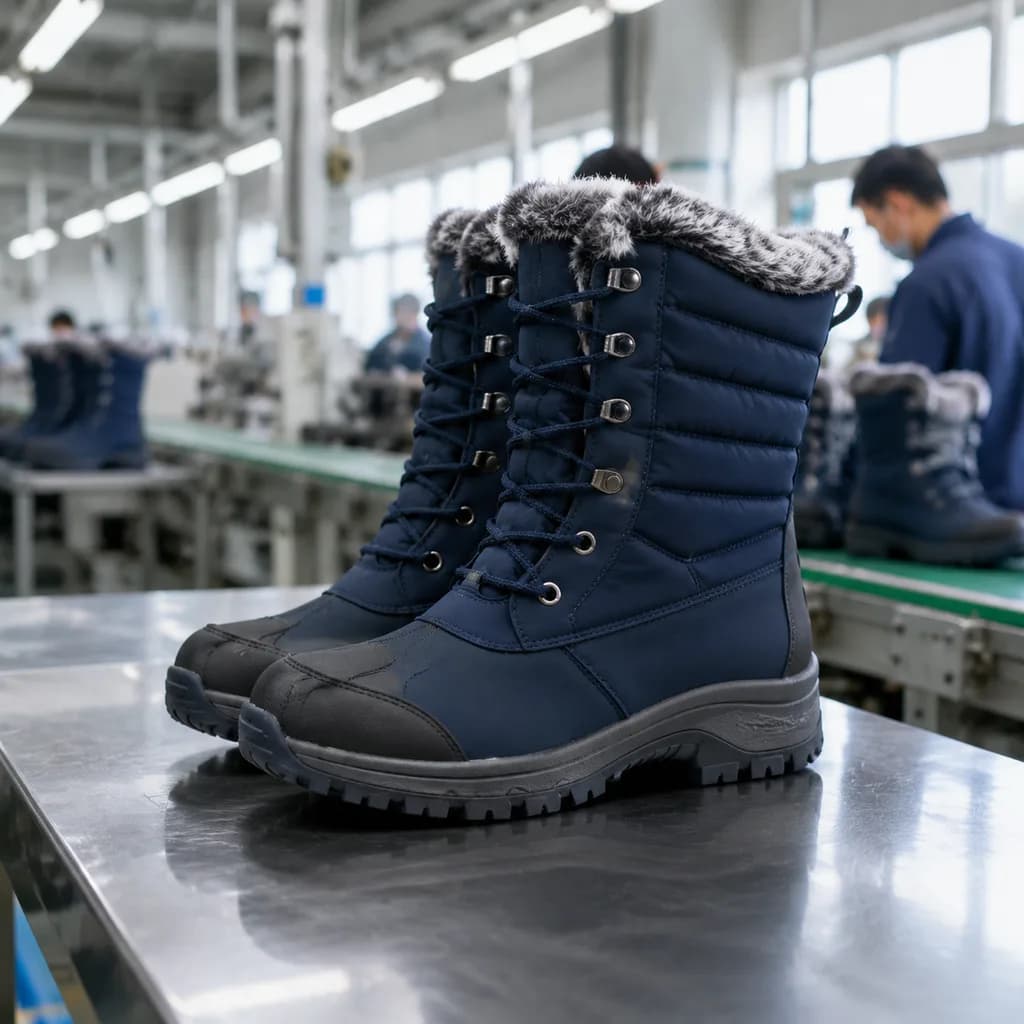
Start women's winter wholesale with fit-led platform families, then co-decide sizing and fit reference before private-label or OEM routing.
Canadian winter footwear brands, outdoor retailers, importers, and product developers often finish color cards and silhouette sketches while the base last and fit reference stay open. Hardware and trim stories travel easily across meetings. Platform family does not. Samples then arrive on mismatched volumetric bases, quotes inherit the same ambiguity, and the assortment never quite becomes one program. That is the failure wholesale women's winter boot platform selection is meant to prevent: treat fit-led platform family as the first commercial filter, co-decide the target sizing system and fit reference in the same pass, stress-test the survivor against outdoor retail needs, and only then open private-label or OEM route language.
Creative choices can still move after that gate. They simply stop rewriting the last after every merchant review.
The assortment error that starts after the mood board
Direction boards help teams agree on look. Trouble starts when those boards stand in for platform and fit decisions. On a women's wholesale program, color stories and surface finishes change without rebuilding the last. Platform family is not that flexible. Once samples run against three different volumetric bases, the assortment stops reading as one collection and starts reading as three unrelated development tracks.
For buyers serving Canadian winter retail and private-label collections, the failure mode is practical. The team agrees on a look, then discovers that entry, shaft volume, and cold-weather character were never aligned. Sampling absorbs the disagreement. Quotes absorb it next. Neither process repairs architecture. Name the platform family and the fit reference before treating a style card as production-ready.
SnowBootWorks presents fashion-and-fit women's snow boots as fit-led women's winter boot platforms spanning clean urban, quilted, and plush cold-weather directions. Buyer fit is stated for women's retail and private-label winter collections. That product framing works as a commercial filter for assortment planning. Teams should treat it as a gate rather than a ranked style catalog for mixing finishes without a shared last logic.
Filter by fit-led platform family first
Platform selection commits the assortment to how the line will sit on the foot, how it will read on a retail wall, and which trims will still look coherent after grading. The three directions below stay inside the catalog labels. The freeze column is editorial recommendation for the buyer: operational items to lock before samples, not factory-defined product physics or performance claims.
| Platform filter | Catalog direction | Buyer-side freeze advice before samples |
|---|---|---|
| Clean urban | Clean urban direction within fit-led women's winter boot platforms | Shaft height band, toe shape family, and the fit reference that will govern width and entry |
| Quilted | Quilted direction | Quilt pattern scale and panel map if surface architecture is a brand signature; whether the line is one platform or multiple siblings |
| Plush cold-weather | Plush cold-weather direction | Collar volume band and how plush SKUs will sit next to cleaner styles on the wall plan |
Editorial guidance for buyers: each filter answers a different assortment question. Clean urban asks how restrained the winter read should stay on shelf. Quilted asks whether surface architecture is a signature or a seasonal effect. Plush cold-weather asks whether the collection needs an explicit soft-winter block for depth of season. Choosing more than one family can be valid for a wide wholesale line when each family has its own fit reference and size architecture. Mixing trims across families without that separation recreates the direction-board failure in product form.
Freeze the platform family before decorative options. Color and branding can still move after the base is named. The reverse order usually forces sample remakes that look like design iteration but are really platform correction.
Co-decide the sizing system and fit reference
Platform family without a named sizing system is only half a commercial decision. SnowBootWorks product framing for women's retail and private-label winter collections lists target sizing system and fit reference as the items to decide first, with a product brief review as the next step. Platform family sets volume character. The fit reference sets how that volume is measured, graded, and approved.
Buyers can treat the co-decision as a short sequence:
- Name the market sizing system the retail or private-label program will sell against.
- Name the fit reference the team will use for entry, width, and length checks on the chosen platform family.
- State whether the assortment is one platform family or several, and keep separate fit references if the families do not share a last logic.
- Only then open color, trim, and branding work that still depends on a stable base.
If the sizing system or fit reference is missing, several things remain undefined even after a polished sample arrives. Size conversion conversations stay provisional. Width and entry feedback cannot be compared across rounds. Branding conversations for private-label collections start without a shared measure of what true-to-size means for the line. Quotation requests may still be possible, but they sit on an incomplete product definition.
A women's snow boot fit reference decision belongs inside wholesale women's winter boot platform selection, not in late QC. Teams that try to sort fit later usually discover that later is when sample inventory and calendar pressure are highest.
Apply outdoor retail constraints without rewriting the platform
Once a platform family and fit reference survive internal debate, outdoor retail needs become a stress test rather than a second redesign. SnowBootWorks describes outdoor retail brands as a buyer fit for winter footwear programs that balance comfort, weather protection, and shelf appeal. Use that balance as a constraint set against the already chosen base.
- Comfort: does the named fit reference still make sense for the wear pattern the outdoor retail floor actually sells, or does the team keep rewriting entry and volume after every merchant review?
- Weather protection: is the weather-facing direction already implied by the platform and brief, or is protection still open language waiting for construction decisions?
- Shelf appeal: will the clean urban, quilted, or plush cold-weather read remain legible next to adjacent categories, or is the wall about to hold three competing winter stories under one style code?
These checks should not rewrite the platform family every cycle. Their job is to reject platforms that cannot carry the retail story cleanly, or to confirm that the chosen family can. For outdoor retail women's winter footwear, shelf appeal includes whether the product looks like one coherent answer to cold-weather use. If comfort and weather protection require a different last family than the one marketing prefers, resolve that conflict before sampling multiplies it.
Route the surviving platform: private label or OEM
Route selection comes after the platform survives. The documented paths on SnowBootWorks stay distinct in inquiry language.
SnowBootWorks presents a Waterproof Snow Boot Private Label Program as a private-label waterproof winter boot program showing how a brand brief moves from reference samples to an export-ready, branded production run. Buyers who have locked a surviving women's platform may route that platform into this documented private-label path when the brand brief is ready to travel from reference samples toward branded production. That description is a program overview path. It is not a measured outcome, ROI case, multi-client pattern, or a women-specific private-label program title, and it should not be restated as a guarantee of any commercial result.
On the OEM side, SnowBootWorks describes OEM manufacturing as developing custom snow boots to the buyer's own specification, with construction, materials, and approval standards driving every decision. That path fits buyers who already own, or intend to own, the construction logic and approval standard set. Platform family still matters, because an OEM brief that names trims without a base last and fit reference remains incomplete. Responsibility stays with the buyer's specification ownership for construction, materials, and approvals.
| Route | What the evidence supports | Buyer readiness signal |
|---|---|---|
| Private label waterproof program | Brand brief moves from reference samples to an export-ready, branded production run | You have a brand brief and want a private-label path framed around reference samples and branded production |
| OEM manufacturing | Custom snow boots developed to your specification; construction, materials, and approval standards drive decisions | You can supply or define the specification stack and approval standards that will govern the build |
Keep private-label language on the brand-brief-to-branded-run path, and keep OEM language on specification-driven development. Review the documented program overview on the case studies page and the OEM description under capabilities when the surviving platform is ready for route language. Outdoor retail positioning for comfort, weather protection, and shelf appeal remains a buyer-fit filter on the industries page.
What remains open after platform selection
Platform selection ends the first commercial filter. It does not close the project. Several decision gaps still belong in development, sampling, or quotation discussion rather than in assumptions made from a catalog page.
- Which single platform family, or which controlled set of families, will carry the women's wholesale line for the season?
- What target sizing system and fit reference will govern entry, width, length, and sample approval?
- Which outdoor retail constraints (comfort, weather protection, shelf appeal) are mandatory for the first drop versus later depth?
- Is the next step private-label movement from brand brief and reference samples toward a branded production run, or OEM development driven by the buyer's construction, materials, and approval standards?
- Which parts of the winter footwear definition are already locked, and which are still provisional?
Documented first-party pages do not publish MOQs, unit prices, lead times, temperature ratings, waterproof test numbers, or Canadian import certification lists for this decision sequence, and none should be invented to fill the blank. Editorial recommendation for the buyer: treat those commercial and compliance details as open questions for a scoped conversation, not as facts implied by a catalog label.
If the current winter footwear definition already names platform family, sizing system, fit reference, and preferred route language, share that definition when you request a quote and ask which development, sampling, or quotation options may apply. If the definition still lives mostly on a direction board, finish the platform and fit filter first. Wholesale assortment quality starts there, before samples try to repair architecture that was never decided.
Evidence layer
Evidence checklist: Wholesale Women's Winter Boot Platform Selection
A supplier comparison becomes useful when each candidate answers the same questions in the same format. Record the closest existing construction, what must change for your brief, which sample revisions are included, and how the approved reference will be carried into production. Keep commercial promises separate from evidence: a polished catalog image is not proof of repeatability, and a low opening price is not proof of landed cost. For this guide, map each supplier response to “The assortment error that starts after the mood board” so a claim is supported by a written specification, sample reference, controlled document, or a clearly marked open question.
Ask for a written development summary, a sample revision log, the proposed inspection checkpoints, and the export documents your importer will need. If an answer is conditional, write down the condition rather than converting it into a guarantee. Cross-check the response against “Filter by fit-led platform family first” and keep every unresolved point visible in the approval record.
- Program fit and closest base style — scoped to wholesale women's winter boot platform selection
- Sample notes, measurements, and revision ownership — cross-checked against “The assortment error that starts after the mood board”
- Production, inspection, and corrective-action evidence — with open risks from “Filter by fit-led platform family first” recorded
Decision framework
Buyer checklist
- Treat clean urban, quilted, and plush cold-weather directions as commercial filters for wholesale women's winter boot platform selection, using catalog labels only.
- Co-decide the target sizing system and fit reference with the platform family before color, trim, or broad sampling work.
- Use outdoor retail needs for comfort, weather protection, and shelf appeal to stress-test the chosen platform rather than to rewrite it every merchant cycle.
- Route only after the platform survives: buyers may place a surviving women's platform on the documented waterproof private-label path from brand brief and reference samples toward an export-ready branded production run; OEM keeps construction, materials, and approvals under the buyer's specification.
- Share the current winter footwear definition and ask which development, sampling, or quotation options may apply; do not invent MOQs, test results, or certifications the evidence does not state.
Sources and verification
Evidence used for this guide.
Continue the specification
Move from research to a controlled brief.
Frequently asked questions
Questions buyers ask next
Why lock platform family before women's winter boot samples?
Platform family sets the volumetric and commercial character of the assortment. Sampling before that filter often produces incompatible bases, weak size logic, and quotes that cannot map cleanly to one collection architecture.
What should be co-decided with a women's snow boot platform?
The target sizing system and fit reference should sit beside the platform choice. Without them, entry, width, length checks, and approval conversations remain provisional even after a visual sample exists.
How do private label and OEM routes differ after platform selection?
Documented private-label waterproof program language covers moving a brand brief from reference samples to an export-ready branded production run. Buyers may route a surviving women's platform into that path; the program itself is not framed as women-only. OEM manufacturing language covers developing custom snow boots to the buyer's specification, with construction, materials, and approval standards driving decisions. Keep those paths separate in inquiry language.