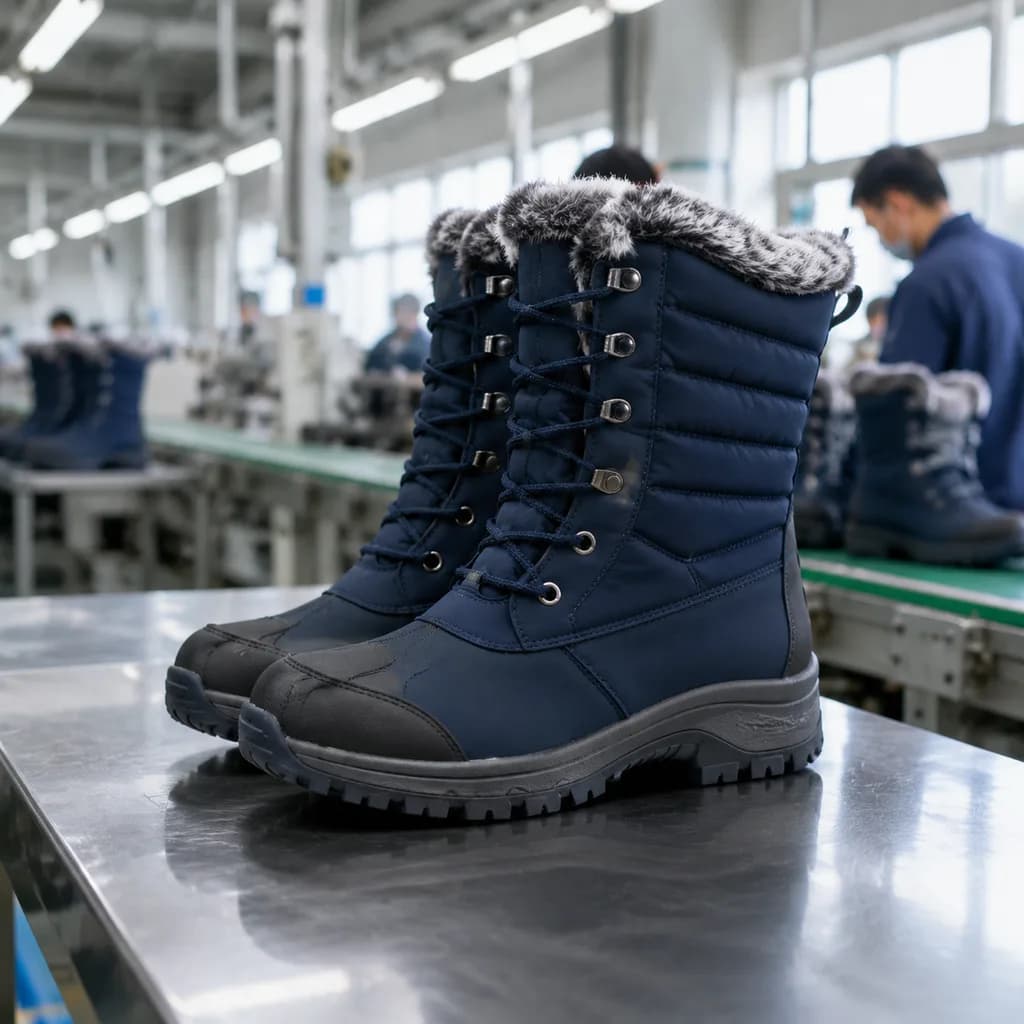
Define custom winter boots through collection role, priority order, fit reference and approval criteria before a development discussion.
When one reference board is expected to communicate silhouette, fit, weather expectations and branding at the same time, its meaning becomes difficult to control. One person may read an image as a shape reference while another treats every visible detail as part of the requested product.
The buyer can resolve that ambiguity before discussing individual features. First define the proposed boot’s role in the collection. Then rank the commercial priorities, identify the fit basis and state which references govern which decisions.
SnowBootWorks describes winter footwear programs for outdoor retail brands in terms of comfort, weather protection and shelf appeal. These are documented program considerations, but the order assigned to them belongs to the buyer. The planning method below is an editorial recommendation for organizing that decision; it is not a description of a required factory process.
Give every reference one declared job
Before expanding the reference board, buyers should label what each existing reference contributes. A boot image might be included for silhouette, while a separate material sample might communicate texture or color. A fit reference should be identified as such rather than left among general design images.
We recommend recording the purpose beside every item and excluding visible details that are not intended to influence the brief. This turns the reference set into a series of controlled inputs instead of an unmarked collection of possible features.
- Direction reference
Identify the element the buyer wants to discuss, such as overall shape, proportion, visual weight or color relationship.
- Fit reference
Name the reference and explain which of its characteristics are relevant to the proposed style.
- Written requirement
State the requested condition, preference or restriction directly rather than relying on an image to imply it.
- Open question
Keep the issue visible and assign it to the buyer-side person or team responsible for deciding it.
Define the collection role
The SnowBootWorks product catalog presents fit-led women’s winter-boot platforms spanning clean urban, quilted and plush cold-weather directions. It places those platforms in the context of women’s retail and private-label winter collections.
Within that stated context, a direction such as urban, quilted or plush can help a buyer locate a proposed style in the assortment. The direction does not by itself define construction, materials, fit or branding.
For planning purposes, we recommend a collection-role field with three buyer-owned entries: where the style sits in the range, which adjacent styles it must differ from and which visual characteristics establish that difference. Any unsettled choices should remain in a separate open-items field. This prevents a broad collection label from appearing to settle details that the buyer has not approved.
Put the commercial tensions in order
Comfort, weather protection and shelf appeal can all appear in a winter footwear product brief, but listing them does not establish how a buyer intends to handle a conflict between them. We recommend ranking the considerations and naming the buyer-side decision owner who may change that ranking.
The priority statement should be short enough to use while reviewing later inputs. It can record the leading consideration, the requirements the buyer regards as fixed and the areas that remain open. This is a planning device for the buyer, not a claim that the order will produce a particular performance, development or quotation result.
| Brief field | Buyer-owned prompt | Status to record |
|---|---|---|
| Collection role | What position should this style occupy, and who may revise that position? | Confirmed or under review |
| Commercial priority | Which consideration leads when requested characteristics compete? | Ranked and owner named |
| Non-negotiables | Which buyer requirements must remain fixed during discussion? | Required |
| Trade-offs | Where is the buyer prepared to consider alternatives? | Preferred or open |
| Decision authority | Which person or team can approve a change? | Owner named |
Control fit before cosmetic detail expands
For the catalog’s women’s retail and private-label winter collection context, SnowBootWorks says to decide the target sizing system and fit reference first. The source does not state that naming a reference guarantees a fit result. It establishes the target sizing system and fit reference as early buyer decisions in that specific catalog context.
We recommend giving fit a distinct section in the brief rather than embedding it in a general style description:
- Target sizing system: Record the system intended for the buyer’s range.
- Named fit reference: Identify the reference unambiguously.
- Relevant characteristics: State which aspects of the reference matter to the buyer.
- Decision owner: Name the buyer-side person or team responsible for fit decisions.
- Unresolved points: List questions separately from confirmed requirements.
This structure makes the buyer’s intent more explicit without asking the reference to carry information that has not been written down.
Build a decision ledger for the specification
SnowBootWorks presents its OEM manufacturing capability as developing custom snow boots to the buyer’s own specification. The capability excerpt says construction drives decisions. It separately says materials drive decisions. It also identifies approval standards as driving decisions.
Those documented subjects can become separate fields in a buyer-controlled ledger. We recommend avoiding a single mixed feature list because requirements, preferences and unresolved questions need different treatment.
| Specification area | Buyer-owned prompt | Reference or authority | What remains open? |
|---|---|---|---|
| Construction | What has the buyer fixed, and what is only a preferred direction? | Name the written requirement or annotated reference | List alternatives still available for discussion |
| Materials | Which preferences or restrictions has the buyer established? | Identify the relevant sample, note or specification | Separate unanswered material questions |
| Visual direction | Which silhouette, proportion and color inputs are intentional? | Assign a purpose to each visual reference | Mark visible details outside the requested scope |
| Branding | What placement, prominence or artwork direction is requested? | Identify the current artwork or brand instruction | Record decisions still awaiting buyer approval |
| Approval standards | What criteria does the buyer intend to use when reviewing the defined product? | Name the internal authority for each criterion | Flag criteria that the buyer has not finalized |
The ledger should reflect the buyer’s actual state of decision-making. A required item should not be diluted by preferences, and an open question should not be presented as a documented manufacturer service or promise.
Separate planning guidance from the published program example
For planning purposes, buyers can keep reference material, written requirements and approval criteria in separate fields. That separation is an editorial recommendation intended to make the brief easier to interpret.
Separately, SnowBootWorks describes a private-label waterproof winter-boot program in which a brand brief moves from reference samples to an export-ready, branded production run. This is one published program description, not a universal workflow. The excerpt does not document intermediate approval stages, timing, testing or logistics procedures.
Buyers should therefore use their own written approval criteria to define what their teams intend to review. The case-study description should not be used to infer additional process steps or services.
Assemble the conversation brief
Before contacting a custom snow boots manufacturer, we recommend consolidating the current definition into one controlled document. It should show what the buyer has decided, what evidence or reference governs each decision and what still requires discussion.
- collection direction and the proposed style’s role in the range;
- ranked commercial priorities and buyer-defined trade-offs;
- target sizing system and named fit reference;
- construction requirements, preferences and open questions in separate fields;
- material requirements, preferences and open questions in separate fields;
- annotated visual references, each with a declared purpose;
- branding requirements and current artwork status;
- buyer-defined approval standards and decision owners; and
- a consolidated list of unresolved buyer decisions.
This format gives a private label winter boots discussion a defined starting point without presenting undecided matters as settled requirements. Share the current winter footwear product brief through the project enquiry and ask which development, sampling or quotation options may apply to the project.
Evidence layer
Evidence checklist: Custom Winter Boots: Set Retail Priorities First
OEM, ODM, and private label are not just marketing labels. The practical difference is who owns the starting design, how much the construction changes, and which decisions must be approved before bulk production. Put the decision in writing: reference style, required changes, branding locations, packaging scope, tooling assumptions, and the point at which a sample becomes the production reference. For this guide, map each supplier response to “Give every reference one declared job” so a claim is supported by a written specification, sample reference, controlled document, or a clearly marked open question.
A strong brief also records what is out of scope. That prevents a fast sample discussion from silently becoming a new mold, a new size run, or a new compliance requirement. Use the same approval language in the quote, sample comments, and purchase documentation. Cross-check the response against “Define the collection role” and keep every unresolved point visible in the approval record.
- Design ownership and permitted adaptations — scoped to custom winter boots
- Branding, packaging, and tooling boundaries — cross-checked against “Give every reference one declared job”
- Sample approval gates before bulk commitment — with open risks from “Define the collection role” recorded
Decision framework
Buyer checklist
- Assign each reference a declared purpose instead of using one board to imply the complete product definition.
- Define the collection role and rank commercial priorities before expanding the feature discussion.
- Record the target sizing system and fit reference early within the catalog’s stated women’s retail and private-label context.
- Keep construction, materials and approval standards in separate buyer-owned fields with requirements, preferences and open questions clearly distinguished.
- Treat the published private-label program as one program description and do not infer undocumented approval stages or services from it.
Sources and verification
Evidence used for this guide.
Continue the specification