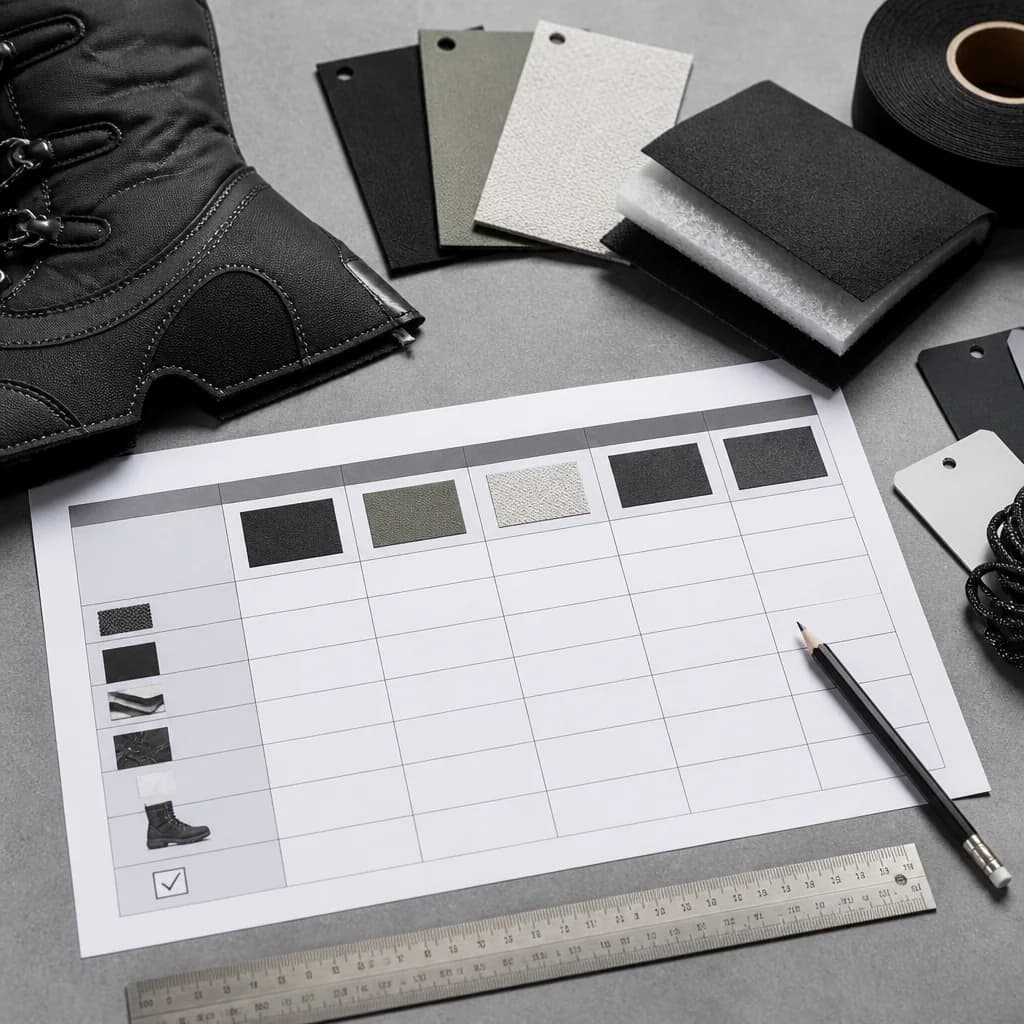
Use an RFQ table to separate textile, finish, backing, construction, reference scope, and approval fields before comparing snow boot quotations.
To compare waterproof textile uppers for custom snow boots, place every quotation into the same field structure before reviewing commercial terms. Consider a hypothetical RFQ line that says only waterproof textile upper. That wording names a general direction, but it does not identify the base textile, the exact finish, the presence or absence of backing, the relevant construction requirement, the scope of any reference, or the approval criterion. A usable custom snow boot upper material specification needs those fields to remain visible until each supplier has answered them.
The comparison method below is an editorial recommendation for the buyer. It is not a documented SnowBootWorks process. Its purpose is to preserve the exact information supplied, expose omissions, and prevent a broad component label from carrying decisions that have not been written down.
Put the unanswered fields on the page
Start with one row structure for every quotation. Enter supplier language exactly as returned. Do not expand a broad descriptor with details taken from another response, a product reference, or a general material category.
Use three status values: specified, unspecified, and requires confirmation. A direct and complete answer is specified. A field with no answer is unspecified. Partial, ambiguous, or conflicting wording requires confirmation.
Blank side-by-side RFQ comparison table
| Field | RFQ requirement | Supplier A exact response | A status | Supplier B exact response | B status | Unresolved question |
|---|---|---|---|---|---|---|
| Upper descriptor | Waterproof textile upper | What exact descriptor applies to the offered upper? | ||||
| Base textile | Not defined in the line | Which fiber or fabric identity is being quoted? | ||||
| Finish or coating | Not defined in the line | What surface finish or coating is included? | ||||
| Membrane or laminate | Not defined in the line | Is backing present, explicitly absent, or not stated? | ||||
| Design direction | Not defined in the line | Which part of the product brief should guide the upper? | ||||
| Reference | Not defined in the line | What is the reference identifier and its decision scope? | ||||
| Construction | Not defined in the line | Which written construction requirements apply? | ||||
| Approval | Not defined in the line | What criterion will the buyer use for acceptance? |
Keeping the supplier cells empty until a response is received matters. If a quotation says nothing about backing, the matrix should not record absent. It should record unspecified. Absence is a supplied fact only when the response explicitly says that no membrane or laminate is included.
Read each descriptor at its written scope
Several labels appear within the waterproof textile upper direction on the SnowBootWorks materials page: coated nylon upper, water-resistant fabric upper, and technical textile shell. The page describes this direction as a woven or laminated synthetic fabric upper, with fibers that are typically nylon or polyester.
The same source says the upper is finished with a durable water-repellent (DWR) coating. It also says the material is often backed by a waterproof membrane or laminate. The qualifiers set useful boundaries. Typically does not identify the fiber in a particular supplier response. Often does not confirm that backing is present in every offered upper.
When one of the labels appears alone in a quotation, record only the information contained in that response:
How to parse isolated supplier wording
| Response contains only | Information available for the matrix | Information still open |
|---|---|---|
| Coated nylon upper | Nylon is stated, and a coating is indicated | The coating identity, backing status, and other material details are not stated |
| Water-resistant fabric upper | The exact descriptor can be recorded | The base textile, specified finish, and backing status are not stated |
| Technical textile shell | The exact descriptor can be recorded | The base textile, specified finish, and backing status are not stated |
These parsing rules do not rank the three descriptions. They show how much definition each isolated phrase supplies. Do not copy the category's typical fiber or often-present backing into a supplier row unless the quotation confirms those details for the offered material.
Keep the component row separate from the boot decision
Custom snow boot development is framed around the buyer's specification on the SnowBootWorks capabilities page. That page identifies construction, materials, and approval standards as decision drivers. A buyer can place those subjects in one comparison table while keeping their functions distinct.
- Material definition
- Record the exact upper descriptor, stated base textile, named coating or finish, and membrane or laminate status.
- Design direction
- Record the part of the buyer's brief that should guide the intended appearance or product direction without treating it as material identification.
- Construction requirement
- Record the written requirement for how the upper is intended to be incorporated into the boot. Do not use this row to fill gaps in the textile description.
- Approval definition
- Record the buyer's acceptance criterion and the material or reference that will support the decision.
A DWR entry defines a finish within the component record. A membrane or laminate entry defines the stated backing. Within the evidence provided for this article, neither entry establishes a waterproof outcome for the completed boot. A detailed textile description also does not answer an open construction or approval field.
This separation keeps an OEM snow boot material comparison focused on like-for-like definition. It can show whether suppliers answered the same questions, but it should not turn a more detailed component description into a finished-product conclusion.
Assign each reference a written job
A SnowBootWorks case-study overview describes one private-label waterproof winter boot program moving from reference samples to an export-ready branded production run. That statement documents the use of reference samples in the program described. It does not establish a universal sequence for other projects.
For the buyer's comparison table, give each reference a controlled identifier and a written scope. The scope might identify a visible feature, texture direction, panel arrangement, or another defined decision the buyer wants the supplier to consider. Record material identity, finish, backing, construction, and approval requirements in their own fields unless the buyer has expressly assigned one of those decisions to the reference.
A precedence note is also useful when a written specification and a reference could be interpreted differently. The buyer should state which input governs instead of expecting the supplier to infer the intended priority.
Preserve the difference between blank and absent
In a waterproof snow boot RFQ, a blank answer is an open question. It is not evidence that a feature has been excluded. Apply the status terms consistently:
- Specified
- The response directly supplies the requested information. An explicit statement that backing is absent also belongs in this status because the supplier has answered the field.
- Unspecified
- The response contains no answer for the field. Keep the cell unresolved.
- Requires confirmation
- The response is partial, uses wording with more than one reasonable interpretation, or conflicts with another controlled project input.
Once the responses occupy the same rows, the buyer can identify differences in definition coverage and prepare focused clarification questions. The matrix is not a basis for assuming price, durability, cold-weather suitability, or material superiority from the wording alone.
The supplied sources do not report a completed-boot waterproof outcome. They do not provide a temperature rating. They do not identify certifications, regulatory findings, or approval thresholds. They also do not report durability, traction, or wear results. Keep those conclusions outside the quotation table unless separate project evidence is available.
An approval row can name the criterion the buyer intends to use and show that supporting evidence is still needed. It should not be marked complete merely because the criterion has been written into the RFQ.
Convert every unresolved row into an inquiry
After the quotations have been transcribed, collect the open cells into one supplier inquiry. Ask each supplier to answer at the same level of detail:
- Confirm the exact textile-upper descriptor.
- Identify the stated base textile or fabric.
- Name the coating or surface finish included in the definition.
- State whether membrane or laminate backing is present, absent, or still unresolved.
- Respond separately to the applicable construction requirement.
- Confirm each reference identifier and the decision it is intended to guide.
- Clarify the approval criterion attached to the upper line item.
The buyer can share the current winter footwear definition through the project inquiry page and ask which development, sampling, or quotation options may apply to the project. Those subjects remain inquiry topics until the project scope has been reviewed.
Before moving quotations into commercial review, check that every supplier has answered the same upper fields. Keep a quotation pending clarification when the base textile, finish, backing status, construction requirement, reference scope, or approval criterion remains unresolved.
Evidence layer
Evidence checklist: RFQ table to compare waterproof textile uppers for custom snow boots
Material selection should connect performance to the commercial brief. Compare abrasion, flex, grip, weight, cold behavior, appearance, supply continuity, and cost together. An outsole compound or upper textile can look attractive in isolation and still be the wrong choice for the target climate, retail price, or repeat-order plan. Use the sample to record what changed and why. For this guide, map each supplier response to “Put the unanswered fields on the page” so a claim is supported by a written specification, sample reference, controlled document, or a clearly marked open question.
When a substitute is proposed, ask which requirement it preserves and which requirement it changes. Keep the approved material reference, color standard, and component source in the same specification pack so the decision survives a handoff between development and production. Cross-check the response against “Read each descriptor at its written scope” and keep every unresolved point visible in the approval record.
- Performance requirement and target environment — scoped to compare waterproof textile uppers for custom snow boots
- Cost, weight, appearance, and continuity — cross-checked against “Put the unanswered fields on the page”
- Approved reference and substitution rules — with open risks from “Read each descriptor at its written scope” recorded
Decision framework
Buyer checklist
- Enter every supplier's exact wording into the same RFQ fields before comparing quotations.
- Preserve the source qualifiers typically and often instead of applying those attributes to every offered upper.
- Record an explicit absence as supplied information, but keep an unanswered field marked unspecified.
- Separate material identity, construction requirements, reference scope, and approval criteria.
- Keep quotations pending clarification when suppliers have not answered the same upper fields.
Sources and verification
Evidence used for this guide.
Continue the specification