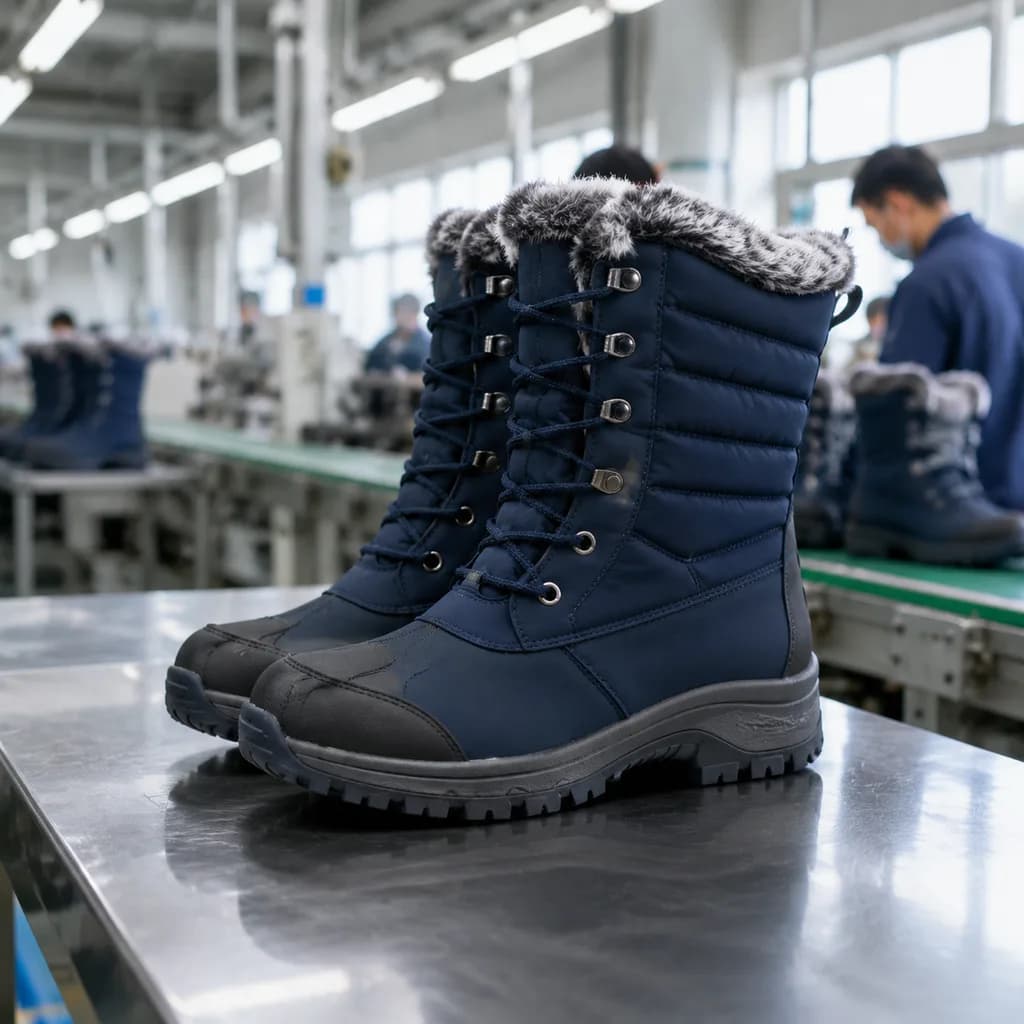
Prepare a waterproof textile snow boot upper inquiry by separating category-level material language from project questions for construction and review.
For custom snow boots with waterproof textile uppers, a short request can identify a useful material direction without defining the upper for quotation. A phrase such as "lightweight waterproof nylon" may contain a buyer preference, a use context, and an expectation, but it leaves the current project's construction and review points unstated.
A clearer winter footwear quotation inquiry begins by recording the material language at the scope shown in the source. The next step is buyer-side: distinguish what has been selected from what needs an answer for this project. That gives a supplier something specific to discuss without treating a category label as a finished upper definition.
Read the materials entry at its actual scope
The materials entry has a heading for Waterproof Textile Upper. Under that heading, it names coated nylon upper, water-resistant fabric upper, and technical textile shell. The description that follows is written for the category: it refers to a woven or laminated synthetic fabric upper, typically nylon or polyester, with a durable water-repellent (DWR) coating and often a waterproof membrane or laminate.
The same category description calls this a lightweight, flexible direction for everyday snow boots that need to stay supple in the cold. For an inquiry, that language is useful context for the category. It is not an individual configuration for any one of the three labels.
- Coated nylon upper
- A label named under Waterproof Textile Upper.
- Water-resistant fabric upper
- A label named under Waterproof Textile Upper.
- Technical textile shell
- A label named under Waterproof Textile Upper.
- Category description
- Woven or laminated synthetic fabric, typically nylon or polyester, with DWR and often a waterproof membrane or laminate.
The supplied excerpt does not map the woven, laminated, substrate, DWR, membrane, or laminate wording to a particular listed label. An editorial recommendation is to name the label under consideration, then ask how the category description applies, if at all, to the present project.
Write the opening before the detail list
Editorial recommendation: start the inquiry with one sentence naming the selected material label. Follow it with a second sentence that separates the buyer's known priorities from the points still open for discussion. This is more useful than placing several material terms together and leaving their relationship implied.
For example, a buyer can state that the project is considering one listed textile direction and that lightweight handling or flexibility is important to the brief. The buyer can then identify whether a woven or laminated direction, a nylon or polyester preference, DWR wording, a membrane, or a laminate is already chosen, preferred, or still a question.
The capabilities page describes custom snow boot OEM work as developed to the buyer's specification, with construction, materials, and approval standards driving decisions. That makes these three areas useful headings in a buyer's own note. It does not determine the details of the current upper.
Keep attributes in their proper column
A snow boot upper material specification can be short while still showing where the definition ends. The table below is an editorial worksheet for preparing the inquiry; the right-hand column contains project questions, not assumptions about a standard material build.
| State in the inquiry when known | Leave as a project question when open |
|---|---|
| The selected category label: coated nylon upper, water-resistant fabric upper, or technical textile shell. | How the category-level description applies, if at all, to that selected label. |
| A buyer preference for a woven or laminated synthetic textile direction. | Which material construction should be considered for the current definition. |
| A nylon or polyester preference, when the buyer has one. | Whether a substrate selection is relevant to the requested upper. |
| Whether DWR, a membrane, or a laminate is a requirement, a preference, or an unanswered point. | How each stated item should be handled in the project discussion and review. |
| The buyer's approval owner and any internal approval standard already identified. | Which material and construction decisions need to be resolved for that review. |
Keeping these columns separate prevents a category description from becoming an unexamined attribute list. It also gives the buyer a place to capture a response without quietly changing the original brief.
Give references a defined job
The case-study overview describes a private-label waterproof winter boot program in which a brand brief moves from reference samples to an export-ready, branded production run. That is limited support for including reference samples in a brand brief. It does not define the material, construction, or approval criteria for another project.
Editorial recommendation: attach a short note to every reference. State whether it is meant to communicate the upper's silhouette, panel arrangement, textile appearance, or another visible characteristic. Then state what the reference does not decide for the new product, including the selected category label and any material points that remain open.
This gives a reference a practical role without asking it to carry the whole definition. A photo, sample, sketch, color indication, or swatch can support the conversation, while the written inquiry records the choices that should be discussed directly.
Ask questions before labels harden into assumptions
A buyer preparing custom snow boots with waterproof textile uppers can put the following questions into the inquiry or use them during an initial discussion.
- Which listed Waterproof Textile Upper label is the starting point for this project?
- How does the category-level textile description apply, if at all, to that label?
- Does the buyer want to name a woven or laminated direction, or leave that construction point open?
- Is nylon or polyester a current preference, or an item requiring discussion?
- Are DWR, a membrane, and a laminate stated requirements, preferences, or open questions?
- Which construction and material decisions must be answered before the buyer's approval standard can be applied?
- What should each supplied reference communicate, and what must remain in the written definition?
For a women's snow boot project, the women's product guidance separately says to decide the target sizing system and fit reference first. That point is scoped to women's snow boots in the supplied product excerpt. A buyer can include it when it is relevant to that product brief rather than treating it as a requirement for every textile-upper inquiry.
These questions are buyer-side prompts. They do not establish material availability, a particular construction, or a finished-product outcome. Their purpose is to make unresolved points visible before a broad material label is used as a complete specification.
Send a definition, not a compressed label
Before submitting the request, check that the current note does the following:
- Names one listed textile direction rather than combining the three labels.
- Separates the category description from the details selected for the current project.
- Marks woven or laminated construction, substrate preference, DWR, membrane, and laminate wording as chosen, preferred, open, or out of scope.
- Identifies the buyer's approval owner and applicable review standard.
- Explains the purpose of each reference rather than relying on it as the complete brief.
- For women's snow boot briefs, includes the target sizing system and fit reference when those points are relevant.
This is enough to move from a material direction to a discussion-ready definition. Share the current winter footwear definition and ask which development, sampling, or quotation options may apply to the project.
Evidence layer
Evidence checklist: Custom Snow Boots With Waterproof Textile Uppers: Inquiry Brief
Waterproof, water-resistant, and weather-ready are not interchangeable briefs. Start with the exposure your buyer expects, then identify the upper, membrane or coating, seam treatment, gusset, closure, and outsole details that support the claim. The specification should say what is being protected and how the finished boot will be reviewed; it should not rely on a single material name as a shortcut for performance. For this guide, map each supplier response to “Read the materials entry at its actual scope” so a claim is supported by a written specification, sample reference, controlled document, or a clearly marked open question.
Keep marketing language aligned with the approved construction and the test method agreed for the program. If the target market has a required labeling or claim convention, confirm it with the importer or compliance specialist before publishing the claim. Cross-check the response against “Write the opening before the detail list” and keep every unresolved point visible in the approval record.
- Exposure scenario and claim wording — scoped to custom snow boots with waterproof textile uppers
- Seam, gusset, closure, and upper interfaces — cross-checked against “Read the materials entry at its actual scope”
- Agreed review method and claim documentation — with open risks from “Write the opening before the detail list” recorded
Decision framework
Buyer checklist
- Treat the three listed textile terms as category labels, then ask how the category description applies to the selected label for the current project.
- Record known material preferences separately from construction and approval questions that still need discussion.
- Use references to identify visible intent, while retaining a written definition for the material and review points they do not resolve.
Sources and verification
Evidence used for this guide.
Continue the specification